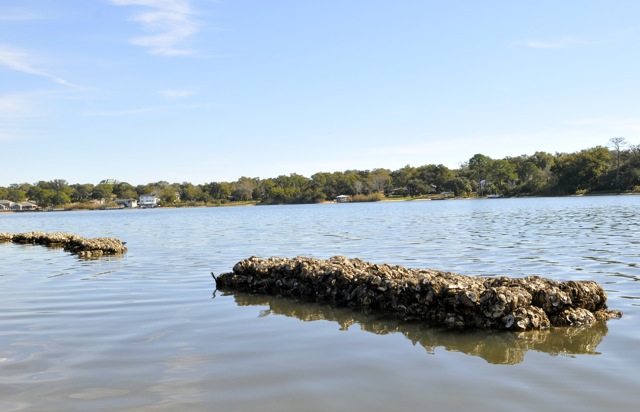
Oyster reefs enjoy a multi-tasked existence. Not only do they provide habitat for future oyster populations, the reefs also facilitate a cleaner aquatic environment. Once the reef is inhabited, the oysters will act as a filter—one oyster can filter up to 50 gallons of water in a day.
“They filter the water because that’s how they feed,” explained Amy Baldwin, with the Florida Department of Environmental Protection.
Baldwin stood near Bayou Texar’s waterline at Bayview Park Jan. 14 and watched as a bucket-brigade of volunteers ferried sacks of oyster shell toward a series of nearshore oyster reefs.
“It’s kind of a if-you-build-it-they’ll-come,” Baldwin said.
The DEP is working in conjunction with Clean & Green, the city of Pensacola, Southern Company and the National Fish and Wildlife Foundation. Together the groups aspire to restore 22 oyster reefs in Bayou Texar.
Since 2005, the state has deployed more than 334 tons of recycled oyster shells into northwest Florida estuaries. Oyster shells needed for the Bayou Texar projects are supplied by two local restaurants: Peg Leg Pete’s and The Marina Oyster Barn.
“We pick it up in 25-gallon trash cans,” explained Jill Cleaver, with Clean & Green.
This past Saturday was another in a series of volunteer work days at Bayview.
“We’re restoring the habitat itself,” said Cleaver, looking out over the reefs.
It’ll take a while before oysters congregate on the restored reefs—spawning will occur in the spring. But the volunteers did get to meet an early reef resident when they wrapped up their prior work day.
“It was so cool,” Cleaver said. “He went up there and perched, like, two minutes after we finished—the sun broke after we finished and then this pelican showed up.”
Anyone interested in more information about the Bayou Texar oyster reef projects may contact the OYSTER Project team at 438-1178.

Popularity: 2% [?]
Independent News
This is a great project! It is a public awareness that everyone should do their part by helping clean up our environment. I agree that the problem begins upstream and thats where public awareness comes into play. If the citizens of Pensacola care about their water then THEY nedd to start with what gets put on their lawns, what they throw out of their cars and all the other pollutants that wash off the roads into these watersheds. As far as eating any oysters….an person that eats local seafood knows when and where to get it to begin with, and Pensacolians know better that to eat from these areas….for now that is. The hope of this project is that, with a collobrative effort from everyone is that we all do our part and help restore these habitats to what they once were….HEALTHY!
B. McA Sorry if my info implied that we should do nothing…we should do everything possible, but oysters will clean the quality of the water, but will not do away with the mud/toxic matter on the bottom. Upstream will continue to be a problem, since rain runoffs of lawns contain nitrogen’s and other chemicals will continue to poison Bayou. Sen. Evers, and Rep. Clay Ingram, pass a law making it illegal for cites and county governments to pass laws restricting types of fertizers that can be applied to lawns and fields…One should not eat anything caught in Bayou Texar…
But when ever attempting to clean up a body of water, you always start corrective actions UPSTREAM.
And work your way DOWNSTREAM.
This project fails to address the problems that created the need for the oyster shell reefs in the first place.
So, L.L. and jeeperman, this is the first effort in my memory to clean up the cesspool that Texar has become, and you two have sort of problem with it? The fact that any remediation effort is underway at all is reamkable and the fact that biological organisms are being used is outsanding!
Oysters have been used for a couple of years now to reclaim portions of Chesapeake Bay and the results have been simply amazing. True, the oysters taking up residnce there should NEVER be eaten.
WARNING: Environmental Science’s have reported historically to Escambia Social and Water Conservation Board of Supervisors, that there is 6ft of toxic mud covering the bottomed of Bayou Texau, that cannot be remover because it is toooo toxic, and no place to put it, plus trying to remove all of the toxic chemicals would just stirrup all types of poisonous chemicals…
Did they post signs on top of these new reefs warning humans not to eat anything that grows on them ?
Would not want humans to be eating the animals that have to live in a bayou that is the most often “waters closed to human contact” because of human waste.
Special thanks to the UWF SCUBA club. They provided a large percentage of the volunteers for the reef restoration work days at Bayou Texar. Shows that UWF students care about their community. Go Argos!
That’s good news for the Bayou. We enjoy launching our kayak and paddleboards at Bayview Park. It’s nice to know that work is being done to help with the water quality. Bayou Texar is beautiful Pensacola treasure.