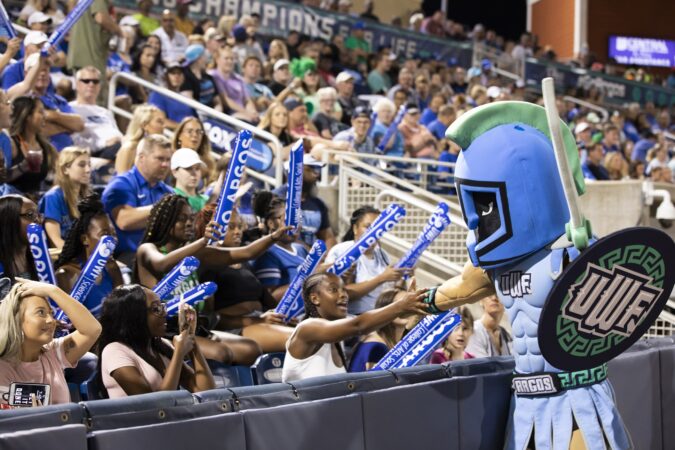
The buzz around the University of West Florida’s athletic future has grown louder since President Manny Diaz Jr. took the helm. According to sources, Diaz is preparing to announce plans to move the Argonauts from NCAA Division II to Division I across all sports. The question isn’t whether UWF wants to make the jump—it’s whether the university can afford it and navigate the complex multi-year process the NCAA requires.
The Reclassification Process
Moving from Division II to Division I is not a quick flip of a switch. As of 2025–26, the NCAA reduced its reclassification timeline from four years to three—but those three years come with annual benchmarks. During the transition, the Argonauts would be ineligible for NCAA Division I championships until they earn full membership.
Dig Deeper: UWF must also secure a Division I conference invitation before the process can advance.
- Sources indicate the university is eyeing the soon-to-be-formed United Athletic Conference—a rebrand of the Western Athletic Conference that would include Abilene Christian, Tarleton State, UT Arlington and several football-playing Atlantic Sun Conference members, including Austin Peay, Central Arkansas, Eastern Kentucky and North Alabama. However, some locals would prefer the Sun Belt Conference.
Sports, Scholarships and Academic Standards
UWF currently sponsors 15 varsity sports, which clears Division I’s minimum threshold of 14—but that floor is just the starting point. The university would need to expand scheduling against Division I opponents and boost scholarship funding to at least the 10th percentile among active Division I members.
What this matters: That means substantially more aid across sports that have operated on the partial-scholarship model typical of Division II programs.
- On the academic side, UWF must rank above the 10th percentile of current Division I members in at least one of three metrics: Academic Progress Rate, Graduation Success Rate or the federal graduation rate gap between athletes and the general student population.
The Money Problem
NCAA data shows median athletics expenses for a Division II school with football run roughly $6.5 million per year. A comparable Division I FCS program costs around $17 million annually. Schools making the D2-to-D1 jump have seen an average spending increase of $3.7 million per year, offset by only about $500,000 in new revenues. The net new institutional subsidy averages roughly $3.2 million annually. Read Dollars & Sense.
For UWF, the math could be sobering. Sources say that without significant budget support from the Florida Legislature and Gov. Ron DeSantis, the school’s athletic program could be in the red within three years of making the move. Diaz—a former state legislator—has made no secret of his willingness to leverage his Tallahassee relationships. “I have no problem asking for money,” he has said.
- Whether those relationships translate into the recurring annual dollars needed, not just one-time capital investments, remains the central uncertainty.
The Bottom Line
A Division I move done right—with a competitive conference home and sustainable funding—could do exactly what Diaz envisions: put UWF on the national map, drive enrollment and transform the Argonauts into a true branding force for Pensacola. Done wrong, it could saddle the university with years of deficits and a mediocre on-field product.
- Pensacola has long asked when—not if—UWF goes Division I. The answer may be closer than anyone expected.
We received this press release at 10 a.m. on Friday, March 27:
 UWF to host press conference for major athletics announcement
WHEN: Thursday, April 2, 2026
TIME: 11 a.m.
WHERE: Argonaut Athletic Club
11000 University Parkway
Building 54
Pensacola, FL 32514






Pretty much the one and only value-added of Diaz as president is his political connections. His salary is D1, and he is pushing all kinds of expensive projects. If he can’t convert his alleged wealth of experience into money–and if he can’t do it quickly–UWF is going to be left holding a very heavy bag when he moves up to the next rung in the GOP ladder. Yet another elite politician fleecing public coffers
The press conference is at 11 a.m. on Thursday, April 2. I received the announcedment this morning at 10 a.m. I apologize for the confusion.
Is the press release at 10am or 11am, there if a contradiction in the updated press release announcement.
Thank you