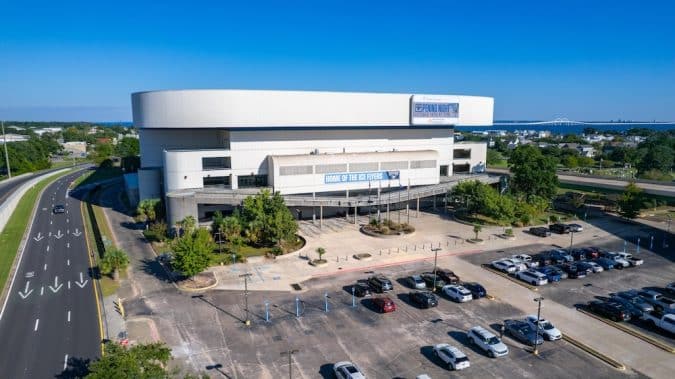
On April 6, WT Partnership presented its report to the Pensacola City Council on the conceptual frameworks for a comprehensive redevelopment of the county-owned Pensacola Bay Center.
- The report took a hard look at the economic environment. What they found was a national economy navigating fragile terrain, a Florida economy showing genuine momentum, and a Pensacola market with strong bones but real vulnerability in key sectors.
Here’s what the numbers say.
The National Picture: Slow Growth, Elevated Uncertainty
The U.S. economy heading into 2026 is not in collapse, but it is not in good health either. GDP growth is hovering just under 2% — positive, but barely. The federal government is running deficits of approximately 5 to 6% of GDP, which is acting as a cushion against a deeper downturn, but the broader picture is one of strain.
Household spending has flattened in real terms as inflation continues to squeeze budgets. CEO confidence fell below the neutral mark in the fourth quarter of 2025, with a Confidence Index reading of approximately 48. Small business optimism is at a multi-year low, driven by high costs and weaker sales.
The tariff environment is adding pressure. The effective U.S. tariff rate has jumped from roughly 2% to roughly 12%, pushing import costs higher and nudging core inflation upward at a moment when the Federal Reserve has limited room to respond. The Fed delivered a third consecutive 25-basis-point rate cut in December 2025, but traders are increasingly skeptical that the easing cycle continues into 2026. The median FOMC participant currently projects just one quarter-point cut this year.
Immigration policy is compounding the labor problem. Near-zero or negative net migration has stalled labor force growth, and industries like construction, agriculture, and transportation — all of which rely heavily on foreign-born workers — are facing worsening supply constraints. That directly affects the cost and timeline of any major infrastructure project.
- Bottom line on the national outlook: slow growth, elevated uncertainty, and continued pressure on businesses and consumers alike. A meaningful rebound is not expected until 2027, and even then it will be modest.
Florida: A Bright Spot With Real Momentum
Against that national backdrop, Florida enters 2026 with a notably stronger hand.
The state’s population reached 23.8 million in 2025, reflecting an annualized growth rate of 2.0% over the prior five years — the fastest of any state in the country. Much of that expansion came from domestic migration, with Jacksonville, Lakeland, and the North Port-Bradenton-Sarasota region among the top ten destination markets nationally.
Florida’s tourism economy hit a record 143.3 million visitors in 2025. The defense sector, now the state’s second-largest industry, contributes more than $102 billion annually and supports over 865,000 jobs statewide. Hotel room completions exceeded 5,000 through the first half of 2025 alone, an 11% increase over the same period in 2024.
The state’s advantages — inexpensive and developable land, lower construction costs, and more streamlined zoning and entitlement processes in many municipalities — continue to attract development activity even as national conditions soften.
Escambia County: Steady Growth in the Right Direction
Escambia County is a mid-sized Gulf Coast county with an estimated population of 331,275 as of July 2024, reflecting approximately 2.9% growth since the 2020 Census. Recent population gains have concentrated in suburban and unincorporated areas rather than the urban core.
Healthcare, government, tourism, education, and military operations define the county’s economic character. Naval Air Station Pensacola anchors employment stability and generates secondary economic impact across professional services, housing, and retail. Defense activity accounts for nearly 20% of the local economy, supporting more than 31,600 jobs. Local priorities for 2026 are focused on infrastructure funding, workforce development, and continued industry innovation.
The City of Pensacola: Strong Core, Shifting Growth
The City of Pensacola proper is home to approximately 55,000 residents — about 17% of the county’s total population. The broader Pensacola Metropolitan Statistical Area, which includes Escambia and Santa Rosa counties, has a combined population of approximately 540,000.
The city generated over $2.55 billion in healthcare and social assistance revenue and roughly $449 million in accommodation and food services sales in 2022, reflecting its dual role as a regional service center and visitor destination. Its 10 largest employers span local, state, and federal government; healthcare systems including Baptist Health Care and Sacred Heart; Navy Federal Credit Union; and the University of West Florida.
Tourism is a defining economic driver. The area attracted approximately 2.6 million visitors in fiscal year 2024, up from 1.5 million a decade earlier. Pensacola Beach was recently named the best beach in the country by Condé Nast Traveler. The city also ranked eighth on Condé Nast’s “Top 10 Best Small Cities” list in 2023 and appeared on LinkedIn’s “Cities on the Rise” list in 2025.
The Pensacola metro area grew approximately 14% from 2015 to 2025, expanding the workforce and maintaining unemployment near 5.2%. The consultants characterize Pensacola as a stable, higher-income, higher-education urban core within a growing Gulf Coast region — one where population growth has shifted outward into the broader county and metro area, but where the concentration of jobs, institutions, and amenities continues to anchor regional economic activity.
Sector by Sector: How the Market Is Performing
The consultants assessed four key commercial real estate sectors within the market. The picture is mixed.
- Retail is the most resilient. Limited new supply, net demolitions, and historically high rents have kept the sector relatively stable. Demand has softened, but pricing power persists and forecasts point to stabilization rather than decline. Minimal new construction keeps downside risk contained.
- Hospitality is healthy but normalizing after several strong years. Elevated average daily rates and revenue per available room continue to support operations, but growth has slowed and capital markets have grown more selective. Within a three-mile radius of the Bay Center site, the hotel submarket shows occupancy at 70.5% — above the 10-year average, though down slightly year over year. The average daily rate has reached a decade high of $153, and revenue per available room stands at $108. The consultants are explicit that future hospitality gains will depend on new demand generators like conventions and events, not on leisure travel alone.
- Office is the weakest sector in the market. Rising vacancy and negative absorption reflect tenant downsizing and space give-backs rather than oversupply. Rents and investment activity remain relatively steady, but the structural outlook is flat. The consultants suggest office works best as a secondary or complementary use in any new development.
- Multifamily fundamentals remain solid — stable occupancy and strong investor interest — but a large pipeline of incoming supply will create short-term pressure on rents and lease-up timelines. Conditions are expected to stabilize over time, though near-term friction is greater than in retail or hospitality.
The consultants draw one overarching conclusion from the sector analysis: destination-oriented and mixed-use programs outperform single-use development in current market conditions. That finding shapes every recommendation they make about what should happen at the Bay Center site.
All data is drawn from the City of Pensacola Convention Center Analysis draft report, dated March 9, 2026, prepared by WT Partnership. Read City of Pensacola Convention Center Analysis- Draft Report
Photo credit: Visit Pensacola
Background: The County’s position is to pursue a major $189 million “event campus” on the existing Bay Center site, focused on renovating the arena and adding a new multi?use event center and practice ice rink, funded primarily with Tourist Development Tax and related bonding authority under county control.
- The Board of County Commissioners commissioned a CSL/Legends Global feasibility study that recommends a three?part project: major renovation of the existing arena, construction of a new multi?purpose event center for conventions and indoor sports, and a separate practice ice facility, all linked as one campus on the current Bay Center property
The City’s position is to treat the Bay Center as the anchor of a broader “Bay Center District” and prioritize a new convention center and mixed-use redevelopment on the rear parking?lot and surrounding area, guided by a separate WT Partnership/CRA study it commissioned, with the expectation that any final plan will require a joint city?county agreement.
The Mayor, Pensacola City Council and the Escambia County Commission have scheduled a joint meeting at 9 a.m. on April 16 at the Bay Center.