Higher Education / Transparency
UWF Forced Me to Drive to Campus to Read Public Board Documents. Here’s What I Found.
The university’s decision to pull agenda materials from public websites sent me 30 miles to read a printed packet in a law office. The documents raise real questions about Division I costs, public comment access, and a self-evaluation that wasn’t there.
Update: After I drove to the UWF campus to read the agenda packet in person, the university posted the supporting documentation to its website. The documents should have been there from the start.
The University of West Florida Board of Trustees meets Thursday, April 23. If you want to know what’s on the agenda beyond a bare list of items, you can thank me. Because after my drive to the Office of the General Counsel on the Pensacola campus, the university changed course.
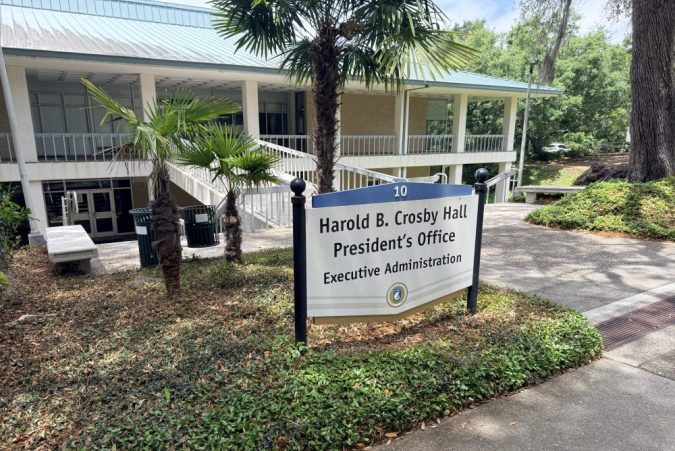
- Under previous leadership, the full agenda packet was posted publicly on the UWF website ahead of board meetings. That practice ended after Manny Diaz Jr. moved from interim to permanent president. When I requested the documents by email Monday, the response I received Tuesday at 5:47 p.m. from Kristie Johnson, Board of Trustees Liaison, pointed me to a physical reading room:
“Thank you for contacting the Board of Trustees Office. A printed copy of the full agenda package can be viewed in the Office of the General Counsel, 11000 University Parkway, Building 10, Suite 125 (the bottom floor).”
So I drove to campus. After the visit, UWF added the supporting documentation to its website—where it should have been all along. Here is what the packet contains, and what it’s still missing.
Division I Athletics: A $2 Fee Hike, But Key Numbers Aren’t There
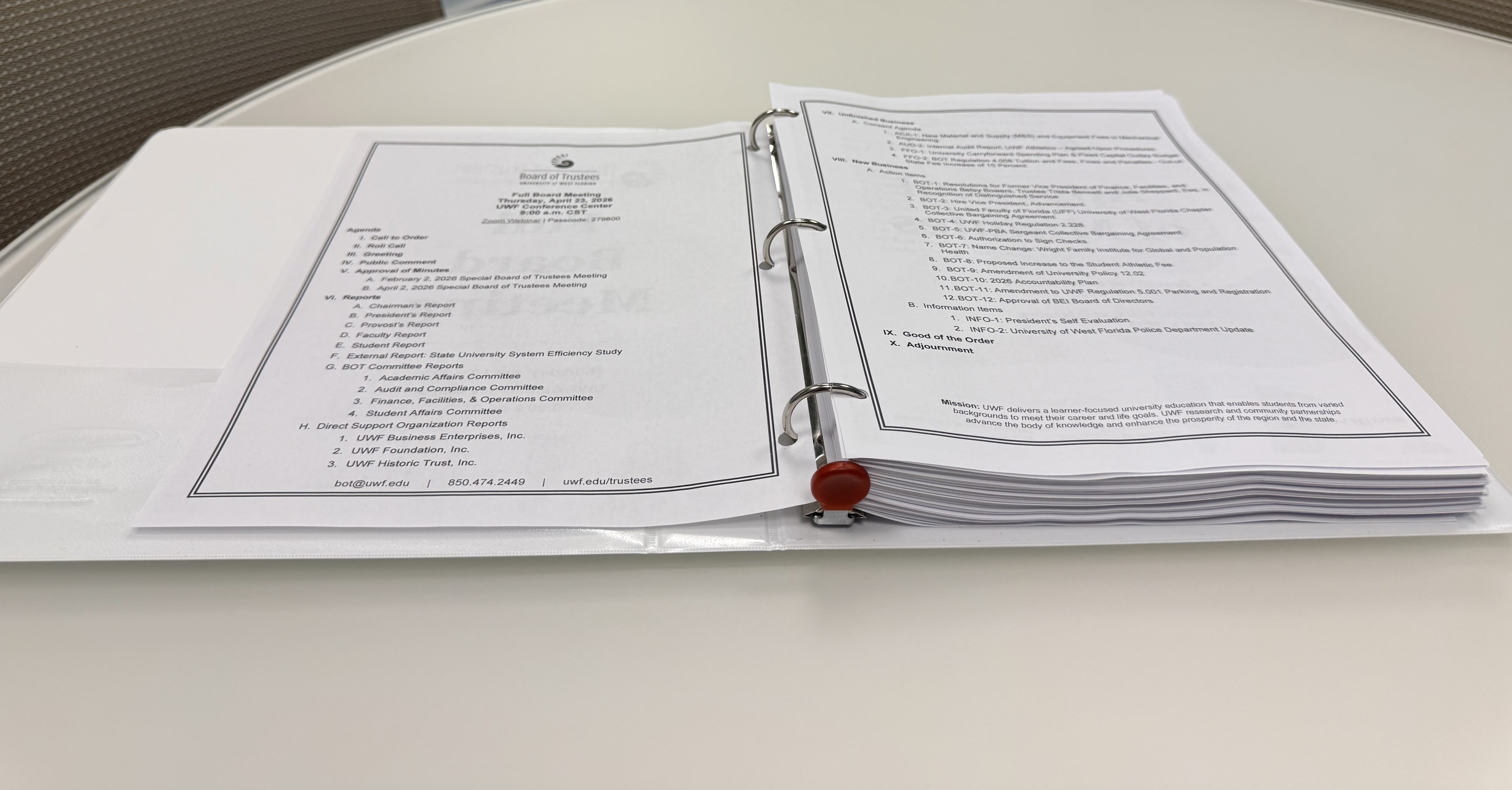 The board will consider a proposed $2 per credit hour increase in the student athletic fee to support a possible transition to NCAA Division I athletics.
Background: In January, President Manny Diaz and Student Government Association President Trista Bennett jointly appointed an ad hoc Student Athletic Fee Committee. The committee met twice—once in January and once in February—and heard presentations from Associate VP of Athletics Dave Scott and VP of Finance Dan Lucas. At its February 10 meeting, the $2-per-credit-hour figure was formally presented.
What’s missing from the packet: The total annual cost to run a Division I program at UWF. That number wasn’t included. For context, comparable schools in the United Athletic Conference—the conference UWF is joining—spent between $13.8 million and $19.4 million on athletics in recent years, according to USA Today data. North Alabama reported $13.8 million; Eastern Kentucky, $19.4 million; Tarleton State, $18 million.
Also missing: how much the $2 fee increase would actually generate. Based on enrollment figures in the Accountability Plan reviewed separately, a rough estimate puts that figure around $500,000 annually—a fraction of what Division I programs typically cost. The gap between what the fee raises and what Division I requires is a question the board should be asking Wednesday, but the packet doesn’t make it easy.
Public Comment Policy Tightened
The board will also vote on amendments to BOT-12.02, the Public Comment Policy. The changes are significant for anyone who wants to address the board.
- Under the revised policy, members of the public wishing to speak at in-person meetings must appear in person—no remote testimony at in-person sessions. Out-of-town residents can submit written comments in advance, but that’s not the same as live public comment. Virtual meetings require a written registration form submitted to the board liaison at least 24 hours ahead; in-person meetings require the form at least 15 minutes before the meeting is called to order.
Speakers must provide their name, address, and relationship to the university. The policy also gives the board chair authority to cap total comment time based on the number of registered speakers.
More Holidays, New Definitions for Police Dispatchers
A less controversial item: the board will vote to revise UWF/REG-2.028, the University Holidays regulation, which dates to 2003. The revision adds three holiday blocks that weren’t previously codified—Spring Break, the full week of Thanksgiving (Monday through the Friday that includes Thanksgiving Thursday), and a Winter Holiday of normally 10 work days covering December 24, December 25, and January 1.
- The Martin Luther King Jr. holiday and Juneteenth remain observed holidays under the updated regulation.
Accountability Plan: Enrollment Up, Degree Goals Down
The board will approve the UWF 2026 Accountability Plan, the annual report submitted to the Board of Governors under the SUS 2030 Strategic Plan. A few figures stand out.
- UWF reported a 5% overall increase in degree-seeking enrollment in 2025, calling it a “historical milestone.” New transfer enrollment grew 12%. Graduate enrollment rose 6%, with nursing programs seeing explosive growth—105% in the M.S. in nursing, 67% in nursing leadership.
But the proposed degree production goals are headed in the opposite direction. The university awarded 2,227 bachelor’s degrees in 2024–25; the proposed goal for 2025–26 and 2026–27 is 2,200—a step down. Graduate degrees awarded last year totaled 1,616; the proposed goal drops to 1,500.
- UWF is also setting enrollment targets through 2030 that show modest, incremental growth—from a total headcount of roughly 14,500 in 2025 to about 15,300 by 2030.
The President’s Self-Evaluation: Listed, But Not Included
The agenda lists the 2025–2026 President’s Self-Evaluation as an informational item requiring no board action. The board is responsible for assessing Diaz’s performance, goals, and compensation. The evaluation was due to the board chair by May 1 under his contract terms.
The self-evaluation was not in the agenda packet.
It’s listed. It simply wasn’t there.
The bottom line: The University of West Florida’s decision to play games with board agenda materials from public access wasn’t a minor procedural shift. It took my protest—driving to campus—to get them to reverse the decision. Thursday’s meeting covers student fees, public comment rights, and the president’s own performance review. Those aren’t internal matters. They belong in public view—before the vote, not after.
 Support Our Journalism

If you like our reporting or pay for my gas to drive to UWF, consider buying us a cup of coffee – here. Your donation will help broaden our reporting. Thank you.






Seems like I heard something once about ‘Sunshine Laws’ or something like that. Prior to the DeSantis assault on higher education we used to take those requirements very seriously. I suppose it’s just another example of regulations applying to everyone except Ronnie and his sycophants.
It’s odd that speakers are required to provide their address and relationship to the University “for the record” because there’s no real justification for requiring that information in a public comment forum. It doesn’t serve the purpose of allowing someone to speak and instead looks like an unnecessary barrier or deterrent.
Also, the language that comments be “tasteful, truthful, and concise” doesn’t align with viewpoint-neutral First Amendment standards and should be removed.