Local Government / Public Safety
Sheriff Simmons: Property Tax Plan Could Force Cuts in Deputies, Not Time to Panic—Yet
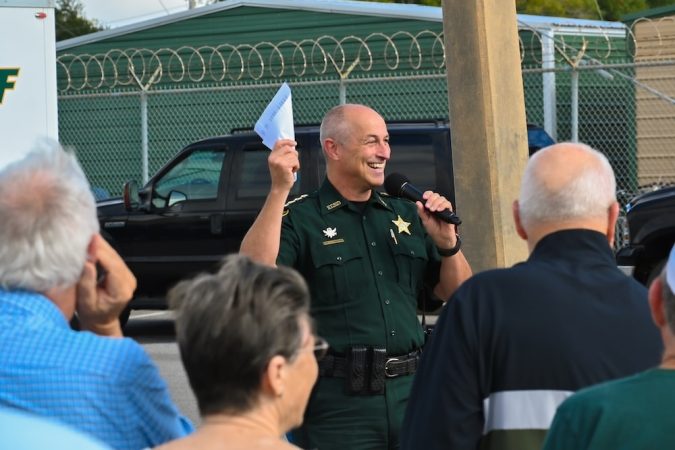
Escambia County Sheriff Chip Simmons is watching Gov. DeSantis’s homestead exemption proposal closely, but says the sheriff’s office has runway before it faces a budget crunch.
Gov. Ron DeSantis has sent the Florida Legislature his proposal to expand the homestead exemption, which would slash property tax revenues for counties and municipalities statewide. For Escambia County Sheriff Chip Simmons, the stakes are clear: 92% of his office’s budget is personnel, leaving almost no cushion if revenues fall.
- Simmons joined We Don’t Color on the Dog yesterday to talk through what the proposal could mean for law enforcement funding and where things stand with the Florida Sheriffs Association.
The Core Concern: A Flat Budget Means Fewer Deputies
Simmons didn’t mince words about the structural problem. Even without a direct cut, holding his budget flat while costs rise amounts to a reduction in force. The Florida Retirement System (FRS) rate increase alone would consume millions with no corresponding revenue growth—a scenario that plays out quietly but hits hard in an agency where nearly every dollar pays a salary or benefit.
“FRS rates look like they’re going up two million dollars just for the sheriff’s office next year. So a flat line budget for us means reductions—reductions in manpower.”
What the Sheriffs Association Is Saying
The Florida Sheriffs Association has not taken an official position for or against the governor’s plan. Simmons described the group’s posture as watchful: monitoring the legislation and holding conversations with House and Senate members, but not yet committing to a stance.
The reason, he said, is that everyone agrees something needs to happen on property taxes—the disagreement is over which approach works without gutting public safety budgets.
- “We all want property tax reform. We all want something that can aggressively tackle property tax, maybe even insurance. We all want that. But we also have to decide which avenue is the best.”
The Three-Year Budget Agreement Provides Some Cover
Escambia County and the sheriff’s office negotiated a three-year funding agreement that has been widely credited with stabilizing the relationship between the commission and Simmons’s office. That agreement offers a degree of protection in the near term, according to the sheriff.
- Background: In 2026, the Escambia County Commission approved a three-year budget for the Escambia County Sheriff’s Office, averaging over $102 million by October 2028.
Simmons said the earliest the constitutional amendment could appear on the ballot is around 2028—and it would still need 60 percent voter approval to pass. The sheriff’s office is already into year one of the three-year agreement and has submitted its ask for year two.
- “My assumption is we’re gonna go ahead and abide by that second year of that budget agreement, and then we’ll have to see how it goes with regards to that third year.”
Open Questions: Sales Tax, State Trust Fund
Simmons acknowledged there are potential remedies being discussed at the state level—including a state trust fund that could backstop local governments losing property tax revenue—but said he hasn’t studied those proposals in depth because the details haven’t been settled yet.
He took a measured tone on the uncertainty: “This has been going on for what, a year or so? And had we started to panic and have a lot of drama a year ago, it’s completely different than what we see right now. So we would have wasted a lot of time.”
“There’s some time for grown-ups to kind of take a look at this thing and then let the chips fall where they may.”
Bottom Line
- 92% of the sheriff’s budget is personnel—any revenue drop hits staffing first.
- FRS pension costs are rising approximately $2 million for the sheriff’s office alone next year.
- The FSA is monitoring but has not taken a formal position.
- The earliest implementation is roughly 2028, pending a 60% voter threshold at the ballot.
- The three-year county-sheriff funding agreement provides near-term stability, though year three could be affected.
Simmons said he’s not a “sky is falling” kind of sheriff—but he’s keeping an anxious eye on the Capitol as the House and Senate work through competing versions of what property tax relief will actually look like.
Dig Deeper
At its Committee of the Whole in early April, the Board of County Commissioners (BCC) discussed all the constitutional officers having to bear some burden of any tax cuts.
Commissioner Mike Kohler went on record that any draconian cuts wouldn’t be limited to the BCC’s own operations. Constitutional officers—Sheriff, Clerk, Tax Collector, Property Appraiser—would need to share the pain.
- “The cuts won’t just be for the county. They’ll be for all the constitutionals, too. There’s no way that I’m going to cut the county and not cut the constitutionals if we get into that situation,” Kohler said.
Commissioner Steven Barry offered a more measured view. “I don’t think we’re going to get a plan back from the property appraiser of how to deal with anything right now, just because the legislation would be specifically targeting them as much as anything.”
Barry also noted the county has a multi-year funding agreement with Sheriff Chip Simmons, but said extraordinary circumstances would require an extraordinary conversation.
- “When things like this would happen, no one would’ve anticipated that at the onset of a funding agreement,” Barry said. “I think it would take a conversation and a partnership, even with him.”