City Hall
Pensacola Mayor D.C. Reeves held his regular press conference Wednesday morning, July 15, touching on several fronts of city business, from a long-awaited construction timeline at Bay Bluffs Park to the ongoing push to renew the Local Option Sales Tax (LOST) this November. Here’s what he had to say:
Bay Bluffs Park: The Money Was Frozen Until April 21
Reeves said the city has moved to bring on engineering firm HDR for site surveying and a detailed structural and geotechnical assessment of the Bay Bluffs boardwalk, with that work expected to begin around August 1. The survey should be complete within five weeks, with the structural and geotechnical review wrapping up closer to the end of October, putting substantive design work in early 2027 and a construction bid process in spring 2027.
- The mayor pushed back on the perception that the city has dragged its feet on the project despite securing a $2.2 million grant from the state and the Department of Environmental Protection roughly two years ago.
“The city of Pensacola could not spend $1 nor lift one finger or spend $1 of resources towards Bay Bluffs Park and this $2.2 million until April 21st of this year.”
Explanation: Reeves called that timeline “probably the most misunderstood aspect of any public conversation about Bay Bluffs,” explaining that the city had no legal ability to spend any of the grant money until it received a formal green light from the state on April 21, 2026. Had the city spent money on the project before that letter arrived, he said, it would not have been reimbursed by the grant and the city would have had to find separate funding.
- Earlier community town halls where HDR gathered public input, he clarified, were a smaller, separate engagement effort undertaken before the state’s approval, not the start of the larger assessment, but that feedback will still be used going forward.
E-Bike Ordinance Back on Track After State Veto
The city attorney’s office has been drafting a local ordinance aimed at Class 3 e-bikes, which can travel up to 28 miles per hour.
“At those speeds they really function almost like motorbikes would versus a traditional bicycle… Technology is a great thing. And sometimes technology outpaces the rules and regulations of the most important part of operating a city, which is keeping people safe.”
Reeves said the ordinance had been on hold while the city waited to see whether the state would act on e-bike regulation, but Governor Ron DeSantis vetoed a statewide e-bike bill. With that resolved, the city is back on schedule for a final internal review next week.
- Timeline: The ordinance could go before city council as soon as the August meeting, or September if not.
Downtown Safety: “Business as Usual” for Gallery Night
Asked whether the city has fielded increased safety concerns downtown following the deadly July 4th weekend mass shooting, Reeves said his office has not seen a spike in contacts, but acknowledged the reality of the moment as Gallery Night returns for the first time since the shooting.
“There’s a reason we’re one of the safest cities in the United States, and there’s a reason that we’ve seen crime decrease significantly, large double digits year over year. It’s because we have an awesome police department, and we’ve got a great community.”
- He said the police department will be “out there in force” for Friday’s event, but that residents should feel free to “go have fun at gallery night this Friday the same way they’ve been having fun at gallery night every time they’ve been down there.”
LOST Renewal: “I’m Only Allowed to Educate, Not Advocate”
With the Local Option Sales Tax renewal on the November ballot, Reeves repeatedly stressed the legal limits on what he can say about the measure.
“I’ll preface by whatever the legal rule is. I’m only allowed to educate, not advocate. So everything I say after this is education only.”
Within those bounds, Reeves described LOST as a foundational funding source for the city:
- Nearly every police vehicle and fire engine in the city was funded, at least in part, by LOST dollars
- About 36% of the city’s LOST collection goes toward parks and community centers
- The Fricker Center is being built partially with LOST funds
- This is the fifth renewal of the tax, not a new levy or an increase
Asked what happens if voters decline to renew it, Reeves didn’t mince words about the scale of the impact.
“That isn’t a haircut, that would be pretty much a decapitation of significant revenue streams. So I wouldn’t even know where we would start there.”
He said his best guess would be an attempt to put the tax back on the ballot as soon as possible, likely within two years, and drew a comparison to the state’s property tax amendment debate, arguing that both measures carry consequences voters aren’t being told about.
Palafox Small-Business Promotion: “Equal Opportunity”
A reporter pressed Reeves on the city’s social media practice of showcasing individual businesses along the Palafox Street reconstruction corridor, asking whether that was an appropriate use of tax dollars and why some businesses were highlighted over others nearby.
“I think it’s appropriate that we fulfill the promise that we had when it was approved, which is we were going to put these specific businesses through a difficult time and that there were dollars set aside and approved by our city council as marketing dollars in order to make sure that we represent those businesses during a difficult time.”
Reeves said every business affected by the Palafox project was offered the same opportunity to be featured, calling it “equal opportunity in terms of who wanted to be highlighted.”
- He said he’d like to extend the same approach to other city projects that disrupt small businesses, pointing to an upcoming stormwater project on Langley Avenue and pointing to visits he’s already made to businesses affected by FDOT work on West Garden Street.
Hard Rock Reverb: “Largest Single Private Investment” in City History
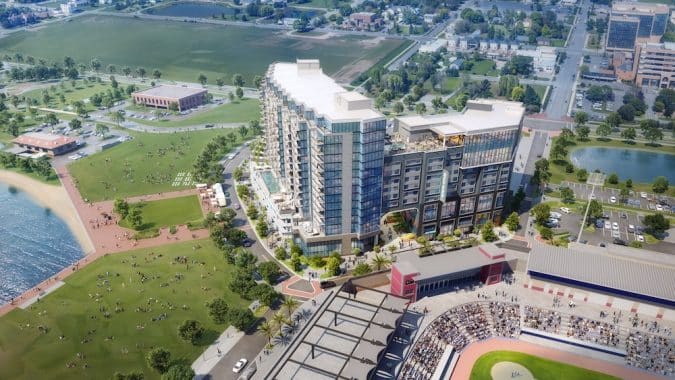
Reeves closed with an update on the Hard Rock Reverb project at Maritime Park, confirming the $310 million mixed-use development is moving forward after developers withdrew their application for an ARA tax abatement in response to shifting state and local property tax conditions.
“We believe outside of when you talk about market rate commercial or mixed use investment, I think it’s the largest single private investment project inside the city limits.”
He acknowledged the deal carries significant financial risk for the developers, which is part of why projects of this size are rare in Pensacola. Visible activity — temporary parking lot construction — should begin in the mid-September to early October window, once the Pensacola Wahoos baseball season wraps up, though vertical construction on the buildings themselves won’t start immediately.
“I think this is a barometer of a city in demand and a city on the rise that we have this size and scale of development and this amount of financial risk of being bet on the city of Pensacola.”
On the affordable housing front, Reeves said the developers still intend to pursue a Live Local Act tax abatement—a state, not city, decision—tied to an estimated $10 million in tax relief. As currently proposed, roughly half of the project’s approximately 190-198 apartment units would be designated affordable under Live Local.
- He said there have been no substantive requests to amend the city’s lease with the developers, and that attention remains focused on the current phase of the project rather than the adjacent lot, where the developer continues making lease payments.