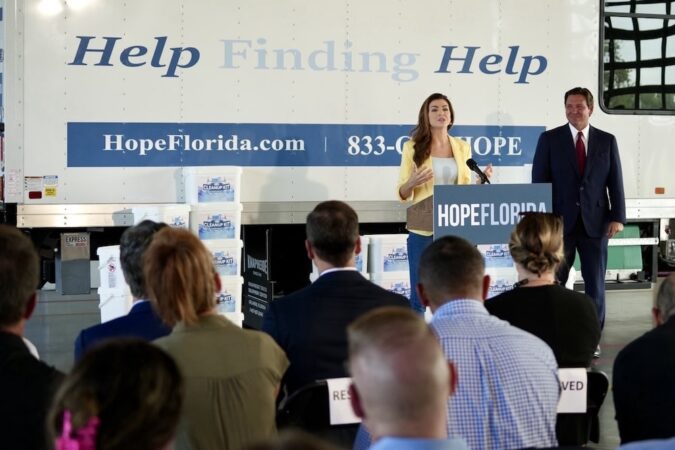
At a roundtable held at a church in Brandon yesterday, Gov. Ron DeSantis and First Lady Casey DeSantis defended Hope Florida, describing it as not merely a program but a “movement” that represents one of the “only meaningful reforms to the welfare state since the Great Society of the late 1960s.”
- The governor was more focused, less emotional and better prepared than when he appeared at Pensacola State College last month. In Pensacola, the couple only took two questions from reporters. However, the couple responded to questions for the media for more than 15 minutes yesterday.
Reimagining Government’s Role
The Governor explained that Hope Florida was created to address a fundamental flaw in traditional government assistance programs. Rather than just processing benefits that keep people “in place,” Hope Florida transforms state employees into “Hope Navigators” who connect those in need with resources outside of government.
- “The problem with [traditional programs] is that’s not really leading someone to a pathway to self-sufficiency and fulfillment,” Governor DeSantis noted. “It’s more of a stay in place rather than lift job.”
According to the DeSantises, what makes Hope Florida unique is its approach to harnessing existing community resources:
- Over 5,000 nonprofits and charities have joined the network
- 834 church response teams actively participate
- More than 9,000 individual church responders stand ready to help
- A technology platform called CarePort allows immediate response to community needs
The First Lady emphasized that this approach “changes the tired orthodoxy that spending more money equates to outcomes,” offering instead a model that limits government’s role while maximizing community impact.
The First Couple touted Hope Florida’s results:
- Over 120,000 Floridians in need have been reached
- More than 30,000 people have transitioned off government assistance (either partially or entirely)
- An estimated $100 million in taxpayer savings has been realized
- Projected savings of $1 billion over 10 years
The initiative continues to grow, with recent expansions to:
- All 28 state colleges through dedicated liaisons
- K-12 school districts, beginning with Orange and Lake Counties
- All 67 Florida Sheriff’s offices
- Disaster response efforts through “Activate Hope”
Defending Against Critics
Both the Governor and First Lady addressed what they characterized as “slanderous false accusations” against Hope Florida.
- “We are not going to waiver on our commitment,” the First Lady declared. “We are not going to be dissuaded by the critics who have been captivated by willful ignorance.”
She emphasized that the program’s focus remains on the needs of Floridians who “don’t care about someone’s personal agenda” but instead “care about trying to find a way to put food on the table, to keep the lights on, to keep their kids in school.”
Growing Scrutiny
Despite the strong defense from the DeSantises, Hope Florida has faced increasing questions from lawmakers and watchdogs:
Transparency Concerns: Critics have pointed out that the state has not provided detailed information about the program’s performance, including specifics about what types of aid people have received or demographic and geographic data about those being served. The Hope Florida executive director resigned last month.
Stagnant Metrics: The administration has been citing the same statistic—that the program has helped 30,000 people get off or reduce reliance on government assistance—for nearly a year, raising questions about whether there are updated metrics or if progress has stalled.
Compliance Issues: A Florida House analysis found that the nonprofit Hope Florida Foundation, which serves as the private fundraising arm of the initiative, had not been filing required tax returns or performing audits required under state law. According to the report, the Foundation’s board was conducting meetings in secret, potentially violating state open meeting laws, and operated without a formal budget or bylaws.
Funding Controversy
In perhaps the most serious allegation, State Representative Alex Andrade, who has been leading a legislative inquiry into the program, accused the DeSantis administration of improperly steering $10 million from a Medicaid settlement through the Hope Florida Foundation to a Florida Chamber foundation and a nonprofit to political committees.
According to Andrade, DeSantis’ then-chief of staff instructed two organizations to request $5 million grants from the Foundation, which then allegedly directed at least $8.5 million to a political committee fighting against marijuana legalization.
At the Brandon roundtable, Governor DeSantis directly addressed these allegations when questioned by a reporter about the appropriateness of the Agency for Health Care Administration (AHCA) settlement.
- “They did a good job negotiating it. They did a good job across the board,” DeSantis responded. “The reality is no one would say anything about this if it wasn’t for, some people have an agenda. Some people want to try to obliquely hit the First Lady, even though she wasn’t involved in the AHCA thing.”
The Governor characterized the criticism as politically motivated, stating, “Maybe it conflicts with their vision. Maybe it’s something that they view as inconvenient because it’s a success.”
DeSantis emphasized that the Hope Florida Foundation operates separately from the state through a board of directors with an application process, claiming the foundation maintains “a 99% grant rate, 1% is overhead.” He further defended the foundation, stating, “No one’s made a penny off this thing. There’s no one that’s been employed or given anything. It’s all been done to grants to fulfill the mission.”
- The Governor also sought to clarify the nature of the funds, insisting it “was a private settlement” rather than money taken “out of a Medicaid fund” as he claimed some publications had reported. “So much of it is intentionally fraudulent and contrived,” he added.
The Path Forward
“Hope Florida is about empowering the struggling to reclaim their purpose, to restore their dignity, and to realize their full potential,” the First Lady concluded. “In Florida, we’re going to choose hope, and we will keep choosing it again and again.”