Mayor D.C. Reeves revealed ambitious plans for the Port of Pensacola during Wednesday’s press conference, addressing both the facility’s current limitations and innovative solutions to expand its capacity and economic impact.
The Challenge: Limited Space, Unlimited Potential
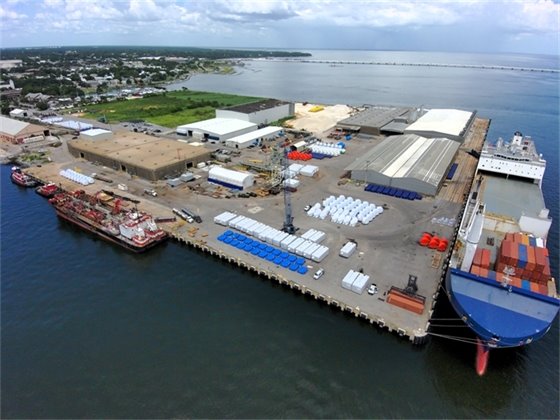
The Port of Pensacola faces a classic dilemma that many urban ports encounter—prime location versus space constraints. “What we all know about the characteristics of the port of Pensacola is that its prime location is a huge benefit in some ways. And it’s only 50-ish acres, which can be a hindrance in some ways in terms of the top-line potential growth,” Mayor Reeves explained.
This limitation has real-world implications for the port’s ability to capitalize on opportunities. “If you were to talk to Lance right now, we’re kind of at capacity from a storage standpoint right now.”
The port is already attracting significant business, with GE Vernova serving as a prime example of current operations. “GE is driving the cells down. And so people see the cells on port and they assume they came in from a boat, really it’s a storage area,” Reeves said. “We love working with them; they’re paying us for that storage.”
However, this success story also illustrates the space challenge. The mayor explained that this storage “could take place on this finite 50 acres, or it could also take place somewhere with a rail spur and offsite somewhere else.”
The Solution: Inland Port Development
The city’s proposed inland port facility represents a strategic approach to overcoming space limitations while maximizing economic potential. “The potential of an inland port only catalyzes our potential growth at both the port facility and the inland port.”
This isn’t just about storage—it’s about creating a comprehensive logistics and business hub. “The inland port doesn’t have to just be for storage as an asphalt transfer. There can be businesses that are built at that inland port as well.”
The inland port concept addresses a fundamental business challenge: having to turn away revenue opportunities due to space constraints. “I’d hate to say no to somebody. I’d hate to turn away revenue and job opportunities. Why not have this other option where we can say yes to both?”
Using a simple but effective analogy, the mayor explained the expansion benefits: “If your bowl is this big and now it’s this big, it just opens up more opportunity for us to do things at both places.”
- The expansion would enable the port to “say yes more often because we’ve got a little more land and a little more leverage to be able to do things.”
When asked about potential expansion into maritime research or companies like American Magic, Mayor Reeves confirmed this aligns with the city’s vision. “Our mission of that line of industry remains the same,” he said, while noting they’re trying to be “out in front of” capacity issues rather than reactive.
The mayor added they’re not currently hindered by storage operations interfering with job creation, “but we anticipate that it’ll be, and we’re trying to be out in front of that.”
While still in early stages, the mayor expressed optimism about the inland port concept. “Conversations so far have been promising,” he said, adding that “we’ll learn a lot more in the weeds.”