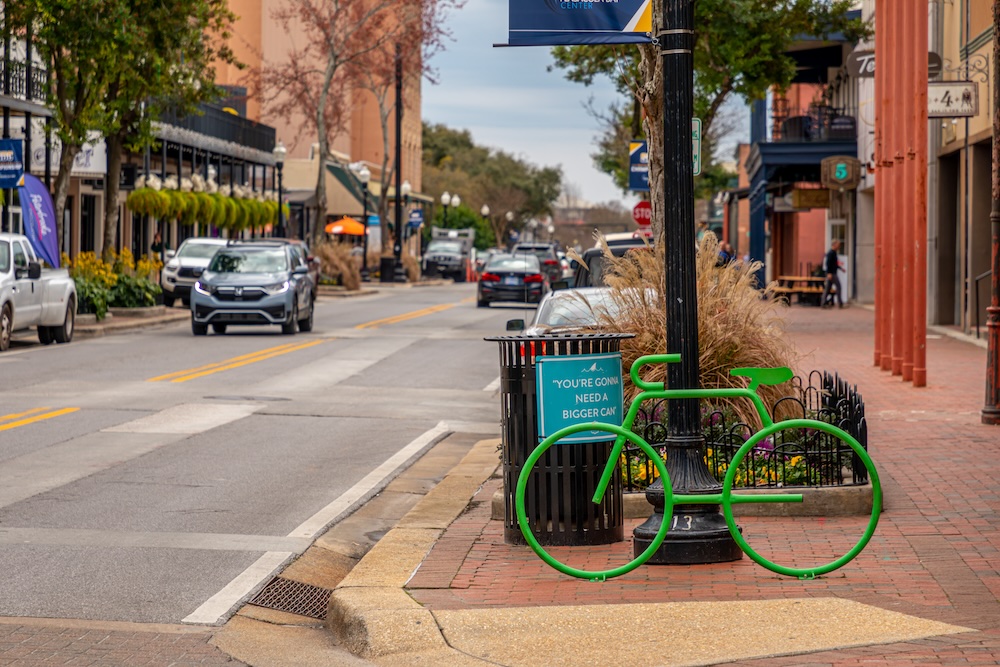
Following Mayor D.C. Reeves’ presentation on the New Palafox Street project, downtown business owners and retailers expressed a range of reactions from cautious support to serious concerns about economic survival during the five-month construction timeline.
Preserving History
Dog House owner Nathan Holler led the questioning, emphasizing the importance of Pensacola’s historic character. “History is a huge thing for Pensacola, and I think when we progress, we need to look at preserving our history,” Holler said. “When we go to a place, we go there for the history, the small business and the charm. I think when we look at this plan, it turns Pensacola into something that doesn’t really preserve our history.”
Holler advocated for exploring alternatives that would reduce construction time while maintaining walkability improvements.
- He referenced urban planning expert Jeff Speck’s work on walkable cities, noting: “One of the things that was brought up…talks about a more walkable city and how it’s so important to have not taken away parallel parking, but to add parallel parking. What this does is it creates a buffer from the street to the sidewalks, and when you do that, it makes people feel safer.”
Economic Survival Questions
Play co-owner Ed Banacia expressed deep concerns about the cumulative impact on businesses still recovering from recent challenges. “We’re barely five years away from the COVID shutdown. And at the same time, we endured Hurricane Sally, and we endured a terrorist attack,” Banacia said. “It feels like a big economic impact for a vanity project aside from the stormwater.”
Carmen’s Lunch Bar owner Maricarmen Josephs spoke about the vulnerability of small businesses.
- “Small businesses, especially restaurants, have very small margins, and now our margins just don’t even make sense right now, and we’re grappling to find ways to bring more people into our businesses,” she said. “My business is used to having a line out the door. That’s what it needs to survive. This project is looking at taking away 50% of my dining, and I just don’t know that we’re going to make it.”
Joseph raised a critical question: “Is the New Palafox going to be a new Palafox with all kinds of new businesses that are chains that are just not the old ones, and are we just going to see a new Palafox that isn’t the Palafox we want?”
Timing and Information Gaps
Innerlight Surf Shop owner JB Schluter highlighted the retail industry’s unique challenges with the proposed January 5th start date.
- “In the retail world, I booked my inventory six months ago, nine months ago. And I’m still at an iffy point, going, ‘Hey, when are you going to make decisions?’ Because all my spring goods come in January,” Schluter explained. “Sixty percent of my business is done from January through May, maybe June, because people are buying for cruises, they’re going spring breaks, whatever it might be.”
Jeweler Patrick Elebash praised the city’s recent communication efforts but criticized the lack of detail on middle-ground options. “The problem I have is that there is a lot of effort that’s been spent on this Cadillac plan. We’re being told there’s three options here to choose from, but the truth is we only really know a whole lot about two of ‘em,” Elebash said. “I don’t think the city has done a good job on that aspect of telling us what we could do or what that possibility would look like.”
Voices of Support
Not all reactions were negative. Attorney Autumn Beck Blackledge offered strong support for moving forward. “I think that after this is done, we will have more traffic on Palafox,” she said. “It is all about our perception and how we are going to sell this to the public…at the end of the day, you have this product that I think we can really, really be proud of as an owner. We’re behind it.”
Server Chris Brown encouraged a forward-thinking approach. “Lose the small-town mentality. If you want to grow, you got to grow. You can’t park whatever you want to, so get over that and let’s move forward,” Brown said, noting that even during Mardi Gras, “people are going to come to your bar, people are going to walk down…They can’t go anywhere.”
Mayor’s Response to Concerns
Mayor Reeves acknowledged the challenges while defending the comprehensive approach. “I can tell you this is an unprecedented level at the city of Pensacola for us trying to mitigate and trying to support the businesses through a road project that’s ever happened in the city.”
- Regarding the project timeline, Reeves explained: “Any feeling of a gap in communication between all the meetings that we had this summer and where we are today is solely on the 132 days it takes to procure…any meetings between our last meeting before this…and today we would’ve had no new information to give you until we had met with the contractor.”
The mayor stated that project timing was designed to minimize business impact: “The only reason we’re pushing right now is so we can start on January 5th when we feel like it’s the least exposure to you guys.”
- As the November city council vote approaches, downtown stakeholders remain divided on whether the long-term benefits justify the short-term pain.




Just like the beach sign, the piggy backing on utility projects with aesthetic improvements create new, worse problems because some people want something to look materially nicer. The aesthetic improvement will not drive more people to downtown and is a false projection.
Additionally, this project will certainly be delayed well into the summer and fall because of the historical artifacts that will be constantly unearthed due to the past inhabitants in this location
The critical thing is, one thing I think Pensacola can learn from Connecticut, is in terms of you think of Connecticut and it has very bucolic landscapes, and in terms of in the towns it has architecture that sort of, you know when you are in Connecticut, because you have the foliage and the architecture.
Connecticut looks very nice, in terms of how the trees mesh with the architecture and we should want that same kind of effect here.