
Pensacola’s $185 Million Question: A New Arena District or Another Decade of Delays?
Elected officials from the county, city, and mayor’s office reached a fragile but meaningful consensus—and then spent an hour debating how to act on it.
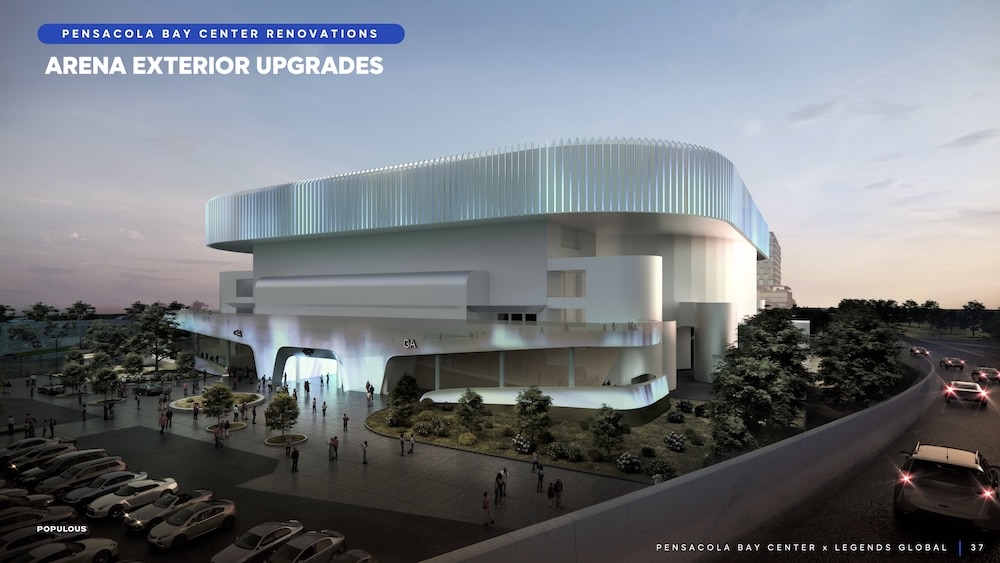
In a room where the words “sooner than later” were used more times than anyone counted, the leaders of Escambia County and the City of Pensacola sat down Thursday morning with one shared understanding: the 40-year-old Pensacola Bay Center is past due for a transformation, and the window to act affordably is closing fast.
The joint meeting, convened at 9 a.m. at the Bay Center itself, brought together the Escambia County Board of County Commissioners, the Pensacola City Council, and Mayor D.C. Reeves.
- After back-to-back presentations from Legends Global and WT Partnership, elected officials spent roughly two hours in open discussion—asking hard questions about money, design, parking, hotels, youth sports, and who should lead the process. What emerged was not a vote, but something arguably more valuable: a public airing of every concern, and a clearer map of where the consensus actually lies.
The Concerns That Kept Coming Back
No single elected official was opposed to moving forward. But several recurring concerns shaped the conversation in ways that will define how this project unfolds. Parking came up in nearly every speaking turn.
- Councilman Charles Bare called it his biggest concern outright and questioned whether expanded trolley service—contracted out to a private company—could ever scale up enough to meet demand. He also recommended that the loop road encircling the Bay Center be vacated, calling it a pedestrian barrier between the main arena and any future adjacent facility.
- Council President Allison Patton pointed out the city had already requested $500,000 for a downtown congestion study, signaling that traffic and parking frustration among constituents is already at a pressure point.
Connectivity was the other persistent theme.
- Councilwoman Jennifer Brahier argued that without a real transportation solution, Pensacola risks building a collection of disconnected venues rather than a destination. She cited Old Town Alexandria’s trolley network as a model for making a district accessible to seniors, families, and everyone who cannot walk or bike. Her practical point: USDOT transportation grants can also be used to fund parking infrastructure, making the transit question inseparable from the financial question.
Commissioner Lumon May raised a concern that others were reluctant to voice directly: the suitability of downtown Pensacola as a youth sports tourism hub. He questioned whether thousands of teenagers leaving a sports facility at night into a bar district constitutes sound planning and noted that the most successful sports tourism complexes in the region—in Hoover, Alabama and elsewhere—were built away from downtown with heavy private investment. His point was not opposition to sports, but a call to think more carefully before committing to a location and model.
Commissioner Barry on the Money
Commissioner Steven Barry offered the meeting’s clearest statement on what the county can actually afford. Earlier board discussions, he explained, had assumed a bonding capacity of $100 million—a figure he said was conservative even at the time. His updated estimate placed the county’s realistic capacity closer to $150 million. That number, he argued, is sufficient to fund both the Bay Center renovation and a new adjacent event center without requiring the county to take on debt for a second ice facility as well.
Barry’s position on the proposed second sheet of ice was nuanced: he is not opposed, but he does not want public bonding capacity devoted to it. Instead, he expressed openness to providing land on the Bay Center campus to a private operator—a deal in which the hockey team’s ownership group and private investors bear the construction and operating risk while the county contributes acreage. He noted that discussions between bond counsel, underwriters, and the team’s owner are already ongoing and do not require immediate commission action.
The hotel question: consultants from Legends Global and WT Partnership were unambiguous: 90% of convention planners surveyed said they prefer or require a headquarters hotel attached to or within one to two city blocks of a venue, with 60% saying they require it outright.
- The cost to build such a hotel now runs approximately $600,000 per key—a number that has roughly tripled over the past decade—creating a feasibility gap the public sector would need to bridge through land donation, tax abatements, and direct equity of $10 to $30 million to trigger $70 million or more in private investment.
The Design-First vs. RFI Debate
The meeting’s most substantive clash was over sequencing. Legends Global consultants argued for beginning the design process for the Bay Center renovation and adjacent event center immediately, noting that design alone takes 12 to 14 months and that every month of delay adds cost. They cited venue convergence—the operational savings from managing all facilities under a single operator—as another reason to move quickly, estimating it saves between $1 million and $2 million annually compared with operating dispersed venues.
Mayor D.C. Reeves pushed back. Going to the private market with a half-designed facility, he argued, risks locking in decisions before developers and management companies have had a chance to weigh in—decisions they might have made differently had they been part of the conversation from the start.
- His preferred path: issue a Request for Information or Request for Proposals that bundles design, construction, management, and private investment opportunities together, letting the market tell the city and county what it wants to build and on what financial terms.
Commissioner Mike Kohler sided with Legends and the design-first camp. He said the body had already conceptually agreed on the core components and that further deliberation without concrete action was itself costing money. Commissioner May, by contrast, aligned with the mayor: you cannot design your way to a number you don’t have yet.
- Independence: Council President Patton added a separate wrinkle: she raised the question of independence. Because Legends Global has been deeply involved in planning the project and would presumably bid on managing the resulting facilities, she argued the RFP process should be managed by someone without a stake in the outcome. She suggested the county’s and city’s consulting teams work together to produce the procurement document, with the city committing to fund its share of that work.
Where Things Stand
By the time Commission Chair Ashlee Hofberger asked whether anyone opposed a second facility, no one did. That was the clearest moment of unanimity in two hours of discussion.
The emerging consensus, as Hofberger summarized it:
- Proceed with Bay Center renovations,
- Build an adjacent flex/event center designed for weekday conventions and weekend sports,
- Continue negotiating a public-private partnership for a second ice sheet, and
- Task the city with addressing parking and transportation—potentially through a parking garage at the long-vacant Tech Park and federal transportation grants.
County Administrator Wes Moreno said he needed formal direction from the commission on the type and scope of the facilities, after which his procurement team could determine whether the path forward is an RFI, an RFP, or some combination.
- He gently deflated a proposal to have something ready by the May 7th committee meeting, suggesting June was a more realistic target given the coordination required between county and city staff.
Mayor Reeves offered to work with Moreno and City Manager David Stafford to draft the guardrails that had emerged from Thursday’s discussion and bring them back to both bodies for confirmation before moving to formal procurement.
- The goal, he said, is to put something to market in its entirety—buildings, management, and private dollars—rather than designing in isolation and discovering too late what the private sector would have done differently.
The Bay Center has been waiting for this conversation for years. The elected officials who showed up Thursday morning agreed it had waited long enough. The question now is whether the machinery of two governments can move as quickly as the moment demands.