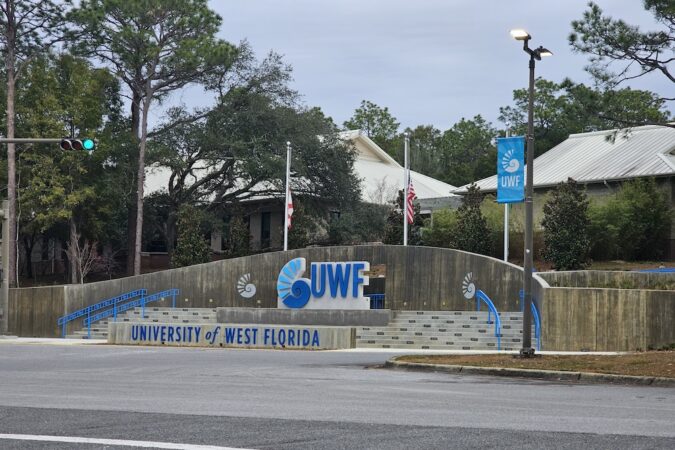
During today’s Academic Affairs Committee meeting of the University of West Florida’s Board of Trustees, the trustees discussed their upcoming accreditation site visit and plans to transition to a new accrediting body, a change stemming from Florida’s 2022 law requiring universities to change accreditors.
- Dr. Dallas Snider, Vice Provost, reported that the Southern Association of Colleges and Schools Commission on Colleges (SACSCOC) will conduct a site visit in two weeks. A team recently completed preliminary visits to UWF’s off-campus instructional sites in Germany. The upcoming visit will include inspections of off-campus locations in the Florida panhandle and meetings with faculty, administrators, and students.
BACKGROUND: The transition follows Governor Ron DeSantis’s criticism of accrediting organizations’ power over universities. When signing the 2022 bill requiring periodic accreditor changes, DeSantis stated, “The role that these accreditation agencies play, I don’t even know where they come from. I mean, they… are effectively self-anointed. They have an inordinate amount of power to shape what is going on at these universities.”
- The governor’s concerns followed SACSCOC’s involvement in two controversial issues: questioning a potential conflict of interest in Florida State University’s presidential search and investigating the University of Florida’s decision to block professors from serving as expert witnesses in a voting rights lawsuit.
At the time, SACSCOC President Belle Wheelan defended the inquiries. She told The News Service of Florida: “Accrediting bodies are governed by the member institutions themselves, sharing their expertise in various disciplines across higher education. While institutions may contribute when associated with other colleagues across the nation, our member institutions found value in collaborating with colleagues from a region with similar values, histories and cultures. It is unfortunate that Florida institutions may no longer have this opportunity.”
SHIFT TO HLC: Looking ahead, UWF representatives will attend the Higher Learning Commission (HLC) annual conference in April to learn more about the procedures of their future accrediting body. The university anticipates receiving a reaffirmation from SACSCOC in December 2025, after which it plans to request permission from the U.S. Department of Education to begin the accreditor transition process in January 2026.
- Committee Chair Dr. Adam Kissel noted that this transition will require updating numerous university regulations and policies that specifically reference SACSCOC. To streamline future changes, these documents will be modified to use more general language referring to “institutional accreditor” rather than naming a specific accrediting body.
- When Board Chair Dr. Scott Yenor inquired about the benefits of switching from SACSCOC to HLC, Kissel cited research by scholar Andrew Gillen indicating that HLC-accredited institutions show strong student outcomes. Kissel also noted that HLC has less history of interfering in state university governance compared to SACSCOC, which he views as an improvement.
Provost Dr. Jaromy Kuhl indicated that the administration is still investigating HLC’s requirements and will provide a more complete analysis of the benefits as their research continues.
DIG DEEPER: The federal government relies on accreditation to affirm that the education provided by that institution or program is a worthy investment of taxpayer dollars. Accreditation is one of the requirements for institutions to qualify for participation in federal student aid programs.
- PROJECT 2025 wants to revamp accreditation, taking it away from the federal government and putting it in the hands of the states.
For the Texas Public Policy Foundation, Kissel co-wrote a paper on accreditation, “The Politicization of Higher Education Accreditation.”
The Texas Public Policy Foundation (TPPF) is an American conservative think tank based in Austin, Texas.
Executive Summary: “Accreditors of institutions of higher education exercise quasi-regulatory authority as gatekeepers of federal student aid. Unfortunately, they often abuse this power. Accreditors have used their authority to create accreditation standards that promote or require diversity, equity, and inclusion (DEI) policies and to stop conservative or even neutral reforms at U.S. colleges and universities.”
Four of the alleged accreditation abuses cited were in Florida – two each involving Rick Scott and DeSantis:
- In May 2021, SACS interfered with the Florida State University (FSU) presidential search when it complained that candidate Richard Corcoran (today, president of New College of Florida) was also on the governing board. SACS president Belle Wheelan argued that Corcoran should step down in order to be a candidate. Yet he was also the state’s education commissioner, and “The state Constitution requires the education commissioner to have a seat on the university system’s Board of Governors” (Dailey, 2021, para. 13).
- In January 2013, SACS opened an investigation in Florida after Governor Rick Scott “weighed in on the selection of a new University of Florida president. It is a misunderstanding of the roles and responsibilities of a governor for SACS to assert that the chief executive officer of a state does not have the right and duty to express opinions on matters of import to state-owned,
operated, and extensively taxpayer-funded universities” (Brown, 2013, p. 6). - In December 2011, SACS threatened the accreditation of Florida A&M University after Governor Scott “publicly suggested Florida A&M University suspend then-president James Ammons a month after [a] hazing death.” In response, SACS president Belle Wheelan sent Scott a letter arguing that the matter should be left strictly to the governing board (Mitchell, 2013, para. 7).
- In November 2021, SACS opened an investigation of the University of Florida “because of an administrative decision that kept three professors from providing expert testimony in a lawsuit against the state” (Barrera, 2021, para. 2).
Kissel had a “special section” on Florida, Gov. DeSantis and DEI, which might explain why the governor chose him to be a trustee and Yenor made him chairman of the Academics Affairs Committee.
In the conclusion, Kissel cites Gillen and his 2020 report for the same foundation, which “proposes a different solution for institutions that wish to innovate or otherwise escape from the undue burdens of politicized accreditation. Off-ramps or “escape hatches” would let qualifying institutions, because of achieving superior outcomes on learning or labor market metrics, retain access to student aid programs regardless of accreditation status.”
- Like Project 2025, he proposed decoupling federal aid from accreditation would “enable accreditors to focus on institutional improvement without a sword of Damocles looming over each institution. This financial sword is what gives accreditors their power, and reformers have good reasons to remove it.”