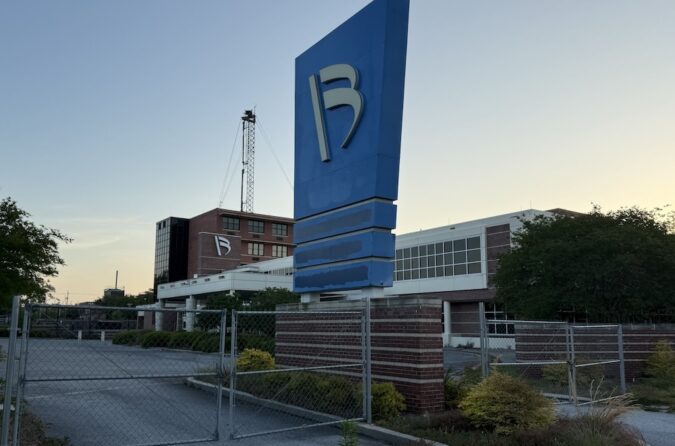
Jacobs Group project manager walks CRA board through demolition timeline, safety protocols, and community engagement plans—
The demolition of the former Baptist Hospital campus is now in full swing, with asbestos abatement work entering its second month and active building demolition expected to begin as early as March.
Josh Wallace, project manager with the Jacobs Group serving as the city’s owner’s representative, delivered a detailed briefing to the Community Redevelopment Agency board on Feb. 9, walking members through the phased demolition plan, asbestos safety protocols, air monitoring results, and plans for salvaging furniture and plants from the buildings before they come down.
- Background: North Star is the general contractor performing all abatement and demolition work. Intertech PSI handles laboratory testing and air monitoring. Jacobs provides daily on-site oversight on behalf of the city.
Four-Phase Timeline: Demolition Could Start in March
Wallace, a Pensacola native who was born at Baptist Hospital — and whose daughter was born there just two weeks before the hospital relocated — outlined how quickly the project has moved.
The project is broken into four phases:
Phase One — Mobilization and abatement setup (December–January). Complete.
Phase Two — Site prep and active asbestos abatement (currently underway). Crews started on the north side of the site with Towers 1, 2, and 3 — Tower 1 being closest to E Street, Tower 2 in the middle, and Tower 3 nearest 8th Street.
Phase Three — Active demolition, estimated to begin in March. “Once we understand that [sequence], we’ll definitely make sure the notices go up via postcard, via website, and that the public is in the know on exactly what they should be seeing from a day-to-day standpoint,” Wallace said.
Phase Four — Site cleanup and restoration, targeted for January 2027. “Hopefully all the buildings are down by then, and then pretty much site restoration, which is where our scope ends on this one,” Wallace said. “And I think we’ll call that a successful job.”
The project website at formerbaptistdemolition.com — yes, another city website — features a 3D/4D visual walkthrough showing the abatement and demolition sequence building by building.
Details
97% of Asbestos is Non-Friable
Wallace addressed the issue generating the most community concern head-on: asbestos.
- The hospital, built before 1970, contains asbestos-containing materials (ACM) used in construction for its heat-resistant properties. Wallace explained the two classifications — friable (can become airborne) and non-friable (cannot become airborne if properly handled before being disturbed).
“The good thing about our job is … 97% of the ACM on our site is non-friable, which means as long as you have a plan in place before you disturb it, it cannot become airborne, which means it cannot become an issue,” Wallace said.
The remaining 3% of friable material is limited to the main hospital building — primarily pipe insulation and some fire-rated doors. About 60% of the non-friable material is flooring and floor mastic.
Detailed Containment and Monitoring Protocols
Wallace walked the board through the containment process in detail. Work zones are sealed with plastic barriers. All potential air escape points — windows, exhaust fans, gaps between rooms — are taped shut. Negative air pressure machines with HEPA filters (99.97% efficiency) keep air flowing inward, not outward.
Workers enter through a decontamination entrance wearing Tyvek suits and respiratory equipment. Upon exiting, they shower inside the containment zone. Their suits stay on the work side and are bagged with the removed asbestos material.
All removed ACM is double-bagged, counted, and placed in plastic-lined dumpsters. Another tarp goes on top before hauling. Everything is delivered to a regulated landfill with a chain-of-custody manifest signed by North Star, Jacobs, the truck driver, and the landfill.
“Everything that is removed from the actual containment zone is double-bagged and taped prior to going into the dumpster,” Wallace said.
Air monitoring occurs daily at four locations: the decontamination entrance, the bag-out area, inside the containment zone, and at the exhaust point. Workers are also individually tested.
“The good news to date is, and I guess January 12th being the first day, a month in, all of our results have been below the regulatory limits for you to even need respiratory equipment,” Wallace said. “That doesn’t necessarily say we can work in the area without it, but I think that’s good as far as just what the results have shown to us thus far.”
Work Hours and Site Security
Work hours are Monday through Friday, 7 a.m. start times, with 8- to 10-hour days. Saturdays are reserved as makeup days.
About 60 North Star workers are on site at any given time. Site fencing surrounds the perimeter, and security personnel are stationed on-site.
Osprey Nest, Stormwater, and Environmental Monitoring
An osprey nest on the property has shown no activity, according to monthly drone monitoring. Wiggins asked Wallace to contact the local Wildlife Sanctuary to confirm whether it’s an active nest.
Stormwater is being monitored to ensure nothing from the demolition site enters the city’s drainage system. “What’s behind our fence stays on our site is kind of the way I like to think about it,” Wallace said.
When active demolition begins, wet suppression — using foggers or water hoses running continuously — will be employed for dust control, along with air monitoring at the fence line.
The final site restoration goal is a green site with topsoil, seeding, and proper grading for drainage.
Furniture, Medical Equipment, and Plant Salvage
Wallace and Wiggins discussed efforts to salvage usable items from inside the buildings before demolition.
Deputy City Administrator Amy Miller said she is working with local nonprofits to organize the effort. “One general nonprofit that has done emergency relief types of projects in the past that knows how to organize all that stuff … One is Habitat for Humanity and Restore. And then one medical device nonprofit that could use medical equipment, whether it’s Health and Hope Clinic, whether it’s Community Health Network,” Miller said.
- Miller noted most of the salvageable items are institutional. “There’s not a lot of lamps and those kinds of things. It’s a lot of conference room tables, conference room chairs, waiting room furniture, that kind of stuff. Not so much things that people would use in a house.”
Wiggins also raised the possibility of salvaging plants from the grounds, noting the seasonal timing makes it urgent. “I don’t have a green thumb. I hate to dig up plants and then all of a sudden they die. But we’re working that out,” Wiggins said, adding that road crews are standing by once dates are set.
Wallace committed to providing at least 72 hours’ notice to board members before any plant or furniture pickup events.
Community Engagement
A public forum is scheduled for March 5 at the Fricker Center. The project team is also planning open “sidewalk talks” on the last Tuesday of every month at 7 a.m. at the site.
“If you have some questions, we’re here to answer them,” Wallace said.