
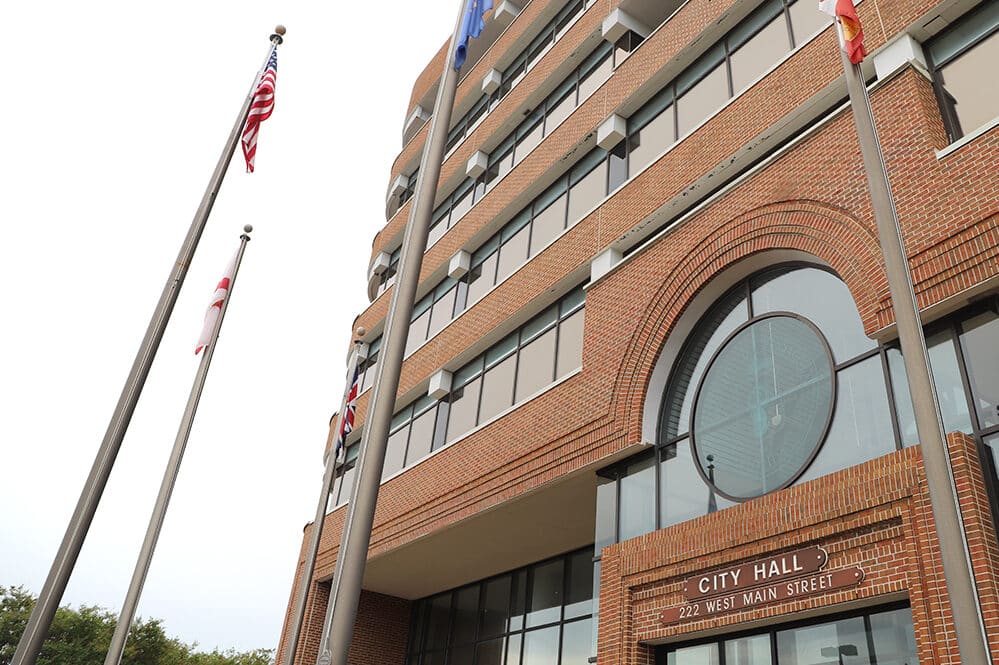
City Hall
Curfew Ordinance Pulled Back for More Work After Marathon Council Debate
Mayor D.C. Reeves pushed to keep it moving. Council President Allison Patton withdrew her second instead—a procedural move that keeps the juvenile curfew ordinance alive but sends it back to the drawing board.
Overwhelming Opposition from the Public
The public comments lasted 28 minutes before the council discussed the ordinance. Of the eleven speakers, only one spoke in support of the ordinance. The rest urged the council to vote no, citing a mix of statistical, constitutional, and racial-equity arguments.
Key themes
- “It doesn’t work.” Multiple speakers cited research from the National League of Cities’ 2018 review and a 1997 Department of Justice study and argued curfews don’t reduce juvenile crime or victimization. Pepper Weimer pointed to Minneapolis spending over $400,000 annually enforcing a curfew that didn’t move crime statistics, and said enforcement pulls officers from higher-priority calls.
- Racial profiling concerns. Several speakers, including Jansen Brummett, Declan McGirk, and Alex Hatley, argued the ordinance would give police a pre-textual basis to stop Black youth. Brummett invoked the 2019 police killing of his neighbor, Tymar Crawford. Gerald Washington, a school board candidate, described being pulled over recently while driving Black youth to sports practice.
- Constitutionality. Attorney Ralph Scofield warned the ordinance would likely be struck down, citing the Florida Supreme Court’s ruling in State v. J.P. striking down a similar Pinellas Park ordinance, and argued a citywide, round-the-clock curfew isn’t narrowly tailored enough to survive strict scrutiny.
Pensacola City Council members spent much of their Aug. 13 meeting wrestling with the proposed ordinance, questioning Mayor D.C. Reeves and Police Chief Eric Winstrom about an initiative in response to the chaos that erupted downtown over the July 4th weekend when police say roughly 500 young people overwhelmed their detail.
- In the end, Council President Allison Patton withdrew her second to send it back for more work rather than force a vote that could have killed it for good.
Why this matters: The proposed ordinance number 14-26 would have created Chapter 8-3 of the city code, establishing a civil juvenile curfew for minors out after 11 p.m. on weeknights and after midnight on weekends, with exemptions for work, authorized events, and minors accompanied by a “responsible adult.” Read Proposed Ordinance No. 14-26
Why Now
Chief Winstrom told council members the ordinance grew out of what he saw the night of the July 4th fireworks celebration.
“There were probably about 500 young people,” Winstrom said. “There were kids younger than my 12-year-old daughter. I could say for a fact that there were 11-year-old and younger individuals down there.”
He said what officers were doing amounted to “a giant, essentially babysitting operation because we knew that we did not have the ability to take any legal steps other than stand there and try and prevent anything from happening.”
- He said the danger escalated as the night wore on. “So really all that was left was this core young group of individuals who then started throwing fireworks at each other so that the anxiety, the fear, the danger started elevating around midnight.”
- Officers made about eight arrests that night, he said, adding, “I made my first Pensacola arrest that night.”
Winstrom pushed back on the idea that the ordinance will turn officers loose on kids. He described it as giving officers the ability to “interact with the young person and remove them to a safe place and appropriate situation.”
- He added later: “Using a curfew as a tool to protect young people from harm is a positive thing.”
The Mayor’s Case
Mayor Reeves defended bringing the ordinance forward without a prior workshop.
“I felt a duty and was compelled by the overwhelming request from my constituents that something be done,” Reeves told the council.
He reminded council members that the ordinance, once passed, stays under their control. “It’s easy to classify and say, well, the mayor has administrative control. Not if you repeal the ordinance, we don’t. So if you don’t like how it’s going, you do have some control as well.”
- Reeves wondered aloud why the council members hadn’t expressed their concerns earlier. “You guys received it on August 3rd. And I don’t think we got any feedback.”
- Pensacola’s version is modeled on ordinances in Miami Gardens, Miami-Dade County and Daytona Beach, which Cobb described as more stringent, including provisions penalizing business owners who let minors into their businesses after hours, which Pensacola’s draft does not include.
Council Pushback
Councilman Charles Bare was the ordinance’s sharpest critic, invoking the city’s history with the 2009 death of Victor Steen, a Black 17-year-old killed after being struck by a Pensacola police officer’s vehicle.
- “If this curfew goes into place, we can probably see more things like this,” Bare said, arguing the measure hadn’t gotten proper vetting. “I don’t believe a juvenile curfew ordinance is even ready for passage.”
Bare also raised the ordinance’s requirement that a supervising adult be 21, rather than 18. “I know plenty of 30-year-olds that are not responsible adults,” he said. “If someone can go to war at 18, I think they can probably watch a child too.”
Councilwoman Tenaide Broughton pressed for alternatives to a curfew, asking Chief Winstrom and city staff about late-night programming for teens. “No one is touching that gap because the kids want to go somewhere. We just don’t have the places for them to go.”
- Deputy Administrator Amy Miller told the council that staff has begun early talks with Parks and Recreation about extending community center hours on weekend nights, though those discussions are not far along.
Patton Pulls It Back
With opposition mounting, Council President Allison Patton floated a middle path instead of forcing an up-or-down vote.
“I hear there’s discomfort but not necessarily disapproval,” Patton said. “Would it make sense to just kind of take some of this back and see if we can work on it and bring it back? Would the sponsor be willing to consider that?”
Mayor Reeves pushed back on the idea of pulling the ordinance.
- “I’m not going to disrespect my staff that way.” He noted the ordinance had been public for weeks: “We’ve been talking about it for weeks… I just feel like that undermines a lot of the work that’s taken place over now six or seven weeks.”
Patton reframed the request as collaboration rather than a rebuke. “In the spirit of collaboration between the administration and the body that passes ordinances, I think probably all of us want to address the problem of kids being in dangerous situations late at night and give the police some tools to do what they need to do with it,”
She was also wary of an outright rejection, since a failed ordinance doesn’t automatically come back for another look.
- In the end, Patton withdrew her second, keeping the ordinance alive without forcing a vote that could have killed it outright.