Commissioner Hofberger defends decorative arch project amid community backlash and design controversy.
Escambia County Commissioner Ashlee Hofberger found herself defending a controversial $7.5 million gateway project at the June 17 Tourist Development Council meeting, as public criticism mounted over the spiraling costs and questionable design choices for the entrance to Pensacola Beach.
A Project Gone Awry
What began as a straightforward request to replace the aging toll plaza with a decorative arch has transformed into what Hofberger described as “a drawn-out process that has now ballooned into a $7.5 million project.” The commissioner outlined her timeline of miscommunication and scope changes that she said left her blindsided by the project’s evolution.
In January 2025, Hofberger requested a solicitation to remove the old toll plaza and build a decorative arch to house tolling equipment. However, when the contract was negotiated, the scope had been significantly reduced without her knowledge. “The first time I was made aware of these changes was the kickoff meeting on April 1,” she told the council.
The situation became more complicated when staff recommended a change order to restore the original scope, only to later cite legal concerns that prevented moving forward. A second solicitation was issued specifically for the decorative arch design, resulting in a $1.1 million contract just for the “pretty part,” as Hofberger characterized it.
Design Controversy Emerges
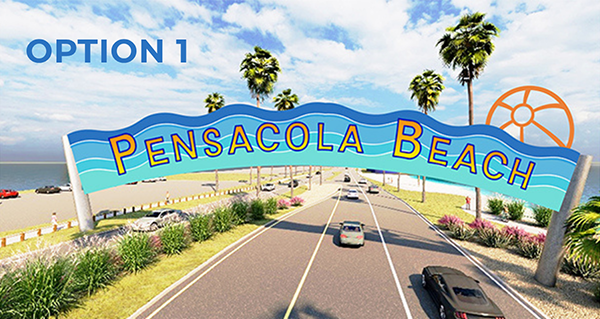
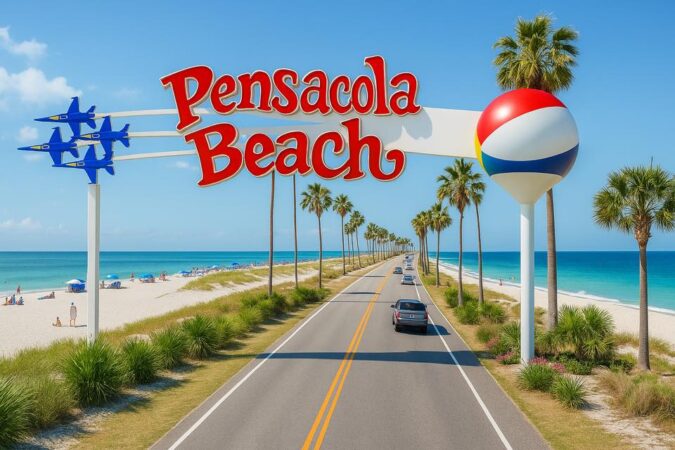
Perhaps the most embarrassing revelation was that the selected contractor’s design was not original work. The design appeared to be copied from a private website, specifically, the logo for pensacolabeach.com owned by Innisfree Hotels. During the meeting, TDC board member Jason Nicholson, senior vice president of development for Innisfree Hotels, confirmed that his company had developed the logo and expressed both surprise and flattery at its unauthorized use.
- “I’d be happy to license that to Escambia County for free,” Jason Nicholson offered, noting the irony of the situation. “It’s still a pretty classy logo. You can’t argue that.”
The design controversy sparked widespread criticism on social media, with thousands of posts on Facebook and Twitter panning the proposed options. Community members expressed frustration that more iconic local symbols weren’t incorporated into the designs.
Public Pushback
Local residents Kevin Wade and Melissa Pino addressed the council with sharp criticism of both the project’s cost and scope. Pino, who has been fighting various county projects for years, argued that a simple gantry system could be installed for $75,000 to $300,000, far less than the millions being proposed.
- “This thing has been jumping all around,” Pino said, calling for the project to “completely go back to the drawing board” or be scrapped entirely. Instead, she advocated fixing parking issues at the beach rather than pursuing what she characterized as a vanity project.
The criticism extended beyond just the gateway design. Pino and others called for the restoration of changing rooms at the beach, which were previously canceled, with funds redirected to the gateway project.
Conflating Toll Booth Removal with Gateway Sign
Hofberger provided a detailed breakdown of costs for just the functional components of the project, excluding decorative elements:
- Toll plaza demolition: $70,000
- Gantry design: $600,000 (already paid)
- Gantry construction: $2 million
- Tolling equipment: $1.2 million
- Roadway fiber installation: $1.5 million
The functional-only total reaches $5.37 million, far exceeding what many community members consider reasonable for a toll collection system.
- The project originally relied on multiple funding sources, including $2.5 million from tourist development tax funds approved by the TDC, $1.5 million expected from the state (which was denied), and $3 million from county funds. The loss of state funding has forced a reconsideration of the project’s scope.
Hofberger defended certain aspects of the project as necessary infrastructure improvements. She argued that the current toll plaza creates traffic bottlenecks and safety issues, and the tolling equipment no longer functions properly. After someone hit the toll booth last year, it now displays “PLEASE KEEP DRIVING FORWARD” in all caps.
- The fiber optic installation component serves dual purposes: ensuring consistent tolling operations and providing better control of the traffic light at the beach entrance, which frequently goes offline and requires manual control.
Getting Back to the Gateway Sign
“I don’t want to conflate the two different issues. One is those things need to go and I know there’s certainly a cost and I think everybody agrees to that. The other is what we’re going to put up there and at what cost.” – TDC Chair David Bear
He wanted to distinguish between the two separate issues:
- The need to remove the existing toll buildings, which he said everyone agrees needs to happen because “They’re in the way, they’re bottlenecking traffic, they’re ugly, looks like a war zone.”
- What to replace them with and how much to spend – which is where the controversy lies regarding the decorative gateway design and its cost.
Bear was essentially saying that just because everyone agrees the old toll plaza needs to be removed, doesn’t mean they should automatically support an expensive decorative replacement. He wanted to separate the functional necessity (removing the old structures) from the aesthetic choice (what kind of new structure to build and how much to spend on it).
The controversy has drawn attention from multiple elected officials beyond Hofberger. City Councilwoman Jennifer Brahier noted that municipal officials from different organizations received messages asking them to be mindful of the project, indicating the broad community concern.
The controversy also has raised questions about community engagement in major projects. While Hofberger noted that nearly 4,000 people voted on design options, critics argued this was a “push poll” that didn’t allow for a “no” option on the project itself.
Suggestions emerged for a true design competition, similar to what other municipalities have done for public art projects. “Is there any way to do something where there could actually be a competition for the sign… so then it is the people’s and instead of ours?” Brahier asked.
Looking Forward
As criticism mounted, Hofberger acknowledged the need to reassess the project. She indicated plans to meet with the county administrator and other commissioners to explore options for scaling back the scope or potentially phasing the project.
“I cannot move forward with it at this price,” Hofberger stated firmly. “We do need to do something. So the question is, what do we need to do?”
The commissioner suggested considering a phased approach, potentially starting with just the functional gantry system and delaying the decorative elements. However, even this scaled-back approach would still cost over $5 million.