
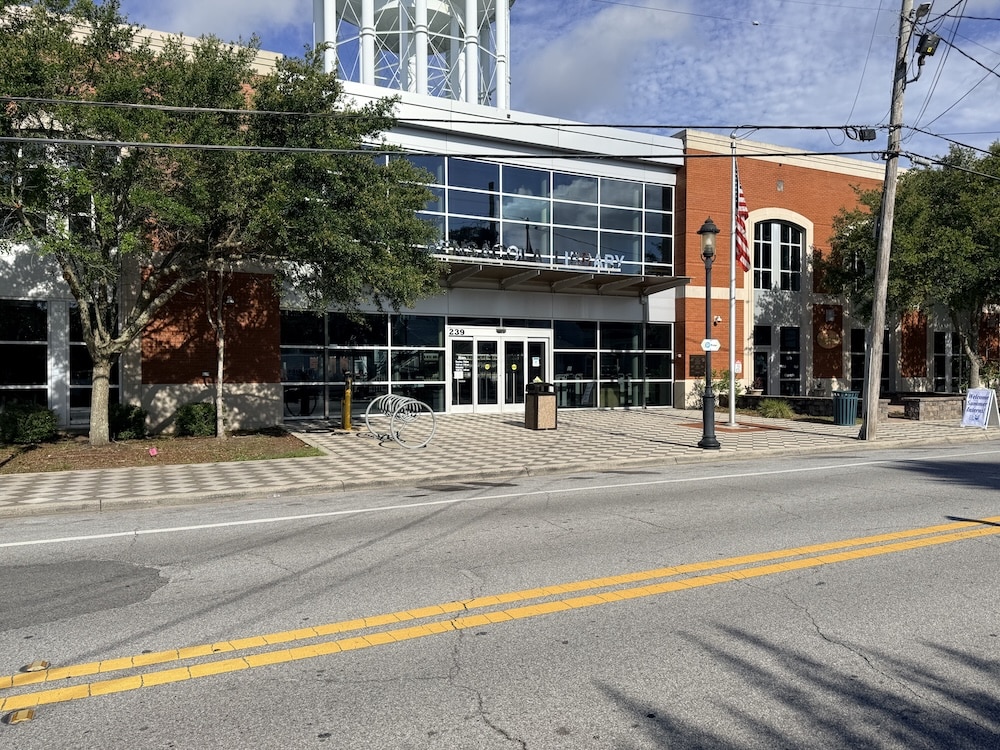
West Florida Public Library
Brahier: The Library Board of Governance Is Not Advisory—And the City Has Standing to Prove It
Pensacola City Councilwoman Jennifer Brahier says the interlocal agreement, county resolution, and state statute make clear that the Board of Governance holds real governing authority, and that the Pensacola City Council should use its standing to challenge the county attorney’s opinion that Wes Moreno acted outside those documents and Florida law.
One of the recurring arguments used to justify Escambia County Administrator Wes Moreno’s decision to bypass the West Florida Public Library Board of Governance’s recommended finalist, Bradley Vinson, is that the board is merely advisory. .
- County Attorney Allison Rogers put it in a memo to Commissioner Ashlee Hofberger and the commissioners: Her opinion is the administrator is “legally and solely responsible for the selection and hiring of the Library Director.”
In October, Moreno told the Board of Governance, “My understanding is that the Board of Governors is an advisory committee to the Board of County Commissioners.”
- When Board member Lori NeSmith challenged Moreno, the county administrator had Mayor D.C. Reeves remove her from the Board of Governance. Read more.
Pensacola City Councilwoman Jennifer Brahier disagrees with Moreno and Rogers, and the governing documents back her up.
What the Resolution Actually Says
Resolution R2013-17, passed by the Escambia County Commission to formally establish the West Florida Public Library Board of Governance, is unambiguous in Section 3. The board was “hereby established to oversee the management” of the library system and makes budget recommendations directly to the Board of County Commissioners—not to the county administrator. Read Resolution Creating Board
That structure is comparable to how the Pensacola-Escambia Development Commission and the Tourist Development Council operate—entities with real governing authority, not advisory bodies that can be overruled at will.
The interlocal agreement approved by Pensacola City Council in July 2013 layers additional authority on top of that. Section 4.7 states that any discontinuance in library operations, funding, or consolidation of assets must be approved by the Board of Governance. That means neither the county administrator nor the county commission can close a branch or consolidate services without the board’s vote.
Brahier appeared on “Rick’s Blog Live,” a daily news program that I am developing with BLAB-TV. She put it plainly:
“It’s not advisory at all. And I think it’s important to note that the reason for all the documentation—laying this in concrete, if you will—is because we’ve got shared monies, we’ve got shared buildings among the city and the county and we issued an interlocal. So the people are taxed for this particular service. And with that kind of obligation comes the obligation that you have a really intense oversight board, something that is publicly chosen, citizen-driven to make sure that the people’s money and the people’s resources are being overseen properly.”
What the Resolution Says About Hiring
The county attorney’s opinion rests heavily on the fact that the library director is a county employee who reports to the county administrator. That much is true—Resolution R2013-17, Section 3B states the director “shall be an employee of Escambia County and shall report directly or indirectly to the County Administrator.”
But the resolution does not grant the administrator the power to hire someone other than the board’s recommendation. Section 3B states:
“The Board of Governance shall recommend to the County Administrator or designee a Library Director to develop and implement a long range plan, an annual plan of service, and an annual budget, and oversee the day-to-day operation of the West Florida Public Library System within the framework established herein.”
The most defensible reading of that language is that Moreno had an up-or-down vote—he could accept the board’s recommendation or reject it and send the process back to the board. What the resolution does not contemplate is the administrator substituting his own hire over the board’s objection.
The board, for its part, unanimously recommended Bradley Vinson as the “preferred candidate to fill the Library Services Director Position.” Chris Hare was unanimously approved as the alternative. Read minutes-february-23-2026.
Crystal Bell Rivera—the candidate Moreno ultimately selected—was not recommended. Brahier noted that Rivera also did not meet the qualifications the board published for the position: five years post-master’s experience in library science, a threshold above even the state’s three-year requirement and the resolution’s own two-year floor.
- “You can’t say a job requires an attorney and then hire a buddy who might become an attorney someday,” Brahier said. “Think how many people who were qualified might have applied if the actual published standard had been used.”
The Board Evaluates the Director—Not Moreno
One provision in the resolution that has received little attention: the county administrator does not conduct the library director’s performance evaluation. The Board of Governance does.
Section 3B states the board “shall conduct an annual evaluation of the Library Director and forward said evaluation to the County Administrator or designee.” The same section gives the board the power to initiate removal: “Upon the written request of the Board of Governance, the County Administrator or designee may remove and/or reassign the Library Director within thirty (30) days.”
In practice, the library director answers to the board—not to Moreno. The county attorney’s claim of sole hiring authority sits uneasily against a document that gives the board the evaluative power and the removal trigger.
The City Has Standing—and Should Use It
What makes the county attorney’s opinion especially vulnerable is that the interlocal agreement is not a county document. It is a binding agreement between Escambia County and the City of Pensacola, and the city is a party to it with its own obligations and rights.
The Board of Governance is structured to reflect that joint ownership: two city representatives (one appointed by the city council, one by the mayor) and three county representatives. None are appointed by the county administrator.
Brahier pointedly raised the stakes for the city council:
“Even though within the city limits the libraries are owned by the city, we can’t shut one down either. This is the board of governance that has that oversight—not us.”
That shared obligation cuts both ways. If the city has ceded certain unilateral powers to the board, it also has standing to insist the board’s authority be respected—including its hiring recommendation.
- The city council has a seat on the Board of Governance because the interlocal requires it.
- City tax dollars flow into the library system under that same agreement.
- If the county administrator can unilaterally override the board’s recommendation, the city’s representation on that board becomes meaningless.
- The county attorney’s opinion does not bind the city—and it has never been tested in court.
Brahier said she was already aware of the concern before the commission vote, having exchanged emails with Commissioner Hofberger urging her to support the board’s finalist. She described Hofberger’s replies as dispiriting: “It felt like the decision had already been made. If you honestly wait and hear from everybody and then make a decision, that’s one thing. But I felt like the decision had been made and I was pretty disappointed.”
The bottom line: The West Florida Public Library Board of Governance was designed, documented, and funded as a governing body—not a suggestion box. The resolution, the interlocal, the bylaws, and state statute all point in the same direction. Mayor D.C. Reeves and the Pensacola City Council have both the standing and the obligation to press that case on behalf of city residents.



If you like our reporting, consider buying us a cup of coffee – here. Your donation will help broaden our reporting. Thank you.