On Monday, Pensacola city officials presented an update to the Pensacola City Council, outlining the next steps for transforming the 41 acres on Pensacola’s west side into a mixed-use community development.
- After two years of due diligence, the City of Pensacola officially closed on the Baptist Legacy Campus property last week. Economic Development Director Erica Grancagnolo thanked the city’s legal team for making “what was very complicated feel seamless.”
The acquisition includes approximately 41 acres intended for redevelopment featuring mixed-income housing, educational facilities, workforce development centers, and commercial retail space. Grancagnolo explained, “Essentially, the goal is to redevelop holistically with everything that a community needs to be healthy.”
Multiple Projects Moving Forward
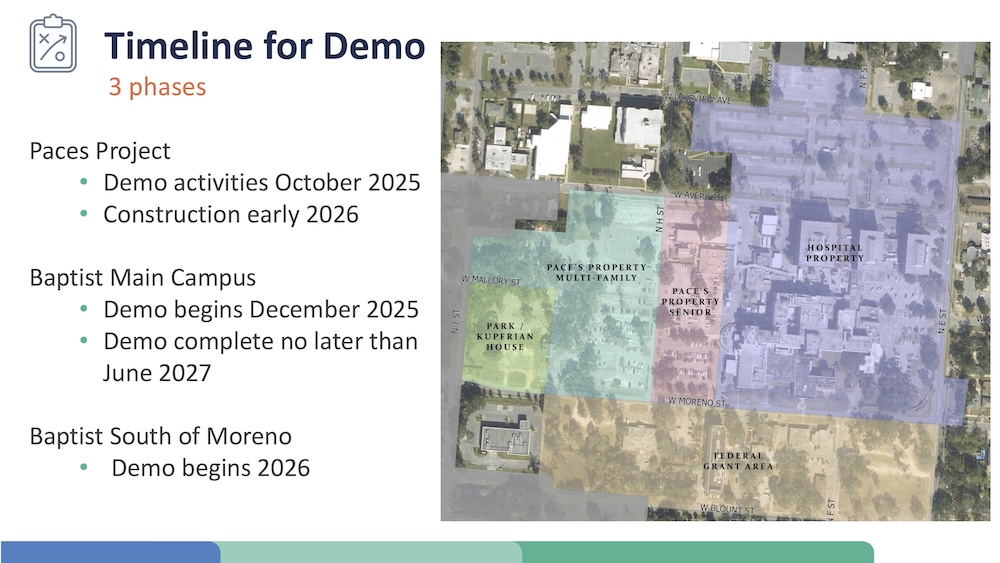
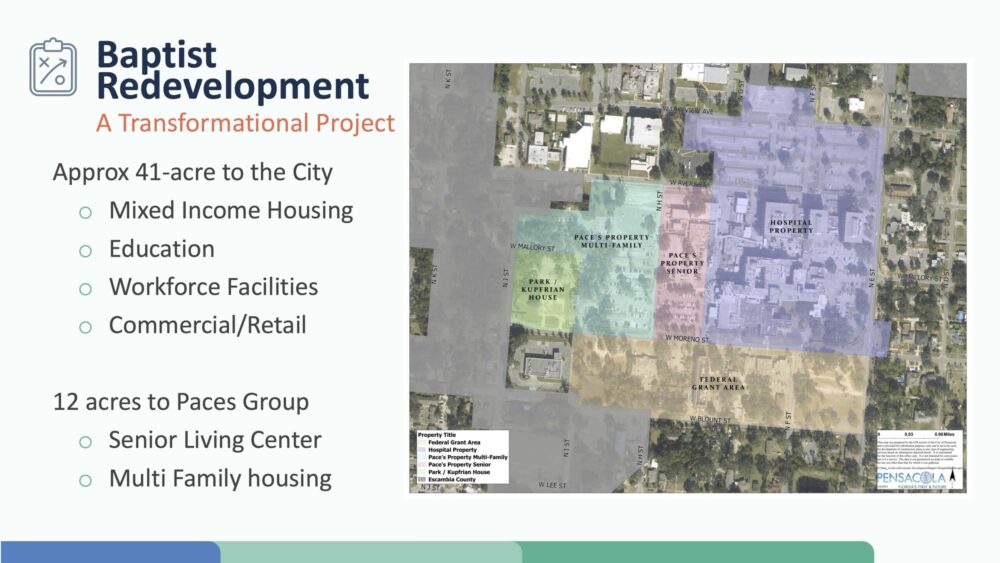 The campus redevelopment involves several concurrent projects. Paces Development will begin demolition and construction within the next couple of weeks on 11 acres they purchased from Baptist before the city’s acquisition. Their projects include multifamily low-income housing and senior housing developments.
- “If (residents) are seeing activity in the vicinity of the Baptist Hospital in the next couple of months, it’s not probably the city portion of the project, it’s most likely this Paces project,” she noted.
The historic Kupfrian House will be preserved. The city’s CRA team is already working with preservation experts to maintain the building’s historical character.
Demolition Timeline and Safety
The main hospital campus demolition contract is expected to come before the council for approval in November, with demolition activities beginning toward the end of 2025 or early 2026. The entire demolition project must be completed by June 2027 in accordance with grant requirements.
Properties south of Moreno Street, comprising smaller ancillary buildings, will be demolished using CDBG funding on a separate timeline, with work expected to begin sometime in 2026.
Grancagnolo stressed the inherent dangers of large-scale demolition work, explaining why the city chose not to use a lowest-bid process. “Demolition is far more dangerous than construction,” she said, noting that demolition contractors had to disclose deaths that occurred on job sites when responding to the city’s RFQ.
Critical Role of Owner’s Representative
The city will require an owner’s representative to be on site every day throughout the 18-month demolition process. This representative will provide an extra set of eyes on safety protocols and sign off on every load of debris leaving the site—a crucial safeguard given the asbestos and lead contamination present in the buildings.
- “We need to make sure that no mistakes are made that would impact the surrounding neighborhood,” the economic director said, highlighting both federal and state compliance requirements and the city’s liability concerns.
 Community Engagement and Planning
Mayor D.C. Reeves acknowledged potential confusion around previous community engagement efforts, noting a fundamental difference in the current process. “For the good of the community, these are acres that can be used and leveraged to bring community good, not to the highest bidder,” he explained, distinguishing the city’s approach from previous Baptist Hospital discussions in the neighborhood.
The city opened requests for proposals for a redevelopment advisor, receiving three responses. The advisor will serve as a strategic partner, “offering expert guidance on how to advance the redevelopment of the Baptist Hospital Legacy campus” while “engaging stakeholders, structuring partnerships, supporting a process that honors the site’s history, meets community needs and promotes long-term sustainability.”
The city expects to bring a redevelopment advisor contract to council for approval in December, with listening sessions planned to gather community input on the demolition and redevelopment process.
Project Budget and Funding
The total funding stack for the main campus demolition is $13.815 million, with an additional $5 million CDBG grant designated for demolishing properties south of Moreno Street. Available funding includes proceeds from the Paces sale, though Grancagnolo noted the final numbers are being finalized to account for closing costs.
- The city has identified a funding gap between available resources and anticipated project costs, which CRA staff plans to cover using identified CRA funds. This funding request will come before council for approval in November.
Major anticipated costs include the demolition contract with North Star, an owner’s representative for approximately $900,000 over the 18-month demolition period, and due diligence and carrying costs for security, utilities, and landscaping during the two-to-three month transition period.
Grancagnolo expressed confidence in the budget, noting that the demolition contract was written to limit change orders, making her feel “very good about where we are with all of that.” The cost for the redevelopment advisor was not included in the presentation, as the city is still in the procurement process and didn’t want to impact ongoing contract negotiations.
See Presentation.
 Support Our Journalism

If you like our reporting, consider buying us a cup of coffee – here. Your donation will help broaden our reporting. Thank you.






During a radio interview this week, CEO Faulkner said Baptist was asked to “not” leave behind any its operations on the legacy campus. Andrew McKay did ask one follow-up question and Faulkner said it was the “county” that made the request. Someone still needs to find out “who” in county government made the request and why. We also need to know why the “Draft Final” West Moreno District Implementation Plan & Strategy (dated December 2016) was never finalized. I suspect the Baptist board secretly voted in 2016 to abandon the old campus. Property Appraiser records show that Baptist began buying up property for the new campus in early 2017 using shell corporations. We also don’t know if the Board of County Commissioners was ever told that Baptist intended to build a hospital with fewer beds. A nurse at Baptist has described the poor layout of the hospital. It would be interesting to know the specifics of the plan as it evolved over the years. Also, I had the impression that Baptist had pledged to build a medical capacity at/near the old campus in consideration for the city council agreeing to annex the Baptist property into the city. Baptist then did nothing. If Baptist promised to do this but failed can the city “de-annex” the Baptist property out of the city? As for the city project funding, Reeves has said that he wants to mostly spend city CRA dollars because they are mostly Escambia County dollars.
Seems to me that since Baptist no longer owns the site, the Baptist name should no longer be used with any progress happening there. (no free advertising) They abandoned the neighborhood, broke promises, and stuck the City taxpayers with the bill to clean it up. The brighter outlook for this neighborhood is not because of Baptist leadership/”legacy”, it is in spite of it. Maybe something that pulls from older history… “New Moreno” “North Hill Highlands” “New Highlands”