
Development / CRA
City Rejects Hard Rock Hotel and Rhythm Lofts TIF Application, Cites Math That Doesn’t Add Up
The Pensacola CRA has deemed Inspired Communities’ $58 million tax rebate request invalid—citing inflated revenue projections, an equity shortfall and a request that exceeded what the city can legally give.
The Pensacola Community Redevelopment Agency has formally rejected a Tax Increment Financing rebate application from Inspired Communities of Florida, LLC—the development firm also known as The Dawson Company—declaring it incomplete and legally unprocessable as submitted. The decision, formalized in an April 16 letter signed by CRA Administrative Officer Victoria D’Angelo, hits pause on what would be one of the most ambitious development proposals in Pensacola history.
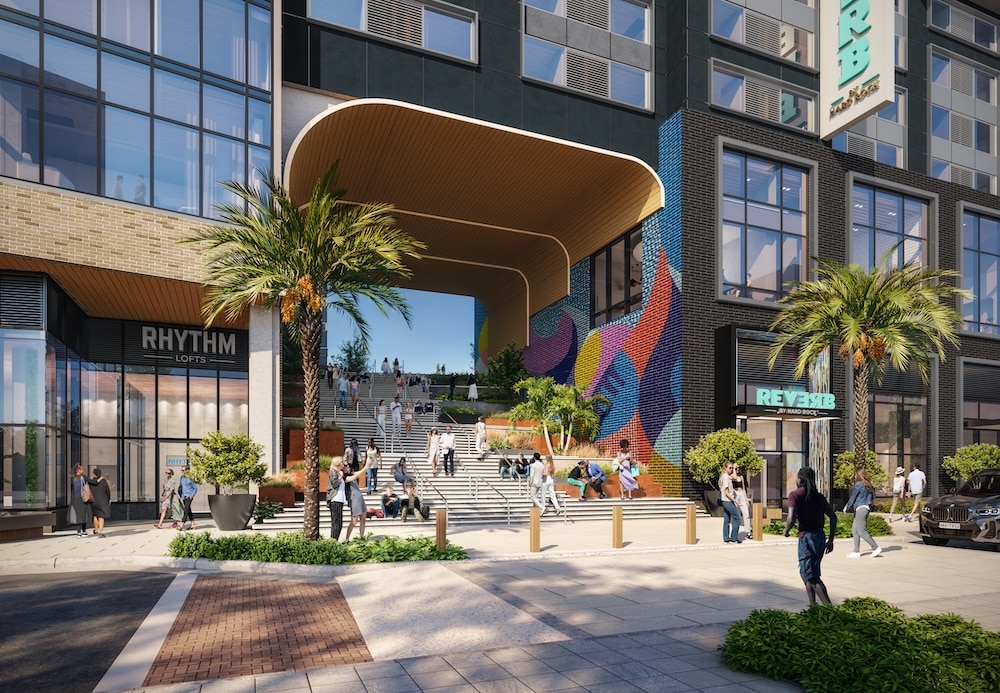
- The project, branded as Rhythm Lofts and REVERB by Hard Rock at Community Maritime Park – Lot 5, envisions a $280 million mixed-use development adjacent to Blue Wahoos Stadium. The plan includes 247 residential units—split between market-rate rentals, deed-restricted middle-income housing and for-sale condominiums—a 147-key Hard Rock hotel, a 25,000-square-foot public plaza and a structured parking podium. The developer projected 3,000 construction jobs and 300 permanent positions tied to the project.
- To make the numbers work, Inspired Communities sought roughly $58 million in TIF rebates over 20 years, or about $2.9 million annually at stabilized operations. Read The Hard Rock Rebate Debate.
What Lambert Found
Before D’Angelo’s letter went out, the CRA retained Lambert Advisory, LLC, to conduct an independent assessment of the application. Lambert’s April 1 memo identified significant financial inconsistencies across virtually every component of the proposal.
Rent Reality Check — Monthly Avg. per Unit
99 of 198 rental units are deed-restricted middle-income, meaning roughly half cannot exceed the $1,840 cap—making the $3,900 average mathematically implausible.
Lambert concluded the projected Year 2 real estate tax assessment of $2.39 million was likely materially overstated. The hotel numbers raised similar red flags: the application’s own hotel pro forma listed food and beverage revenue of $15.7 million for Year 2—more than four times the $3.6 million projected in the developer’s own market study, translating to over $400 per occupied room night.
Lambert’s memo put it plainly: the rental, hotel and condominium pro formas each contained inconsistencies significant enough to make it “extremely difficult (if at all possible)” to validate the project’s “But For” requirement—the legal standard requiring a developer to show a project would not occur without public assistance.
The condominium pricing proved equally difficult to reconcile with the market. The application projected studio units selling at $1,705 per square foot and one-bedrooms at $1,725 per square foot—but the developer’s own market study showed the Pensacola condo market rarely exceeds $800 per square foot. Those inflated sale prices matter because the pro forma relies on condo revenue to pay down multifamily rental debt.
CRA’s Six Grounds for Rejection
A Request That Exceeded What the City Can Legally Give
Mayor D.C. Reeves, speaking at his April 21 press conference, distinguished his own policy objections and the CRA’s formal finding of invalidity.
- “The request outpaced what we legally could give, even if we wanted to give,” he told reporters. The application included a $952,900 “Live Local Exemption” figure and apparent inclusion of school district millage and other non-CRA taxes—none of which the CRA can legally rebate under any circumstances.
The math also conflicted internally. The application’s own line items—$1.05 million annually from the rental component and $1.57 million from the hotel—sum to $2.62 million, not the $2.9 million headline figure. And the 20-year rebate window assumes a 2029 project completion that Lambert called “highly aggressive.” With the Urban Core CRA set to sunset in 2043, a 2029 delivery would allow at most 14 years of TIF eligibility.
By the Numbers
At the corrected annual figure over the eligible term, the realistic maximum TIF falls between $36.7 million and $40 million—well below the $58 million headline—and that’s before any corrections for overstated revenues.
What Comes Next
The CRA’s letter does not close the door on the project. D’Angelo’s correspondence invited Inspired Communities to resubmit a revised application that fully addresses the deficiencies. Any additional consultant review required for a resubmittal will be billed to the applicant—standard under CRA policy for projects of this complexity.
Reeves confirmed a meeting with Harold Dawson Jr., principal of Inspired Communities, had been scheduled after the rejection letter went out. He said the developer had been told to assume a deeper, applicant-funded analysis would be required on any resubmission. “We already know enough about this request to know that this is not going to be approved or sponsored or promoted without greater detail,” the mayor said.
Timeline


If you like our reporting, consider buying us a cup of coffee – here. Your donation will help broaden our reporting. Thank you.