 —Concerns Mount Over Out-of-State Firm’s Role in Project—
Community activist Hale Morrissette is sounding the alarm about the redevelopment of Pensacola’s Baptist Hospital Legacy Campus, raising serious questions about community displacement and the city’s choice to work with Bayou District Foundation, a New Orleans-based organization with a controversial track record.
A Warning From New Orleans
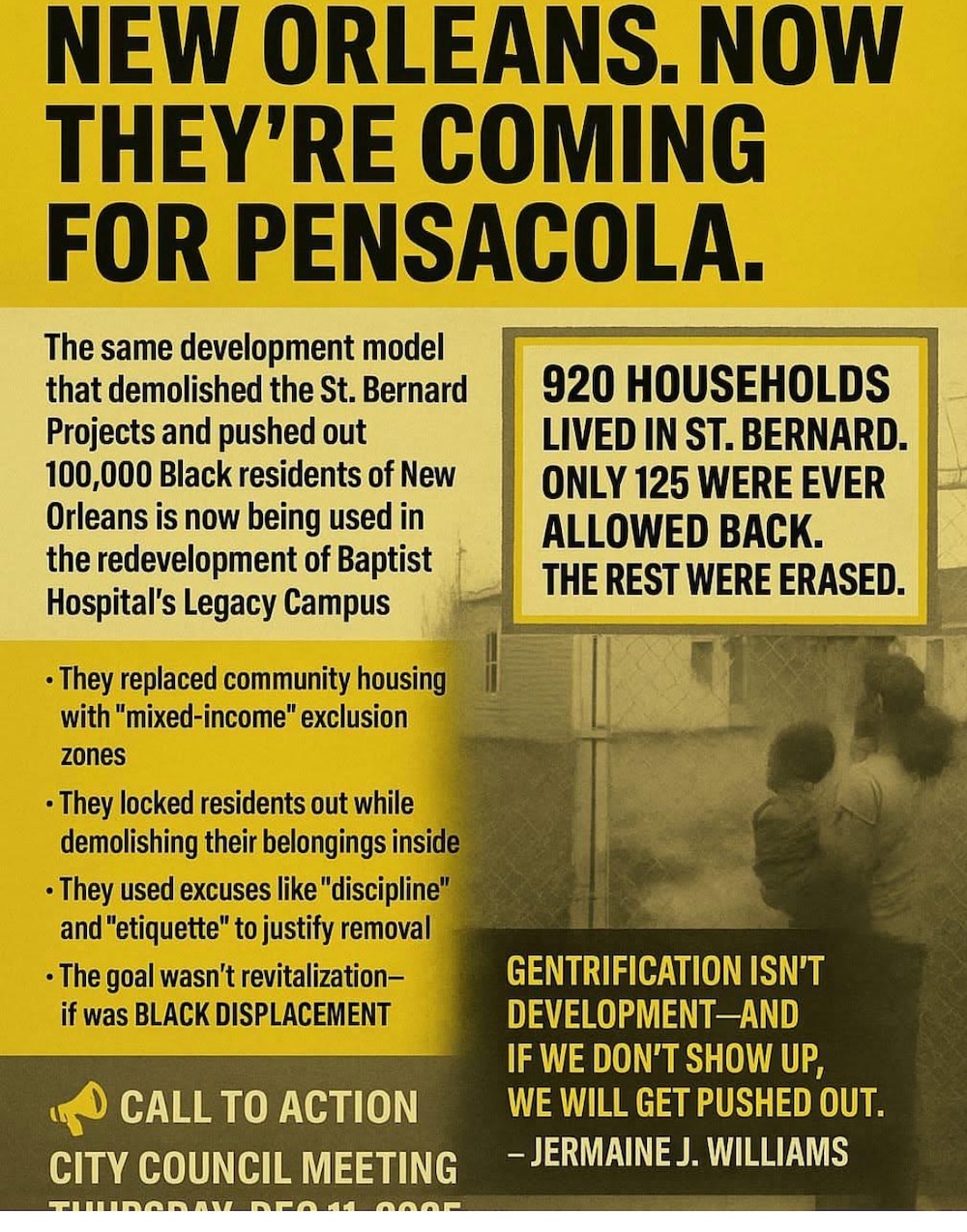
Morrissette’s concerns stem from the Bayou District Foundation’s history in post-Hurricane Katrina New Orleans, particularly its Columbia Parc project in the St. Bernard District.
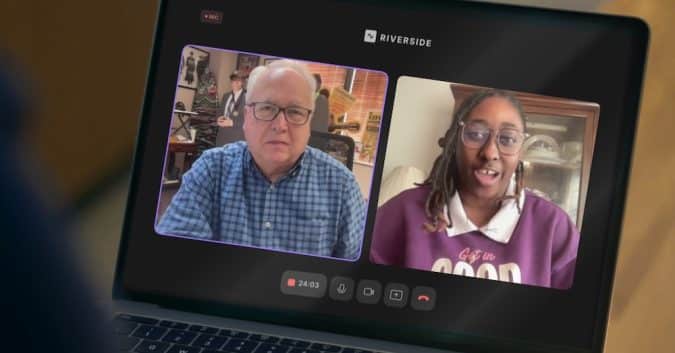
“They displaced a lot of people,” she said on the “(We Don’t) Color On the Dog” podcast. “I’m actually trying to reach out to some of the families in New Orleans to hear about how it happened over there when they were getting displaced.”
St. Bernard was one of New Orleans’ largest family public housing developments, with roughly 1,300+ units, overwhelmingly occupied by low-income Black residents before Hurricane Katrina. Post-Katrina, HUD and the Housing Authority of New Orleans opted not to reopen St. Bernard or the other “big four” projects, instead pursuing HOPE VI–style mixed-income redevelopments, including Columbia Parc on the St. Bernard site.
- According to reports, only 125 of the 920 households that live in the district were allowed to move back.
Mayor D.C. Reeves has recommended the selection of Bayou District Consulting, LLC, which includes the Bayou District Foundation’s principals, for the development advisory services on the redevelopment of the Baptist Hospital Legacy Campus. The Pensacola City Council will vote on the recommendation at its Dec. 11 meeting.
Lack of Communication Fuels Distrust
Former Councilman Ronald Townsend, now in his early nineties, lives near Baptist Hospital with his wife. His primary concern isn’t just the redevelopment itself—it’s the complete absence of communication about health hazards from demolition and environmental issues. The Townsends aren’t alone.
- “Nobody has showed up on his doorstep,” Morrissette said, referring to fellow activist Jermaine Williams, whose family home sits just two to three blocks from the site. “I’m an old school door-knocking girl. There is no reason to me why we could have hired a few folks like myself to go knock some doors, go get some surveys done, go talk to the people.”
Morrissette described attending a meeting where she was asked to leave because sSunshine laws prevented her from watching presentations by consulting firms being considered for the project.
“How did that make any sense?” she questioned. “If I wasn’t someone who’s pretty much unthought and just kind of rolls the way that I want to roll in the city, I think that would’ve been something that went under the radar.”
What’s at Stake
“The city of Pensacola has a track record,” Morrissette stated bluntly. “It has a track record of displacing folks and being happy to gentrify our areas. Being told, well just sit back and wait and just watch and listen and we’re going to do the right thing by you. That doesn’t work anymore.”
- Beyond displacement concerns, Morrissette highlighted immediate community needs: “People are not getting jobs. Folks are getting displaced and people need housing now. People are hungry.”
Call to Action
Morrissette has asked the community voice their concerns at the Pensacola City Council at 5:30 p.m. on Thursday, Dec. 11. She is calling for a pause in the process and a comprehensive community engagement plan.
- “The demand and the hopeful outcome is that we get something on the calendar that says, as a community, we’re taking feedback, and we’re actually going to see that feedback show up,” she stressed.
The buzz around Baptist Hospital’s redevelopment is spreading throughout Pensacola’s Black community. “A hundred percent,” Morrissette confirmed when asked if these concerns are widespread. “People are talking about this. It’s the buzz right now.”
- The message is clear: Pensacola residents want transparency, communication, and a genuine seat at the table BEFORE decisions are made that will reshape their neighborhoods for generations to come.


Like me, Hale Morrissette is a community leader, and I respect her, and we as community leaders strive to build a better community.
At one time I advocated for generally the campus to be an extension of the University of West Florida, to have a law school, medical school, an expansion of an urban campus and ultimately, it is not to be the location, but there needs to be a UWF law school, medical school, it is possible to build it into one of the most competitive universities in the country.
But Hale Morrissette is addressing valid points, in particular, the 60% labor force participation rate is atrocious, in terms of how many retirees we have, that number should be 80% or higher. Everyone who wants a job that pays the bills should be able to get one. That this is not the case is a problem for our community, and so I thank Morrissette for bringing up this vital topic that we must discuss that pertains to economic justice.