
Note: I opened today with WT Partnership’s assessment of our economy because I didn’t want it overlooked. The City of Pensacola and Escambia County have several significant economic development projects in various stages: American Magic/SailGP, Outlying Fields, ST Engineering, Pegasus Laboratories, REVERB by Hard Rock, Project Maeve and others. The analysis should help guide decisions on those projects.
Here is my report on the CRA meeting and the City of Pensacola Convention Center Analysis- Draft Report.
The City of Pensacola got its most detailed look yet at the future of the Pensacola Bay Center district on Monday, when consultants from WT Partnership presented a 158-page feasibility study to the City Council sitting as the Community Redevelopment Agency board.
- One problem: The City of Pensacola doesn’t own the Bay Center, but that’s a story we’ve already told. See Bay Center Battle.
The report’s bottom line: Pensacola has a real shot at transforming a largely vacant six-acre parking lot next to the Bay Center into an economic engine—but the window won’t stay open forever.
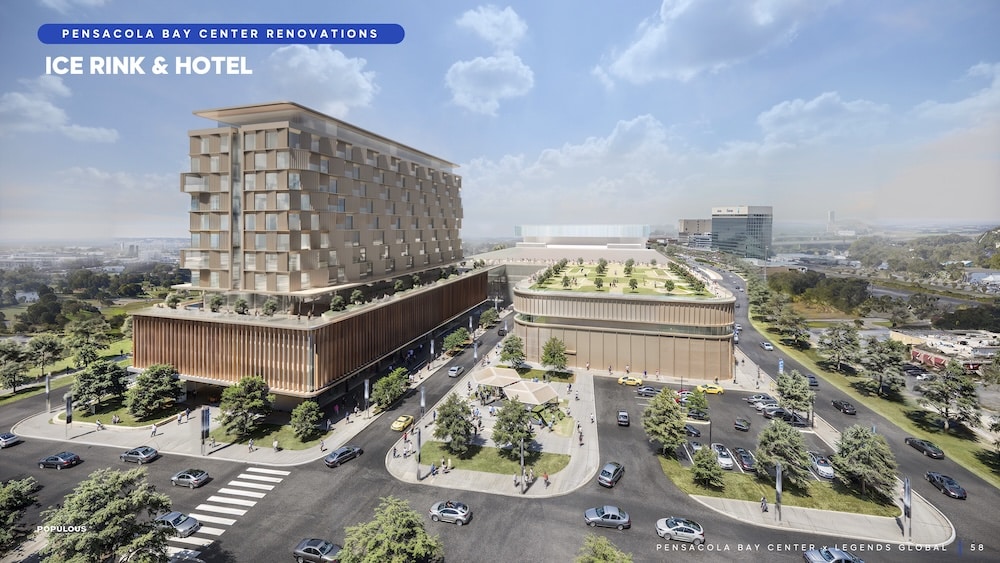
- Background: WT Partnership was engaged in November 2025 to evaluate development options for two parcels at 201 E. Gregory Street and 9th Avenue at Gregory, adjacent to the Pensacola Bay Center. Senior Vice President Jose Davila and Associate Vice President Sana Dadabhoy walked the board through four development scenarios, ranging from a straightforward publicly financed convention center to a full public-private partnership that layers in a hotel, mixed-use retail, a parking structure and a transit-oriented development component.
The Core Finding: Pensacola Is Leaving Money on the Table
The consultants found that Pensacola’s existing event facilities—the Bay Center and the Hilton Pensacola Beach—offer roughly 25% to 30% of the ballroom and exhibit capacity found at comparable Gulf Coast venues.
- The average non-Pensacola regional competitor provides more than 44,000 square feet of event space. Pensacola tops out around 33,000 square feet, and none of it is modern, flexible or hotel-adjacent.
Real consequences: Navy Federal Credit Union holds major employee events out of state because local venues can’t accommodate them. Military and veterans’ groups wanting to hold reunions of 600 or more people in the city they served get turned away. The Greater Pensacola Chamber of Commerce caps its own events because the space simply doesn’t exist.
- According to the report, a convention center offering approximately 50,000 square feet of divisible exhibit space—along with a ballroom and flexible meeting rooms—would close that gap and allow Pensacola to compete for regional conventions it currently can’t bid on.
Four Paths Forward
WT laid out four development scenarios of increasing complexity.
Scenario One is a traditional design-bid-build convention center, 100% publicly financed through bonds and tourism development taxes. It’s the fastest to execute but produces the least economic impact and leaves the City holding all the deferred maintenance risk—the same trap the Bay Center itself has fallen into.
Scenario Two pairs a publicly built convention center with a privately financed hotel, either on the Tech Park site or at the adjacent Grand Hotel property. The consultants called this the industry standard—convention centers without adjacent hotels consistently underperform.
Scenario Three adds a parking structure and mixed-use retail to that package, structured as a full public-private partnership.
Scenario Four goes furthest, incorporating transit connectivity—bus routes, trolley integration, the potential for a Southern Rail stop—making the district eligible for TIFIA federal financing through the U.S. Department of Transportation’s Build America Bureau. TIFIA loans carry interest rates around 4.75 percent, compared to eight or nine percent on the private market.
- The report also identified the historic L&N Passenger Depot, listed on the National Register of Historic Places, as a potential source of federal historic tax credits that could further reduce the public financing burden.
The Council Ask the Right Questions
Too Many Purposes? Council President Alison Patton pushed hard on whether a facility designed to do too many things ends up doing nothing well. The consultants acknowledged the tension but noted that modern convention centers are increasingly being built with modular, flexible layouts designed to serve both sports tournaments and regional conferences from a single footprint.
- The proposed conceptual design features a 54,000-square-foot exhibit hall, a 16,000-square-foot ballroom with capacity for 1,200 guests, and nine meeting rooms across two levels.
Right Spot? Councilman Charles Bare raised doubts about the site itself—the Interstate 110 ramp, limited walkability, the absence of nearby restaurants and retail—and questioned whether this was the right location at all.
- Mayor D.C. Reeves pushed back with two important pieces of context: FDOT has verbally agreed to remove the under-used off-ramp, and the Tech Park was originally created as the Bay Center’s Phase 2 expansion area, meaning the two sites were always meant to work together.
What Happens Next
The City is now headed into a joint meeting with Escambia County on April 16 to gauge whether there is shared appetite for moving this project toward an RFP.
- Dig Deeper: The consultants were clear that an RFI (Request for Information) should come first to gauge developer interest and refine the project structure, with an RFP (Request for Proposals) as the final deliverable once the vision is narrowed and the market has been tested. They cautioned against jumping straight to an RFP before completing stakeholder alignment, FDOT conversations and market sounding.
Citing that $75 million in tourism development tax funds—assuming the county commits them—isn’t enough to build two facilities, Mayor Reeves stated that any path that includes a new convention center requires layering private equity, federal financing and potentially CRA investment to close the gap.
The consultants said convention centers don’t make money on their own. Cities build them because everything around them does. The beach doesn’t charge admission. Neither does the national park. The Bay Center district’s return on investment will show up in bed tax and sales tax receipts.