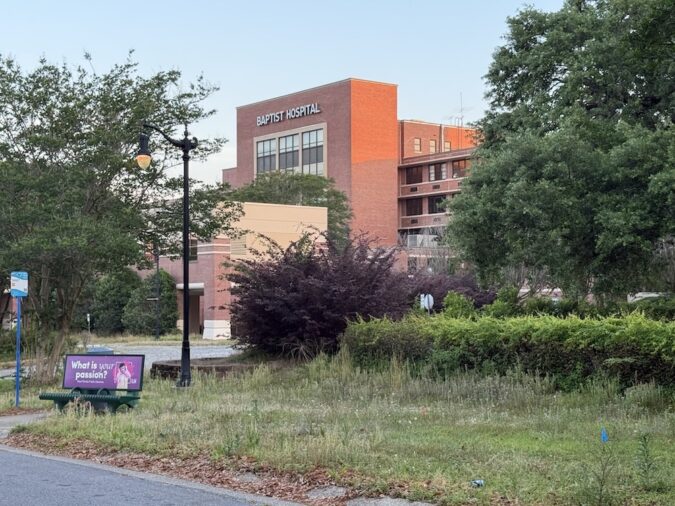
The Pensacola City Council, sitting as the Community Redevelopment Agency (CRA), discussed the selection of Bayou District Consulting, LLC, for the development advisory services on the redevelopment of the Baptist Hospital Legacy Campus. After more than 100 minutes of discussion, the council approved a 180-day contract on Monday.
“Promise Made Before”
Before the vote, District 7 Councilman Delarian Wiggins made an impassioned speech for community input, especially from the Black community that lives around the campus.
Wiggins drew a direct line from Hawkshaw to Tanyard to the Baptist Hospital Legacy Campus, warning the City Council that another generation of broken promises would perpetuate a cycle of displacement that has defined Pensacola’s Black community for decades.
The District 5 councilman made his points bluntly: this time, the community’s voice must be more than a box to check before developers move forward with predetermined plans.
- “This project is very important, not only for me, but for the people that came before me and the people that’s coming after me,” Wiggins said. “The Black community has been made promises for years.”
A Pattern of Displacement
Wiggins catalogued what he described as a systematic pattern of displacement across historically Black neighborhoods in Pensacola:
Hawkshaw: “You go down there now, there’s nothing there for the Black community. And it was the Black community that lived there for years.”
Tanyard: “You go right on the other side of this building to the Tanyard. It’s being gentrified right now. This was once a Black community. Now that they’re gone, they’re displaced.”
The councilman’s point was clear: each development promised community benefit, each resulted in displacement, and each eroded trust between the city and the residents it claims to serve.
“Once Brick and Mortar Starts, It Can’t Change”
Wiggins emphasized the urgency of getting community input right before development begins, not after. “Once brick and mortar starts being built on that site, it can’t change,” he said. “We have an opportunity right now to make sure that everybody is able to live in that district.”
- He praised the Bayou District’s development in New Orleans as “great” but questioned whether that model fits the Baptist Hospital site and its surrounding community. “As the district representative of that area, it is incumbent upon me to listen to my constituency and make sure that their voices are being heard.”
While city officials and developers often focus on the benefits of redevelopment, Wiggins raised the issue few want to discuss: “That community is afraid because they’re going to get displaced. Rising property taxes. Nobody is saying anything about that.”
- It’s the question that haunts every urban redevelopment project: how do you improve a neighborhood without pricing out the people who live there?
“Not Just Writing It Down on a Sheet of Paper”
Perhaps Wiggins’ most pointed critique was directed at the performative nature of past community engagement efforts.
- “I’m not just talking about listening to these, listening to the community, writing it down on a sheet of paper, and we do something totally different,” he said. “We did that with Hawkshaw, we did that with Blount and everything we did that Black people have heard that before. They’ve heard it. And so now they have created a distrust.”
That distrust, Wiggins argued, is earned. It’s the product of decades of broken promises and development decisions made without genuine regard for existing residents.
- “I am going to stand up for my district,” Wiggins declared. “I’m going to stand up for the people in my district, and I’m going to make sure that their voices are being heard and that we get this project right. They need a win in my community, and this is going to be a win for them.”
The Stakes
The Baptist Hospital Legacy Campus represents more than just another development project. It’s a test of whether Pensacola can break its cycle of displacement and broken promises to Black residents. It’s a test of whether “community input” means genuine partnership or rubber-stamping predetermined plans.
- Wiggins framed it as a defining moment: “If I don’t stand and get it right today, it’s going to be a repetitive problem for later on. Whether we start developing at Community Maritime Park or anywhere else, it is going to be a rising issue.”
He reluctantly agreed to give Bayou District Consulting, LLC 180 days to prove itself, but he admitted he was still “leery.”