
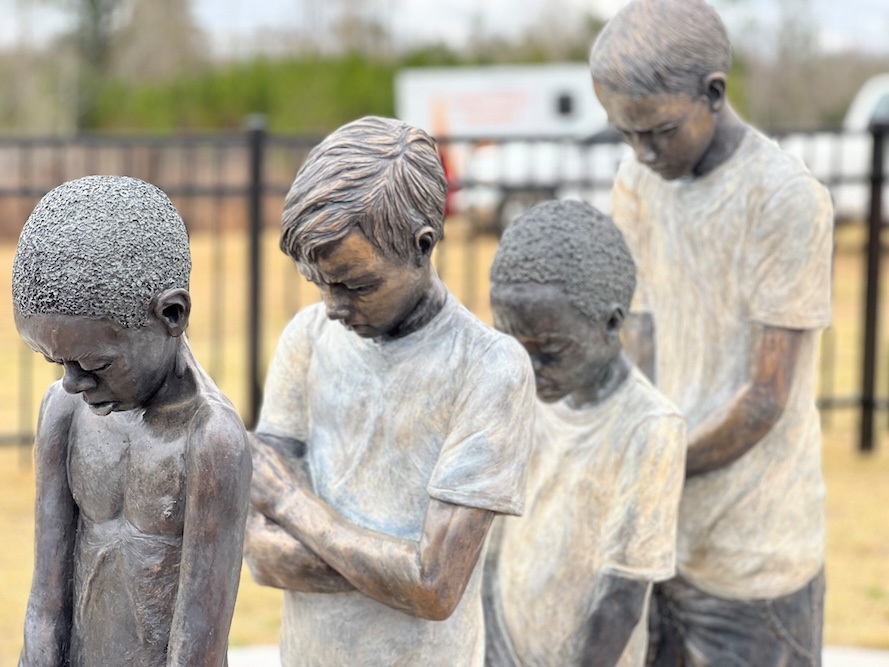

After decades of silence and suffering, 926 survivors of Florida’s notorious reform schools are finally receiving acknowledgment and compensation from the state. Last week, men who endured horrific abuse as children at the Arthur G. Dozier School for Boys in Marianna and the Okeechobee School began receiving checks of more than $21,000 each as part of a historic $20 million reparations program.
A Life-Changing Visit to the Grounds of Horror
For attorney Troy Rafferty, who championed their cause, the journey to justice began with a life-changing visit to the abandoned Dozier School grounds in 2022.
“Standing in front of that White House changed my life,” Rafferty recalled during a recent podcast interview. “When you stand there with the victims and you’re looking at it, the evil and the hatred and the violence are also palpable. You can feel it.”
The emotional weight of that visit was perhaps best captured by one survivor’s testimony.
“I remember we were in one of the victims that was with us, did not want to get out of the van,” Rafferty said. The man, Cecil, had served three tours in Vietnam. “He looked at me and he said, ‘I’ve done three tours in Vietnam, Troy on the front lines, crawling through the mud and the blood and the muck with bullets flying, not knowing if I was going to live or die from one moment to the next. And I can promise you one thing, I would rather be there right now than in front of this White House.'”
A Century of Forced Labor and Abuse
The Dozier School operated for over 100 years as what Rafferty describes as a “forced labor camp.” Children were sent there not just for serious crimes, but often for truancy or when single mothers couldn’t manage difficult sons. The facility was a moneymaker for the state, producing bricks and raising livestock using child labor.
“They would work together when they needed more labor,” Rafferty explained. “They would work together and say, we need more labor. We need more kids in this facility to make sure that we make the quotas.”
The scope of the tragedy extends beyond the living survivors. “There’s still almost 200 souls unaccounted for,” Rafferty noted. “There are 55 dead souls that have been recovered so far in unmarked graves.”
Fifteen Years of Doors Slammed Shut
The path to justice was neither quick nor easy. Survivors, known as the “White House Boys” after the building where much abuse occurred, spent 15 years being turned away from the state capitol.
“I want to commend all of those survivors,” Rafferty said. “Their courage and their persistence and their perseverance of going up and literally having the capitol slam the door in their face for over a decade for almost 15 years, telling them, no, no, no, no. And they kept coming back.”
The breakthrough came with crucial support from Pensacola Representative Michelle Salzman. “This wouldn’t have happened if it wasn’t for Pensacola’s Michelle Salzman,” Rafferty added.
The Work Continues
For Rafferty, this case represents something profound about the practice of law. “This whole project, this whole process, everything that got us to this moment literally changed my life,” he said. The settlement provides “the only form of justice we could get these folks.”
Yet the work continues. As Rafferty soberly noted, “While you and I are talking on this podcast, it is happening right now to a child somewhere in this country, and we have to stop it.”
The Florida settlement serves as a model for addressing institutional child abuse nationwide, proving that even decades later, justice can still be served.
Fifteen Years of Doors Slammed Shut
The path to justice was neither quick nor easy. Survivors, known as the “White House Boys” after the building where much abuse occurred, spent 15 years being turned away from the state capitol. “I want to commend all of those survivors,” Rafferty said. “Their courage and their persistence and their perseverance of going up and literally having the capitol slam the door in their face for over a decade for almost 15 years, telling them, no, no, no, no. And they kept coming back.”
The breakthrough came with crucial support from Pensacola Representative Michelle Salzman. “This wouldn’t have happened if it wasn’t for Pensacola’s Michelle Salzman,” Rafferty emphasized.
The Only Form of Justice Possible
For Rafferty, this case represents something profound about the practice of law. “This whole project, this whole process, everything that got us to this moment literally changed my life,” he said. The settlement provides “the only form of justice we could get these folks.”
Yet the work continues. As Rafferty soberly noted, “While you and I are talking on this podcast, it is happening right now to a child somewhere in this country and we have to stop it.” The Florida settlement serves as a model for addressing institutional child abuse nationwide, proving that even decades later, justice can still be served.
