
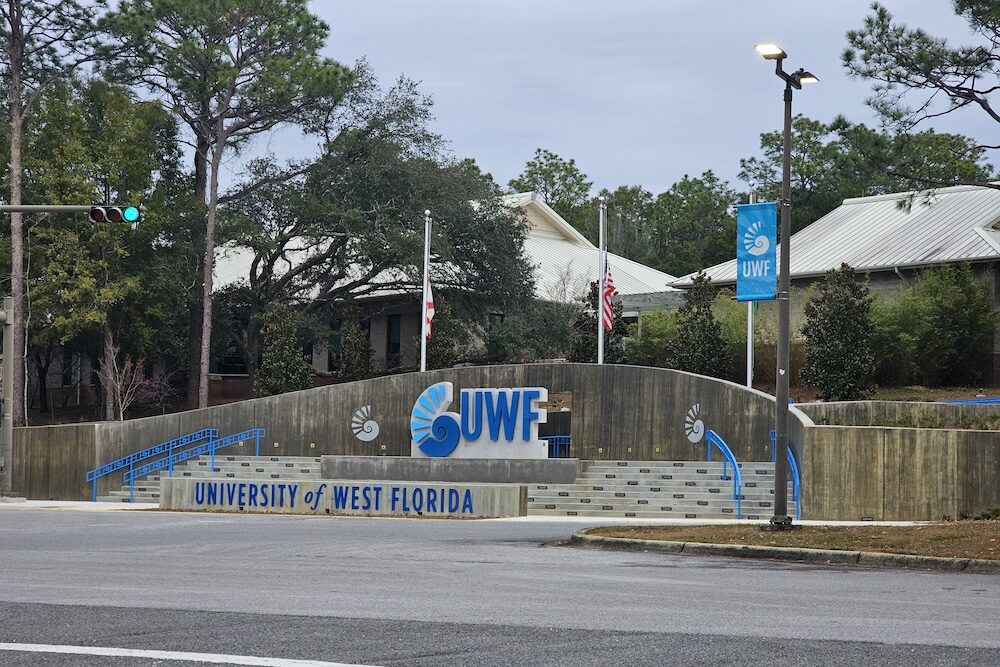
The changes to the Student Code of Conduct were initially on the agenda of the Student Affairs Committee, which Trustee Zack Smith chairs. However, the committee was canceled the day before the August 14 meeting. Read 2025.08.14—STU-Agenda (1)

Why?
From the agenda: “To address ambiguities in UWF REG 3.010, Student Code of Conduct, related to free speech, UWF requested guidance from the Foundation for Individual Rights and Expression (FIRE) to
obtain recommended language that ensures the Code aligns with and upholds students’ constitutional rights to free speech.”
Background: The Foundation for Individual Rights and Expression (FIRE) is a nonprofit organization formed in 1999 as the Foundation for Individual Rights in Education, which originally focused on defending freedom of expression and due process on college campuses.
- Dig Deeper: UWF Trustee Adam Kissel joined FIRE in 2007 as the Director of the Individual Rights Defense Program. Kissel was rejected by the Florida Senate committee, chaired by Sen. Don Gaetz, and subsequently reappointed by Gov. DeSantis. Kissel will have to be confirmed next year to remain on the Board of Trustees.
Is Harassment Free Speech?
The changes regarding the definition of sexual harassment before the committee didn’t go as far as the amendment currently being proposed:
Student Affairs Committee: “Sexual Harassment – unwelcome conduct based on sex, gender, sexual orientation, or gender identity, that is sufficiently severe or pervasive so that it unreasonably alters the terms and conditions of the Complainant’s employment or educational environment.”
- “Unreasonably” is what was added. An Inweekly reader wrote: “There is no such thing as ‘reasonable’ severity when it comes to sexual harassment, and that this was supposedly done, per document, in the name of ‘addressing ambiguities’ as well as the ‘free-speech’ schtick; how exactly does adding ‘unreasonably’ do anything but make it less clear?”
Current UWF Administration Proposal (8/20): Sexual Harassment – unwelcome conduct based on sex, gender, sexual orientation, or gender identity on the basis of sex, as defined and prohibited by applicable federal and state law, that is sufficiently so severe, or pervasive, and objectively offensive so that it unreasonably alters the terms and conditions of denies the Complainant’s employment or educational environment equal access to the University’s education program or activity.
- Reader comment: “There is no such thing as ‘objectively offensive,’ either. The newer 8/20 updates to the Code made it worse and more vague. They also don’t protect free speech. Nothing here does anything to protect defendants and only places arbitrary, poorly-defined restraints on what Complainants can bring up. What both these definitions have in common is that the changes modify the environmental standards for what students can call sexual harassment.”
“If this is a matter of free speech, ‘sufficiently severe or pervasive’ (which was already there) would have sufficed. That is the part of the definition that maintains requirements to consider individuals’ conduct as sexual harassment. The addition, ‘unreasonabl[e],’ regards how the “environment” is ‘alter[ed]’; it is not in reference to individual conduct at all. This places an unclear limit on what the Complainant can address, in a way that does not involve individual others’ speech, so it does not serve to protect that either.”
Deadline – Sept. 3
People must submit their concerns to the Office of General Counsel by September 3. The University may then solicit additional written comments, schedule a public hearing, withdraw or modify the proposal, in whole or in part. Or the University may proceed with adopting the amendment.
- Concerns can be sent to: Office of the General Counsel, 11000 University Parkway, Building 10, Pensacola, Florida 32514, or gcfrontdesk@uwf.edu


If you like our reporting, consider buying us a cup of coffee – here. Your donation will help broaden our reporting. Thank you.