
Florida Politics
DeSantis Sends Legislature Race-Neutral Congressional Map, Urges Adoption at Special Session
The Governor’s general counsel argues Florida’s Fair Districts Amendments are unconstitutional—and submits a proposed 28-district map drawn without any consideration of race.
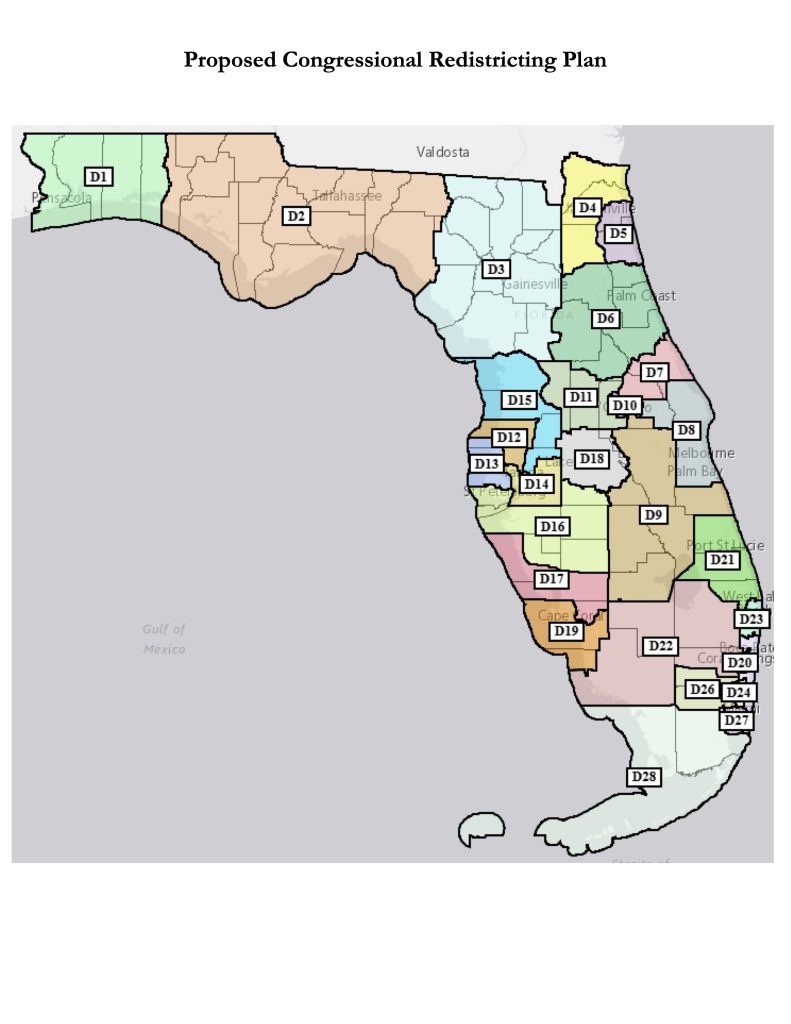
Florida’s congressional district lines could be redrawn from Pensacola to the Keys within days. Gov. Ron DeSantis’s office delivered a proposed new congressional map to legislative leaders Monday, urging the Florida Legislature to adopt it during Special Session D scheduled to open April 28. The House Select Committee on Redistricting takes up the proposal Tuesday, with a full House floor vote expected Wednesday.
“Race was neither a predominant factor nor one of many factors” in drawing the proposed map, General Counsel David Axelman wrote—a deliberate departure from requirements the Governor’s office says are unconstitutional.
What the Transmittal Letter Says
The three-page letter, signed by Executive Office of the Governor (EOG) General Counsel David Axelman and addressed to Senate Ethics & Elections Committee Chair Don Gaetz and House Select Committee on Redistricting Chair Mike Redondo, lays out three interlocking arguments for why a new map is needed and why the proposed one is legally defensible. Read EOG_Transmittal Letter
Florida was undercounted—and shortchanged a seat. Axelman cites a post-census survey by the U.S. Census Bureau finding Florida was undercounted by more than 760,000 people in the 2020 census, which the letter argues cost the state at least one additional congressional seat. Florida currently holds 28 seats; the proposed map maintains that number.
The Fair Districts Amendments require unconstitutional race-based line-drawing. The letter argues that Florida’s 2010 Fair Districts Amendments (FDA)—passed by voters to prevent partisan and racial gerrymandering—have paradoxically forced the Legislature to use race as a factor in drawing districts.
Axelman contends those race-based provisions cannot survive strict scrutiny under the Fourteenth Amendment and cites the U.S. Supreme Court’s pending decision in Louisiana v. Callais as likely to affirm that position.
- That case was argued three times—March 2025, June 2025, and October 2025—a procedural posture the letter compares to landmark re-argued cases including Brown v. Board of Education and Citizens United.
The existing map has racial fingerprints that the Governor wants erased. Axelman singles out Congressional District 20 in southeast Florida, describing its shape—featuring two “claws” tracking the Black population—as a telltale sign of racial predominance drawn to create a majority-minority district under Section 2 of the Voting Rights Act.
- Other southeastern districts, the letter says, were drawn with Hispanic voting-age population targets in mind to satisfy FDA requirements. The proposed map redraws those districts on race-neutral terms.
What the Data Packet Shows
The accompanying data packet, time-stamped Monday morning, contains population, compactness, boundary, and county-split statistics for all 28 proposed districts. See Data Packet.
Population equality is near-perfect. Every district is drawn to a target population of 769,221 residents—a figure representing one twenty-eighth of Florida’s 2020 census population. Only District 8 (Brevard/Orange) deviates, by a single person.
District 1 keeps the Pensacola area whole. Under the proposed map, District 1 encompasses Escambia, Okaloosa, Santa Rosa, and part of Walton counties—keeping the Pensacola metro, Fort Walton Beach, Destin, and Niceville in a single northwest Florida district. Pensacola’s city population of 54,312 and Escambia County’s 321,905 residents anchor the district.
Compactness scores vary widely. The data packet’s compactness report shows most districts scoring reasonably well on standard measures, but several southeastern districts score notably lower—District 25 posts a Polsby-Popper score of just 0.16, and District 28 (Miami-Dade/Monroe) scores 0.24, reflecting the geographic challenge of the Florida Keys.
Population growth shaped the redesign. The transmittal letter notes Florida added nearly 2 million residents between the 2020 census and July 2025—an 8.9% increase—concentrated in the Tampa and Orlando suburbs and the Palm Beach County corridor. While still anchored to 2020 census data, the proposed map attempts to account for those shifts through district reconfiguration.
What Happens Next
- Tuesday: House Select Committee on Redistricting takes up the Governor’s proposal.
- Wednesday: Full House floor consideration anticipated.
- Senate: The letter is also addressed to Senate Ethics & Elections Committee Chair Don Gaetz, signaling parallel consideration in the upper chamber.
- Legal exposure: Any map adopted is likely to face immediate court challenges—both from voting rights advocates arguing the race-neutral approach dilutes minority representation, and potentially from those who argue the FDA still applies unless and until a court formally strikes it down.
Rick’s Blog will continue covering Special Session D and the redistricting debate. Follow updates at ricksblog.biz.