
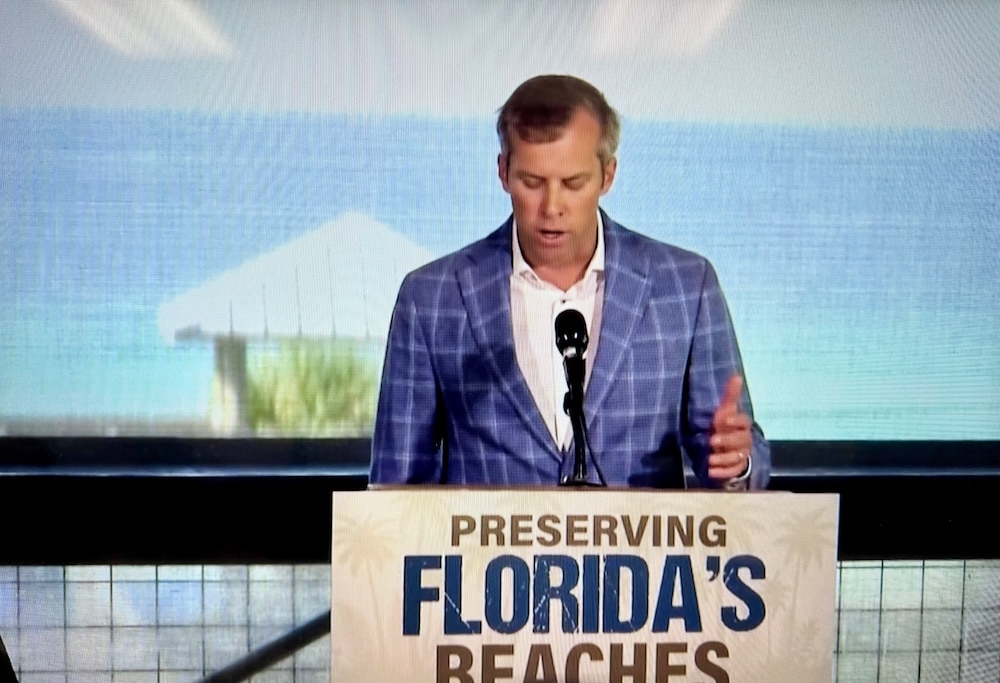
Gov. Ron DeSantis signed Senate Bill 1622 at Shunk Gallery Oyster Bar on Tuesday, delivering a long-awaited victory for beach access advocates who have fought for years to restore traditional public use of Florida’s shorelines.
- Background: The legislation overturns a controversial 2018 law that severely restricted local governments’ ability to recognize customary public use of beaches, particularly impacting Walton County residents who found themselves locked out of beaches their families had enjoyed for generations.
- Why it matters: At his town hall meeting on April 28, Escambia County Commissioner Steve Stroberger addressed beach access easements behind condominiums. He said that this bill might offer a remedy to the stand-off.
Restoring Local Control
“Senate Bill 1622 will repeal the burdensome state mandates and return decision-making power to local governments when it comes to recognizing recreational customary use of beaches,” DeSantis said during the signing ceremony.
- Under the previous law, local governments were prohibited from affirming public recreational use of dry sand areas on private beaches without navigating a complex and expensive judicial process on a parcel-by-parcel basis.
- The new legislation allows counties and cities to adopt ordinances recognizing recreational customary use like walking, fishing, and swimming without costly judicial declarations.
State Senator Jay Trumbull, who sponsored the legislation, described the profound impact of the 2018 restrictions.
“Overnight, people who had walked the same stretch of beach for generations were being told that they were trespassing,” Trumbull said. “That’s not the Walton County I know, and it’s not the Florida I believe in.”
Economic Stakes
The beach access restrictions threatened the economic foundation of coastal communities. With Walton County’s economy relying on tourism for approximately 80% of its revenue, the limitations created uncertainty for millions of annual visitors expecting to enjoy world-renowned beaches.
State Representative Shane Abbott emphasized how the legislation benefits residents, tourists, and thousands of employees whose jobs depend on tourism. “As these beaches go, so does the county’s livelihood,” Abbott noted.
Streamlined Beach Restoration
Beyond restoring local control, SB 1622 includes significant provisions to accelerate beach restoration efforts. The legislation allows the Florida Department of Environmental Protection to advance restoration projects in areas already declared critically eroded as of August 2024, without requiring costly assessments from private Gulf front landowners.
For Gulf Coast counties with populations under 275,000 and at least three municipalities, the bill allows the state to use the mean high-water line as the erosion control line, eliminating duplicative procedures that have delayed critical restoration projects.
DEP Secretary Alexis Lambert explained the benefits: “The bill clarifies how local governments can set beach use rules without unnecessary red tape and simplifies how we can set erosion control lines, allowing vital beach nourishment projects to move forward more efficiently.”
Balancing Interests
Throughout the ceremony, speakers emphasized that the legislation carefully balances public beach access with private property rights. The bill includes an explicit declaration that the state is not expanding its ownership claims beyond what is already constitutionally recognized.
John Dillard, founder of Save Our Beaches, extended an olive branch to beachfront property owners: “This law protects your property. It does not redraw property lines. It was never our intent to take property from those who own it.”
Community Victory
The signing represented the culmination of years of grassroots advocacy, including thousands of calls to legislators, multiple trips to Tallahassee for committee hearings, and peaceful protests. The bill passed with overwhelming support, unanimously in the House and with only two opposing votes in the Senate.
With SB 1622 now law, Walton County has $60 million allocated for beach renourishment projects, with matching federal funds available, creating opportunities to expand public beach access through restoration efforts.