UWF / TRANSPARENCY
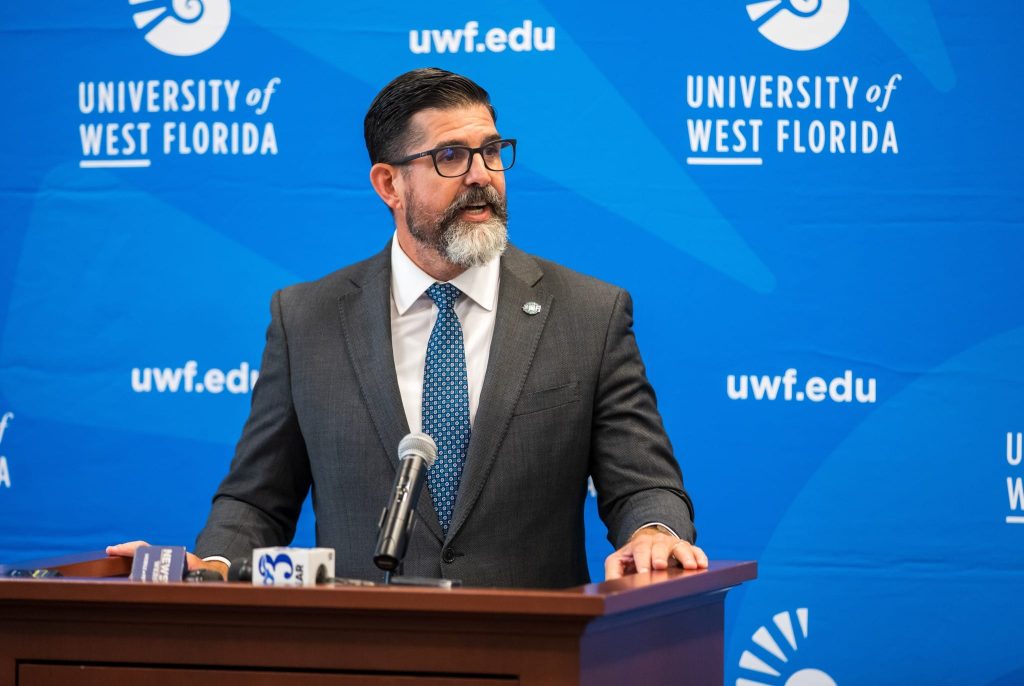
Diaz Era Brings Less Transparency to UWF Board of Trustees
Board meeting agendas have been stripped of supporting documents—leaving faculty, students, alumni, and the public in the dark before votes are cast.
Something important has quietly disappeared from the University of West Florida Board of Trustees meetings since Manny Diaz became president: the public’s ability to know what the board is actually deciding before it decides it.
- The agenda for the Thursday, April 23 Board of Trustees meeting is only 20 pages. That may sound like a full agenda—until you compare it to the September 18, 2025, agenda, which ran 226 pages. The September agenda included the reports, contracts, resolutions, and supporting documents that the board was being asked to consider. Under the previous practice, anyone—faculty, staff, students, alumni, taxpayers—could review those materials in advance and show up informed, or offer input before a vote.
That practice appears to be over.
Why this matters: The faculty, staff, students, alumni, and general public should know the matters coming before the UWF Board before the meeting, so they can offer meaningful input. Stripping the agenda of supporting documents eliminates that opportunity.
The Division I Vote—With No Paper Trail
The transparency problem didn’t start with April’s agenda. On April 2, the Board of Trustees held a special meeting and voted to move UWF athletics to NCAA Division I—a decision with sweeping financial, academic, and institutional consequences. The public has no access to the documents that President Diaz and Athletic Director Dave Scott presented to the board in support of that decision.
The minutes offer only a bare-bones account:
“President Diaz and Athletic Director Dave Scott presented a request for the board to approve the University of West Florida Athletics to join the Atlantic Sun Conference and the United Athletic Conference, and to begin the transition to NCAA Division I starting in fall 2026.”
“Trustee Riddell voiced concerns from the faculty, including hiring of staff to monitor the academic progress of athletes that fit the new schedules as well as enhanced communication with faculty of NCAA requirements, makeup exams, proctoring requirements and student travel.”
“Motion passed unanimously.”
The faculty raised real concerns. Diaz and Scott apparently addressed them. And then the board voted. But what analysis supported the decision? What cost projections were presented? What revenue assumptions underpinned the move? The public doesn’t know because the documents were never made available.
What’s Missing from the April 23 Agenda
The stripped-down April agenda is not just thin on volume—it is thin on substance that directly affects UWF employees, students, and the broader community. Here is what board members will be voting on, but that the public has not been given the opportunity to review in advance:
- Resolutions 2026.1 and 2026.2 recognizing distinguished service by Trustee Trista Bennett and Interim General Counsel Julie Sheppard.
- Victoria (Tori) Bennett’s appointment as Vice President of the Division of Advancement—including her resume, tentative offer letter, and the job description for the position.
- The 2026–2029 UFF-UWF Collective Bargaining Agreement governing faculty employment terms.
- Revisions to UWF Regulation 2.028 on University Holidays.
- The Police Benevolent Association Sergeant (UWF-PBA Sergeant Union) Collective Bargaining Agreement.
- Resolution 2026.3 authorizing specified officers and employees to sign checks effective April 27, 2026.
- A proposed $2-per-credit-hour increase in the student athletic fee to support the Division I transition—a direct financial impact on every enrolled student.
- The name change of The Wright Family Institute for Global Population Health to The Wright Family Research Institute for Health and Technology, along with an amended gift agreement.
- Amendment of University Policy BOT-12.02, the Board of Trustees Public Comment Policy.
- The UWF 2026 Accountability Plan.
- Revisions to UWF Regulation 5.001 on Parking and Registration.
- President Diaz’s 2025–2026 Self-Evaluation.
The student athletic fee increase alone warrants full public disclosure before any vote. Students are being asked to shoulder the financial cost of a Division I transition they had no meaningful voice in approving—and now they won’t even have access to the underlying documentation before the board acts.
Why This Is a Pattern, Not an Oversight
It would be easy to dismiss a thin agenda as an administrative oversight. But when you connect the April 2 special meeting—held with no supporting documents made public—to the stripped-down April 23 agenda, a pattern emerges. Under President Manny Diaz, the UWF Board of Trustees is conducting significant university business with less public information, not more.
- UWF is a public university. Its board is a public body. The taxpayers of Florida—and the students, faculty, and staff who make the university run—have a legitimate interest in knowing what is being decided in their name, and why, before the gavel falls.
That interest is not being served.
.

If you like our reporting, consider buying us a cup of coffee – here. Your donation will help broaden our reporting. Thank you.