
Hurricane Recovery
Escambia Moves From Storm Response to Long-Term Recovery
Public Safety Director Eric Gilmore says the county is waiting on a federal major disaster declaration from the White House, and that internet service now belongs on the list of priority utilities.
Escambia County has finished the emergency phase of the hurricane and is now in long-term recovery, Public Safety Director Eric Gilmore told me on Rick’s Blog Live.
The life-safety response is done. So is the short-term work of restoring water and power. What remains is debris cleanup, insurance claims and a wait for Washington.
Where things stand
- The county is still waiting on a major disaster declaration from the president, including Individual Assistance. Gilmore hopes to hear something this week.
- Debris trucks are working neighborhoods across the county.
- Some residents still can’t get power because the weatherhead was pulled down and a licensed electrician must make the repair.
City Perspective
Pensacola Mayor D.C. Reeves echoed Gilmore’s sentiments about the federal declaration at his press conference on Wednesday morning.
- “What we’re waiting on is that declaration,” the mayor said. “It’s obviously just a matter of time. And so somebody said, “Well, how long should it take?” I’m like, “Well, yesterday would be great.”
Reeves said he has had no indication from state or federal officials that President Trump won’t sign the declaration. “It’s really just a waiting game for us right now and yesterday would be the best and while I’m finishing the sentence right now would be the second best time. So hopefully it moves quickly and lets us get not only the city operation, but get individuals the assistance that they need as well.”
Why Individual Assistance Matters
Gilmore said federal help is meant to bridge the gap when insurance doesn’t cover a family’s full losses. It can also open the door to SBA loans and other government assistance. The governor’s request for the emergency declaration, he said, was a big first step.
A Week of Preparation.
Gilmore said the work began Monday, Oct. 5, days before the storm arrived, when his public safety team planned for a Category 3 scenario.
- Monday, Oct. 5: Public safety leaders, including the fire and EMS chiefs, met with the county meteorologist and planned staffing and needs.
- Tuesday, Oct. 6: Law enforcement, hospitals, ECUA and other operational partners joined a call with the National Weather Service in Mobile.
- Wednesday, Oct. 7: Operational and non-operational partners, the Red Cross and long-term recovery groups joined a state webinar.
- Thursday, Oct. 8: Trigger points were locked in, the county dropped from Level 3 to Level 2 activation, and a final weather briefing followed.
- Friday, Oct. 9: The Emergency Operations Center went to Level 1, a 24-hour operation with two 12-hour shifts, 7 a.m. to 7 p.m. and 7 p.m. to 7 a.m.
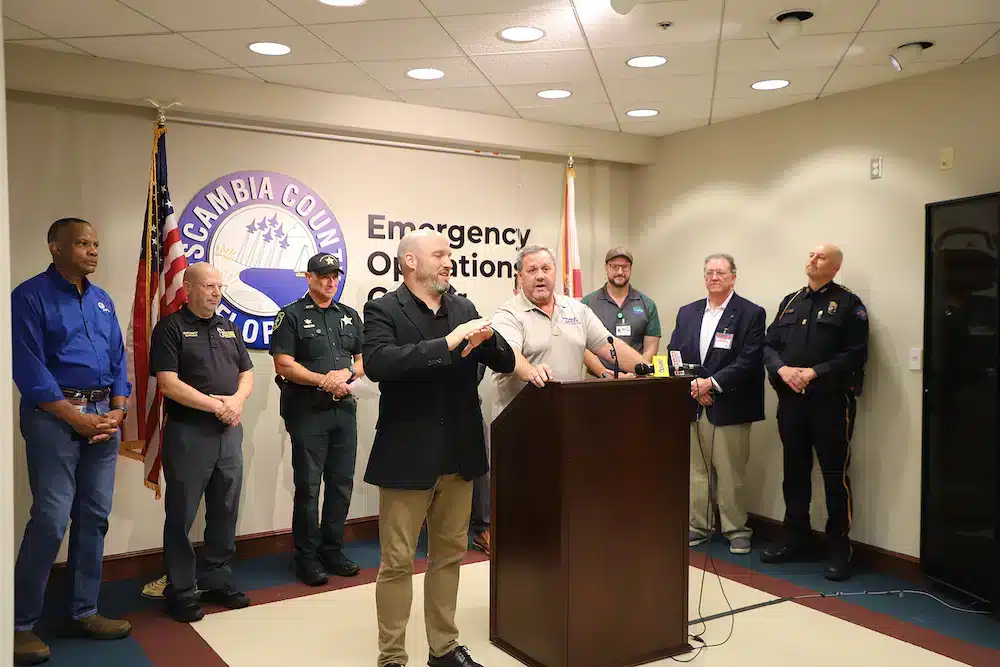
Emergency Operation Center (EOC)
Everyone in one room. Hospitals, schools, utilities and businesses all have desks in the EOC. Agencies also feed updates into WebEOC software, which puts what’s up and what’s down on a shared dashboard in real time.
- Gilmore said the value showed up quickly after the storm. While crews were running rescues and working through a backlog of 911 calls, word came that all three hospitals had lost water.
With all three hospital representatives and ECUA in the room, “we can just walk across the room versus having to get somebody on the phone.”
The Lesson: Internet is a Vital Utility
The county had treated water and power as the priority utilities. Gilmore said that is changing.
Internet service now powers life-saving home devices, TV, streaming and emergency notifications. Gilmore said emergency manager Travis Tompkins is bringing internet providers into the EOC so the county can see in real time how quickly they restore service and what is delaying them.
