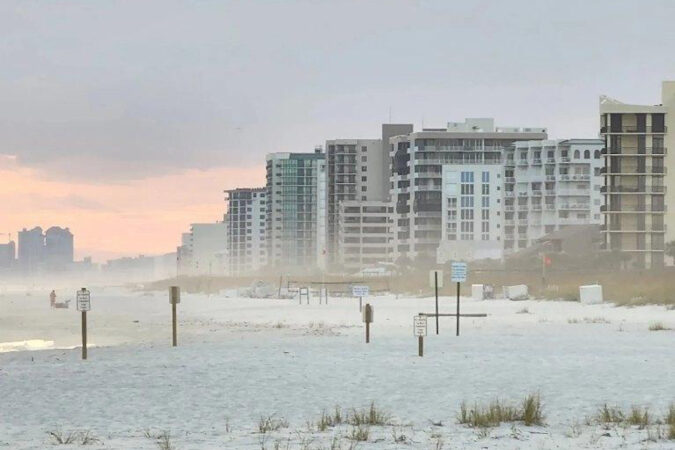
Escambia County commissioners navigate treacherous legal and political waters as they consider a customary use ordinance for Perdido Key beaches, attempting to balance private property rights against public beach access in what has become the most polarizing issue first-term commissioners, Steve Stroberger, Mike Kohler and Ashlee Hofberger, have faced on the board.
The February 5 Committee of the Whole meeting drew a packed house as the commissioners discussed opening privately-owned “dry sand” areas to public use.
- “In my little over three years on the board, I don’t think we’ve had anything this polarizing as of today,” District 2 Commissioner Mike Kohler said. “On any given day, we get 20 emails on both sides, for and against.”
What’s at Stake
At the heart of the debate is the legal doctrine of customary use, which holds that the public has an “ancient,” “reasonable,” and “without interruption” a right to use privately owned dry sand portions of beaches for recreation.
- Why this matters: Currently, Perdido Key beaches allow public access to the “wet sand” area south of the mean high-water line. Private property owners, however, can restrict access to the dry sand portions of their beachfront property. A customary use ordinance could change that, legally opening these private areas to walking, fishing, swimming and other recreational activities.
History Lesson: The issue emerged following the 2025 repeal of a 2018 state law that had previously limited public access to private dry sand areas. Gov. Ron DeSantis signed Senate Bill 1622 to restore “local control,” allowing counties to recognize recreational customary use without the costly, parcel-by-parcel litigation that has plagued other Florida beach communities.
Deep Divisions on Display
The divide among commissioners mirrors the split in the community, with District 1 Commissioner Steve Stroberger emerging as the strongest voice for property rights.
- “This is both an easy and difficult issue, but I think everyone feels the same way,” Stroberger said. “It’s easy for me because we’re the legislative body for the county. And our job is simple. It’s to protect life, liberty, and property.”
Stroberger argued against what he sees as government overreach: “I don’t believe that the public’s perceived right to trample on private property trumps property rights. I mean, where do we draw the line if we don’t draw the line right now?”
He presented a stack of emails from constituents opposing customary use and described conversations at recent town halls where property rights resonated strongly with residents, even those living far from the beach. “They believe like I do, that property rights is pretty foundational right, and that I should protect that. That’s my duty to do that.”
Contrasting Perspective—From District 3 Commissioner Lumon May:
“There are a couple of things that God gives us. He gives us the land, the seed, the fish, the water. And unfortunately, many people are limited access because of affordability of what they can’t afford,” May said. “I have a fresh memory of my parents being able to go to Johnson Beach for free and walk around in those sands and maybe look up at condos that they could never afford or their children couldn’t afford.”
May made clear where he would stand if forced to choose: “If I ever fail in my vote for anything, I’m going to fail on the side of supporting public access, whether it’s any beach.”
Walton County’s Shadow
The specter of Walton County’s customary use battle hovered over the debate.
“That was like an $8 million lawsuit,” Stroberger noted, warning his colleagues about the financial risks ahead.
County Attorney Alison Rogers confirmed that property owners have already warned the county about potential litigation. “I do think that we have been warned that there will be lawsuits.”
- The attorney outlined several legal hurdles, including a state requirement for business impact studies before passing most ordinances. She suggested the county might use the University of West Florida Haas Center for such a study if commissioners decide to proceed.
Stroberger described his efforts to avoid customary use battles altogether by pursuing alternative solutions: securing more public beach access through property purchases and negotiating partnerships with state parks on Perdido Key Drive to provide Escambia County residents with beach access.
“I’m trying to avoid all that,” Stromberger said. “I’m still going to pursue more property, beach access. That’s what I want to do, and I think that’s the right thing to do. I think this whole subject of customary use is trouble. It’s asking for trouble, and it will not be easy to prove.”
Seeking Compromise
Despite the sharp divisions, other commissioners asked about finding middle ground.
- Kohler suggested the board could pursue a targeted approach rather than a blanket ordinance: “When you look at the definition on customary use, I do think without interruption and free from dispute is a problem. I don’t know where it’s going to land in court. I don’t know that, right? But I’d prefer not to get into a lawsuit. I’d rather try to work to get more customary use with you folks and the condo owners.”
District 5 Commissioner Steven Barry questioned whether the county could identify specific areas with the strongest case for customary use, then build a record through public testimony and historical documentation.
- Rogers emphasized that customary use doesn’t have to be an all-or-nothing proposition: “It’s our interpretation that customary use is not an all-or-nothing proposition. It can be smaller pieces. It’s not all of the beach or none.”
Waiting for Court Guidance
The board’s discussion revealed that timing may not be entirely in the commissioners’ control. County staff referenced an upcoming 11th Circuit Court of Appeals case involving Redington Beach’s customary use ordinance, with oral arguments scheduled for Feb. 24.
County staff expressed hope that the decision “will lend a lot of explanation to these elements” of customary use law that remain undefined.
- However, Rogers cautioned that oral arguments don’t guarantee a quick decision: “Just because the oral arguments are on the 24th does not mean we’re going to get a written opinion on the 24th. We can’t control when that would happen. They could sit on it for a week or a year.”
What Happens Next
The board made no decisions at the February 5 meeting, instead directing staff to continue researching the issue.
Public comment is scheduled for the March 19 regular board meeting, where residents on both sides will have the opportunity to speak and potentially submit historical documents, photographs and other evidence to support their positions.
Stroberger made clear he’s open to continuing the conversation, but with ground rules: “Everyone’s got to be a lot more respectful, no more damn fingers and all that stuff. That really ticks me off. If you want to help and you want to come to a compromise, you need to find out what a compromise is going to be for you, too.”
- As the March 19 public hearing approaches, both sides are preparing to make their case—knowing that whatever the board decides, someone will likely see them in court.
 Support Our Journalism

If you like our reporting, consider buying us a cup of coffee – here. Your donation will help broaden our reporting. Thank you.




I am shocked that any one of the Escambia commissioners, and especially Mr. Stroberger who represents so many of the county beach going public, are even considering refusing customary use i.e. public access. The condo associations have refused to pay for seasonal life guards on those beaches. If it is considered customary use/public access the state/ county can put life guards there. If I recall correctly, just two years ago two young boys drowned in front of those condos. They are not the only drownings that have happened there.
These are hotel condos for the most part with few full time residents. That means the condos are being rented to out of town tourists most of whom do not understand the dangers of the rip tides and currents in the Gulf and yet are swimming without the protection of lifeguards. The commission should be supporting customary use/ public access if for no other reason than the very purpose of the right to put lifeguards there to protect the lives of all swimming in front of those condos. One life lost because the beach is “private” is too many! Further, in his statements regarding respect for “property rights” Mr. Stroberger continues to attempt to ignore the 75 feet of deeded beach easement that runs with the land in front of those condos. He never mentions it in his comments. That 75 foot easement was ruled valid in 2023 by a past court order. The Sea and Surf condos brought a lawsuit challenging it and lost! Mr.Strobergers “respect for property rights” should be applied equally. The 75 foot easement is no less a “property right” simply because the owners of the property happen to be the public. By voting for public access both the public and the condos associations win. The condo owners and renters would get life guards at no expense to them and public families will be better protected. I can see the red and blue lights of the emergency vehicles on those beaches from my house. I would hate to look over there in the future and see another search and rescue effort taking place for a missing swimmer that might not have happened if our county commission had voted for the public access and public safety.
The beach is for everyone! Sorry if someone sold you the beach. I have a bridge I’d like to sell you!
Mr. Terrezza,
The lawsuit against the County per the federal easement was dropped because the condo owners were all fighting amongst themselves, including threats of suing each other, because they all had to be on board for the suit, and many wanted no part of it. Not even the Gulf front owners are united against customary use.
Just as a recent two and a half year president of the Perdido Key Association quit over the subject of customary use, refusing to take part in the organization’s crusade after a 6-2 vote against it.
Think about that. 335,000 citizens in Escambia County. 2500 Gulf-front owners. Many or even most of them live out of town. Not all of them are against it, and the closest thing they have for general uniformity is the Perdido Key Association, which is represented by a board of 8 people.
I’m not sure whether you are aware that the federal easement, which is about a mile and a quarter strip allowing people on the 75 feet, has already been open to the public for a while now, and was open during the duration of the pointless suit against it. (Next up, we need more parking for that, and expanded parking at beach access 3.) So you are posing questions as if you believe they still need to be worked out, and perhaps in court. Nothing needs to be worked out. It is in all in place and has been.
Why do you pretend if people approach the dune from the south it necessitates them walking on it? In imitation of the condo owners who trample it from the north, perhaps?
Why do you pretend that anyone would think that, when a hurricane again wipes out the dunes (as has happened before), that means the public can go on the restored dunes? Of course they can’t. Just another disingenuous red herring.
Why do you pretend this would be an extension of public property? The property lines won’t change. Of course the property owners will sue as if it is a taking, and who knows what they will convince the court of. There is statute, BTW, that clearly limits what types of recourse they can seek.
Why do you think you should be the determiner of what activities are acceptable for the dry sand? The level of hubris on the part of people who think they lord it over the beach never ceases to astonish.
No, the public is not interested in crumbs, but wants to stop being hassled, period, about exercising customary use that has always existed on Perdido, now that the temporary and fleeting legislation that has emboldened the owners out there for a brief 6 or 7 years has been wiped out. The American public are not peasants in a patriarchal feudal system. Not yet, anyway. We aren’t rabble looking for overlords to define for us what we should be satisfied with. Thanks for the thought, though.
Ms. Pino,
The dispute over the existence of a 75 foot easement for public use generally has not been “dealt with sufficiently.” The lawsuit was dismissed by the condo owners before the court ruled. There are lots of questions remaining. If the deed language is enforceable how do we measure the 75 feet? Is it from the mean high water line? Do we look at where that was at the time of the deed or now?
What is your reasoning for arguing that customary use should go all the way to the dune line? If people walk on the dunes so they flatten, then that area becomes public? If a hurricane wipes out the dunes then it’s all public? If the dunes are restored and they extend down towards the water then that area all becomes private?
I am not opposed to public use of the beach. Customary use of the wet sand, and some dry sand for activities like fishing, surfing, and sunbathing seems reasonable but extending public property all the way to the dunes is a unconstitutional taking of private property without compensation.
Thank you, Rick, for capturing Commissioner Stroberger’s persistent and stubborn bent towards absurd disinformation tactics, this round with his flagrant and intentional misquoting of the Declaration of Independence. As I expressed during the meeting, it is appalling to watch a retired military officer cum commissioner who has at least twice sworn to uphold the constitution try to twist a document sacred to the founding of our democracy into service of the Sky Box Set he so desperately wants to become part of It’s of course “life, liberty, and THE PURSUIT OF HAPPINESS”–you know, like taking your kids for a day on the beach without getting screamed at by a bunch of NIMBY-drunk hotheads (on full display at the podium Thursday night) before getting directed to the wet sand by their off-duty deputies.
In my opinion, what really ought to lead not just coverage of this issue but the general understanding by public and elected officials alike is that these condo owners were only able to try to push the public off the dry sand for the LAST EIGHT YEARS, and down on the Key it started in earnest only six or seven years ago, once Doug Underhill got teamed up hot and heavy with the PKA on it. It was such an unmitigated disaster all over the State of Florida, Perdido included, that the legislature repealed *their* previous action, which all but guaranteed Gulf front owners would be emboldened to try to block public access, but left the mess they created in their wake for local counties and municipalities to clean up.
In the material rather than the political world, polarization does *not* require neutrality. But when a well-meaning commissioner such as Mike Kohler says that he has “never seen an issue so polarizing,” people hear a roughly 50-50 split between yeas and nays, and this is aided and even tipped by Stroberger’s gimmick of holding up a stack of paper “representing” one side, and one side only. (I asked, “Where’s the other stack”?)
In reality, yes, this topic is polarizing between (a) the positive charges, i.e. the public who recognizes their right to continue to be on that Beach, as they have been, time out of mind, and (b) the negative charges, i.e. the condo owners trying to block their access, but the overall charge is still *overwhelming* positive. The only reason the scant number of negative charges are understood by some to rival the positive ones is because elected officials are willing to gift what should be de minimus negative obstruction with far more importance to the total positive potential than it should actually have.
By the Perdido Key Association’s own estimation, THERE ARE ONLY 2500 GULF FRONT CONDO OWNERS. Many if not most of them don’t actually reside in Escambia County; among the 20 or so down at the meeting last Thursday, they were having chit chat about when they planned on leaving to “go back home” so they could start renting their Perdido condos for the shoulder season. So the polarizing emails and meeting attendance, what is *visible” is on one side, you have condo owners who have all the time in the world to be writing emails fighting tooth and nail to own Gulf access and protect what they consider and asset, and on the other, you have public advocates “lucky” enough to have the time to engage with the County and fight for the public right to be there.
Who are we fighting for? The rest of the 335 thousand citizens of Escambia County who CAN’T attend meetings, who DON’T have the time to write emails, who won’t have a CLUE that this topic is even up for discussion, as they are too busy trying to figure out how to keep a roof over their heads and decide if they buy food or cough up the co pay on their medication this week.
A word on the legal: a piecemeal simply will not work, despite attorneys ready to gobble up fees informing media sources otherwise, and boy, do they stand to make a mint confusing the legal realities to get as many parcels under contract as possible. In truth, what Ms. Rogers stated about the patchwork nature of Walton County (and the corresponding patchworks lawsuits, which unlike Commissioner Stroberger, Commissioner Barry wisely understands is a very different thing from the scenario on Perdido Key) is that Escambia needs to remain apples and oranges with Walton, and not put the County in the position of a piecemeal definition and enforcement that is the surest way to a barnburner of a lawsuit.
Therefore the cleanest, most honest, and the most legally sound way to define customary use on the Key is simply the whole Gulf front (setting aside the federal easement area, which has already been dealt with sufficiently), from the dune line down. And we believe that the testimonials, which we have already been soliciting, will demonstrate that historical use as fact.