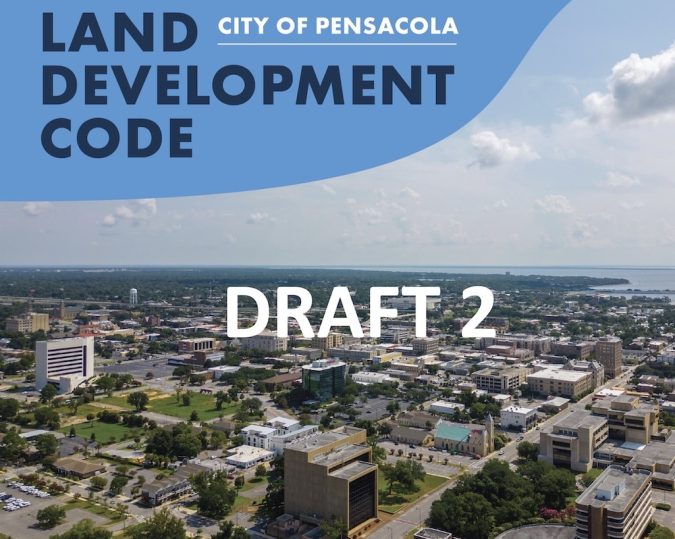
The City of Pensacola will hold its third and final open house from 3 p.m. to 6 p.m. today, offering the public an opportunity to provide feedback on the second draft of the updated Land Development Code.
- Notes: The draft incorporates recent feedback from the Architectural Review Board, city staff, Planning Board, previous public workshops and the project website.
“This update represents a long-overdue, comprehensive review of the city’s Land Development Code,” Planning and Zoning Division Manager Cynthia Cannon said. “While the city’s first zoning ordinance was adopted in 1947 and has been amended many times since, this is the first time the code has been evaluated holistically in its entirety.”
Open House Date: Tuesday, Feb. 17
Time: 3 p.m. – 6 p.m.
Location: Pensacola City Hall, Hagler-Mason Conference Room, 222 W. Main St.
- Please note that this event will be a drop-in open house. No formal workshop activities are planned.
October Workshop Notes: More Housing Options, Better Bike Infrastructure and Stronger Historic Protections
The City of Pensacola’s October workshop on its land development code rewrite drew a wide range of public input, and the message from residents, builders and board members was clear: modernize the rules, but don’t lose what makes Pensacola’s neighborhoods special. Read the full report.
- Background: The code overhaul—the first comprehensive update in years—is meant to replace the city’s current patchwork of zoning and development regulations with a cleaner, more user-friendly framework.
“Missing Middle” Housing Gets Broad Support—With Conditions
A significant takeaway was the general embrace of so-called “missing middle” housing—duplexes, triplexes, quadplexes and small multifamily buildings that fill the gap between single-family homes and large apartment complexes.
Participants supported allowing these housing types in some single-family and low-density districts, a significant shift from traditional zoning approaches.
But that support came with a caveat: Residents want strong design standards to ensure new townhomes and small multifamily projects don’t look like monolithic blocks dropped into established neighborhoods.
Accessory dwelling units: Multiple commenters pushed for more flexible ADU rules, including relaxing the current requirement that an ADU can’t exceed 60 percent of the main house’s size—a rule that effectively penalizes owners of smaller homes. Residents also questioned the 25 percent rear-yard limitation and asked for adjusted setbacks on larger lots.
- One question that surfaced: why does the code’s definition of “family” cap households at six individuals? Several participants asked the city to reconsider that limit.
Historic Neighborhoods Want Flexibility, Not Just Restrictions
Residents of historic neighborhoods like North Hill and East Hill made their voices heard. They want to preserve the character of those areas while still allowing context-sensitive growth—not an easy balance to strike.
- Architectural Review Board members raised a practical concern that often gets overlooked: the city’s existing height and coverage limits can actually make it harder, not easier, to replicate traditional architectural styles. Victorian homes, for example, don’t always fit neatly into modern dimensional standards, forcing homeowners into awkward proportions or repeated trips to the Board of Adjustment for variances.
The ask was straightforward—give historic districts more flexibility to match historic building forms, create a clearer process for designating properties as historically or culturally significant, and develop stronger tools to prevent the demolition of older buildings in favor of cookie-cutter construction.
- Some participants also floated incentives such as reduced permit fees for maintaining or rehabilitating buildings that are 100 years old or more. That’s the kind of carrot-over-stick approach that could actually move the needle on preservation.
Parking and Bikes: A Shifting Conversation
The parking discussion revealed a community in transition. There was conditional support for revised parking ratios, including higher minimums for multifamily and townhomes, though some cautioned that piling on parking requirements would trigger pushback from the development community—and potentially undermine the housing flexibility goals elsewhere in the code.
- Commenters supported tools like parking studies, shared and mixed-use parking arrangements, and reduced minimums in appropriate areas. There was explicit support for moving parking behind buildings and reducing surface parking generally.
Bikes: Many participants pushed hard for safer biking infrastructure and secure bike parking citywide, arguing that better bike lanes and year-round biking conditions should be central to reducing car dependence and congestion. For a city with Pensacola’s climate, that argument carries real weight.
Stormwater Concerns Pit Builders Against Resilience Advocates
The stormwater discussion exposed a real tension. Several participants questioned why triplexes and quadplexes would be exempt from stormwater plan requirements—a fair question given that those buildings represent more impervious surface than a single-family home.
- On the other side, builders warned that requiring grading and drainage plans for every single-family home could add an estimated $5,000 per residence and delay permits, especially if grading plans are required too early in the process.
Resilience advocates pushed for more ambitious approaches: incentives for green infrastructure, native landscaping, resilience districts, community “lighthouses,” and microgrids. The challenge for the city will be finding standards that meaningfully address flooding and drainage without pricing smaller projects out of the market.