
The Florida Department of Government Efficiency released its report on local government spending last week, and Pensacola’s section alone is worth a careful read because Gov. DeSantis and CFO Blaise Ingoglia don’t believe Mayor D.C. Reeves is following their anti-DEI playbook. Read DOGE_Pensacola.
- Background: Gov. Ron DeSantis created Florida DOGE (Department of Government Efficiency) to use data analysis and technology to identify unnecessary spending in state agencies, universities, and local governments. Very little analysis of state agencies has been done, while local governments have become DOGE’s favorite target.
The report is the first written document produced about its August site visit. It makes sweeping generalizations without offering a detailed analysis. The review paints a picture of a city where spending has outpaced growth—alleges accountability has some significant gaps. (The links below are tied to our reporting on some of the issues and city announcements.)
Spending Up, Population Flat
Since Fiscal Year 2016-17, Pensacola’s General Fund budget has grown from $50.9 million to $77.9 million — a 52.8% increase — while the city’s population grew from roughly 54,000 to 55,000. Ad valorem tax revenues nearly doubled over the same stretch, jumping from $13.8 million to $26.6 million. The city now employs 867 people to serve a population of just over 55,000.
- Among the items flagged by DOGE: $3.2 million in pay raises for city staff, not counting raises still owed to firefighters and police. A compensation study costing over $60,000 was commissioned to justify those raises. The city administrator’s salary was set at approximately $200,000 — nearly four times the median household income in the Pensacola metro area.
Big Raises, Bigger Questions
The report also raised eyebrows over $1.4 million in what it called “questionable contracts,” including $618,000 in lobbying spending across 2023 and 2024, $686,515 to update Community Redevelopment Agency plans, and $38,600 for an artist-in-residence. Human Resources spending grew 88% between FY 2019-20 and FY 2024-25.
A Revolving Door at City Hall
DOGE noted that its review was complicated by staff turnover. Long-time city officials, including the previous city administrator, had already departed before the site visit. Current staff claimed limited knowledge of prior spending decisions and DEI initiatives. Then, just two weeks after DOGE’s visit, the City Administrator resigned — with an interim stepping in.
DEI Spending and a Growing Pension Tab
On the DEI front, the report documented $130,000 paid to a consulting firm for a strategic plan that listed “prioritize racial and economic equity” as a top consideration. The Mayor’s office distanced itself from the DEI elements, but the report noted that multiple city staff were directly involved in the year-long process.
- Pension benefits already eat up over 10% of the city budget. With the recent salary increases baked in, that number is only going to climb.
- The full report is available here.
Broad Recommendations
The Florida DOGE report, which covers all the “audits,” lays out recommendations in three broad areas:
Oversight and accountability. The report calls for expanding the state CFO’s ability to audit local governments, particularly when they’re looking to raise taxes or create alternative revenue sources.
- It also pushes for pay caps on local government executives tied to median household income, limits on collective bargaining for non-public-safety employees, and greater public transparency around employee wages.
Ending DEI and climate initiatives. This is a significant chunk of the recommendations. DOGE wants state law to explicitly ban the use of public funds for DEI-related programs, training, and terminology — listing out a long string of specific concepts like “implicit bias,” “microaggressions,” and “intersectionality.”
- It also calls for requiring public employees to take a non-discrimination oath as a condition of employment.
- On the climate side, the report wants to block local governments from pursuing “net zero” policies or following externally imposed green building codes, and from joining organizations that promote climate initiatives at odds with state policy.
Budgeting and structural efficiency. Here, DOGE recommends requiring voters to re-approve referendum-based tax increases every six years, standardizing budget formats across municipalities so spending can be compared more easily, and encouraging zero-based budgeting.
- It also floats the idea of reviewing Florida’s 411 municipalities for potential consolidation or abolition, particularly smaller ones, to cut costs and streamline services.
Mayor’s Response
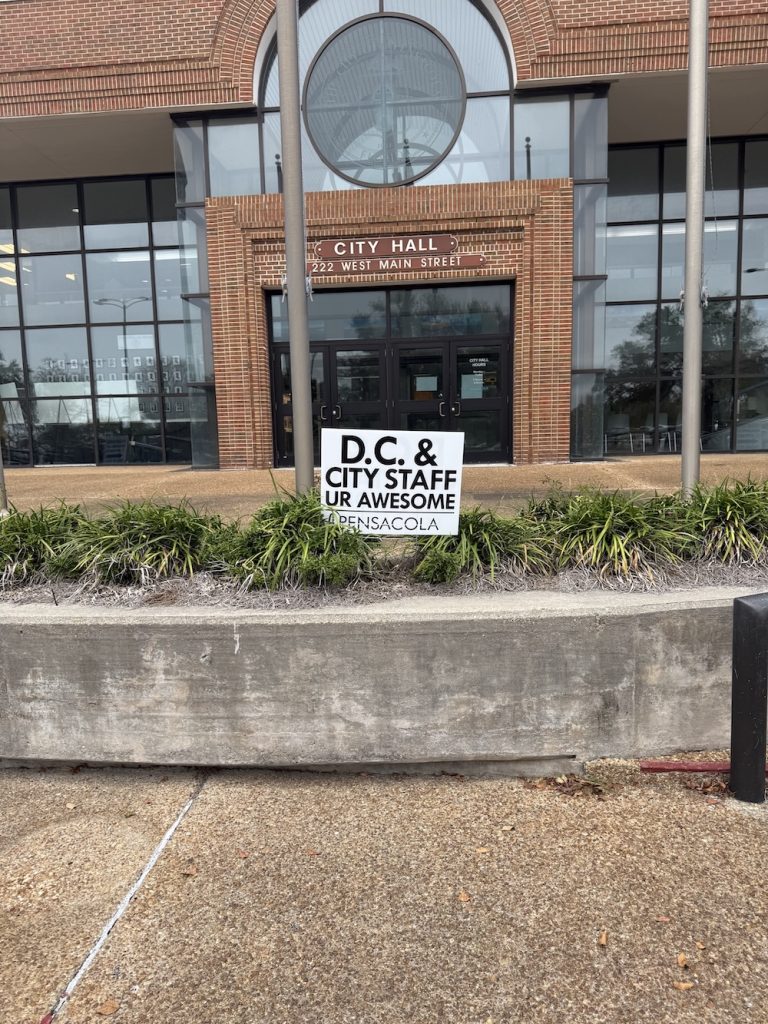
Mayor Reeves has two opportunities to publicly respond to the report. He has shifted his weekly press conference to 10 a.m. Wednesday, Feb. 4 at City Hall, 222 W. Main St. The news conference will take place in the Hagler-Mason Conference Room on the second floor.
On Thursday, the Pensacola News Journal and Civicon are hosting the mayor’s annual State of the City address at 6 p.m. at Bayview Community Resource Center, 2001 E. Lloyd St. Reeves will discuss his initiatives, brag about his accomplishments, and provide updates on the city’s strategic plan.
- “Now more than ever, this will be a year of heavy lifting. Large projects, many decades in the making, will take true shape,” the mayor said in a recent PNJ viewpoint – which may or may not have seen.
Those interested in attending can register for the free event here. The event will also be live-streamed on Pensacola News Journal’s Facebook page at facebook.com/pnjnews.