
Community Radio
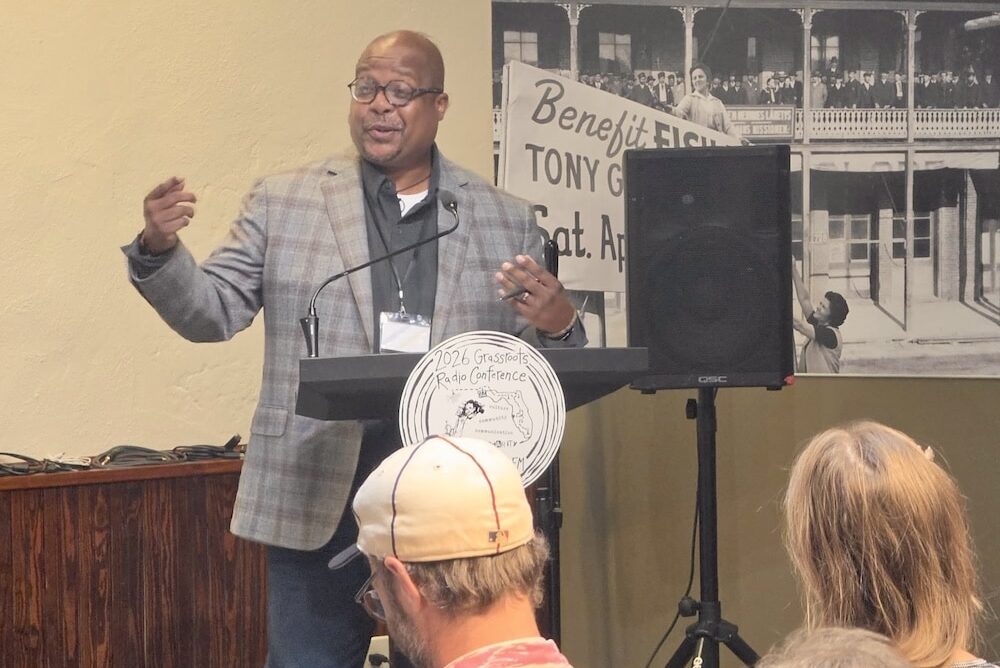
Dr. Nashid Madyun, executive director of Florida Humanities, delivered the keynote address at this year’s Grassroots Radio Conference, which was held at the Voices of Pensacola Museum from Oct. 24-26.
- He used his family history and two decades of work in museums and archives to make the case for a new kind of network: a “cultural corridor” of community radio stations, museums, archives and universities running from New Orleans to Miami.
How Culture Travels
Madyun opened with a proposition he returned to throughout the talk:
“Culture does not travel according to state lines. Culture travels with the people.”
It moves, he said, along rivers and railroads, highways and migration routes — carried by musicians chasing an audience, families chasing opportunity, and communities carrying memory from one place to another. Radio, he argued, has been one of its main vehicles for more than a century.
- The Gulf Coast—Pensacola, Mobile, New Orleans and Tampa Bay—has been quietly linked that way for generations, through music, food , religion, maritime culture and waves of migration that rarely get told as a single story.
A newspaper in the front room, a radio station down the road
Madyun grounded the pitch in his own upbringing in Helena, Arkansas, where his parents ran a community newspaper out of the front of the family’s house through the late 1970s and ’80s.
- Note: After his speech, he told me that the newspaper, the Community Consultant, was the only Black newspaper in eastern Arkansas.
Madyun shared that a family friend eventually launched a community radio station nearby and asked Madyun’s father to bring the newspaper’s stories to the airwaves. The paper’s readership was limited, but a radio signal could reach far more people. For about a year and a half, young Madyun listened to his father on Saturday afternoons and absorbed a lesson that stuck: if you have a story, there should be a platform for it.
- In Greenville, Miss., Hodding Carter owned the Delta Democratic Times and later started the town’s first AM station, WDDT. The station has since evolved into an internet radio station, run by former DJ Dan Diamond.
Madyin said that he later learned that plenty of communities have stories with no platform to reach them, which is precisely the gap he wants a Gulf Coast radio network to close.
Stories That Museums Collect
Drawing on his time running exhibitions at the Texas State History Museum in Austin, Madyun described institutions as good at collecting artifacts but often slow to connect them to the people and communities they came from.
- One example stuck with him: he didn’t know, until building an exhibit, that from 1907 to 1914 Galveston Island served as an alternate entry point to the United States for Jewish immigrants who couldn’t get through Ellis Island because of religious or ethnic restrictions—and later for Vietnamese immigrants as well.
“There are some remarkable stories in your backyard, and we need to ask the question: then what?”
That “then what,” he said, is exactly the job a radio network could do — turning archived interviews, photographs and objects into stories that actually reach an audience.
Cultural Relativity
The talk turned into a genuine back-and-forth once Madyun opened the floor for hometown stories. One audience member, identified as Mike August, described interviewing a Memphis musician who pointed out that Stax Records and the pool at the Lorraine Motel—where Martin Luther King Jr. was assassinated—were two of the only places in Memphis where Black and white residents could spend time together.
- Madyun used the moment to introduce what he called cultural relativity: the discipline of understanding a story from the perspective of the community it came from, rather than importing an outside frame onto it—pointing to the Green Book as a parallel example of a place that provided safety and dignity long before it became known for tragedy.
Other attendees offered their own material: a newly published history of French-language radio in Louisiana dating to 1928, called “French in the Morning,” and a story about a Cleveland auto-salvage yard whose informal owner functioned as a neighborhood hub for decades.
- Madyun closed by describing the cultural corridor not as a new program, but as recognition of a connection that already exists and an invitation to the conference’s community broadcasters to treat themselves as nodes in the same network rather than isolated stations.