
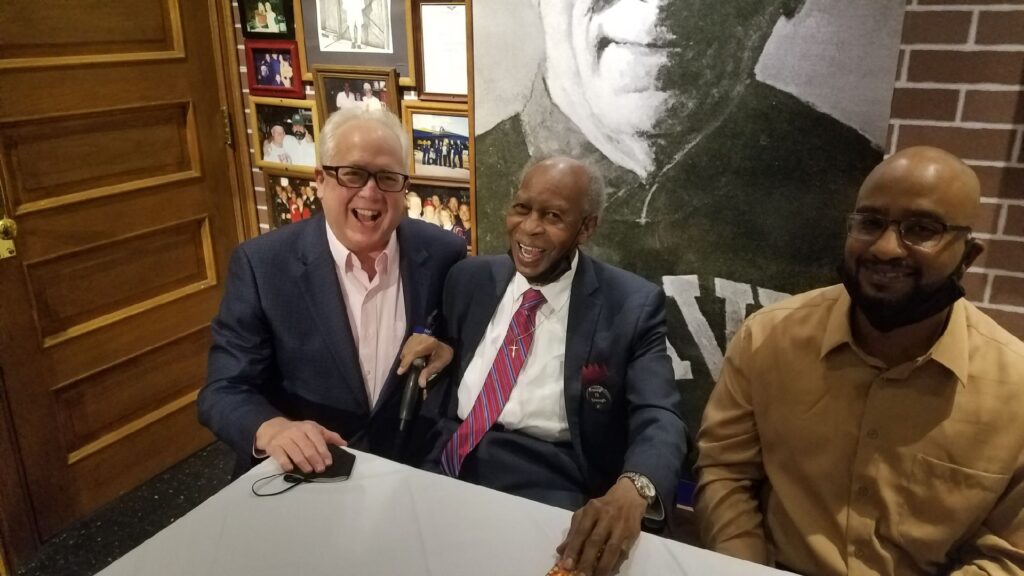
The recent passing of Rev. HK Matthews marks the end of an era for Florida’s civil rights movement. In a touching tribute on the “(We Don’t) Color On the Dog” podcast, Dr. Michael Butler—author of two books about Matthews—reflected on the legacy of a man who never stopped fighting for justice.
- “We lost a truth teller,” Butler said. “We lost a truth teller in an age where truth is debated.”
Matthews had an unwavering commitment to calling out injustice, regardless of how uncomfortable it made others.
- “One of the legacies of losing Rev. Matthews, at least here, is that we lost one of the people who was very willing to hold up a mirror to society and point out the flaws that he saw with the hope that it could be improved,” Butler shared.
Even in his sharpest critiques, Matthews maintained hope for progress, always pointing out “how far we’ve come and the promise that we can realize as Americans.”
The Movement Didn’t End in the 1960s
Matthews understood that the civil rights struggle, especially in Escambia County, Florida, continued long after landmark legislation passed. He embodied “so much of the blowback against the legislative victories of the sixties.”
“Rev. Matthews brought to light that the civil rights movement didn’t end with what happened in Selma. It didn’t end with the Civil Rights Act. That racism persisted and it persisted in different ways,” said Butler.
“And Rev. Matthews was on the front lines of that first wave of people that said, ‘Wait a minute, the way that the police treat us is racist. The presence of these Confederate icons in schools is racist.’”
White Southerners didn’t want to hear that. Bulter said, “They thought that they had given up enough, and Rev. Matthews was a strong advocate of the uncomfortable truth to many that the civil rights movement didn’t end when legislation passed. It was only beginning. And he faced the consequences of that very unpopular stance at the time.”
Florida’s Unique Civil Rights Challenges
Butler discussed Florida’s distinct civil rights history, explaining that, unlike other Southern states, “there never was a large 20th century or post-World War II era statewide campaign for anything.” Instead, struggles remained localized, creating pockets where civil rights progress was significantly delayed.
- In Escambia County, Matthews threatened the carefully crafted image that local leaders wanted to project. Butler explained that the News Journal “viewed Matthews as a problem” because his activism “ran counter to what the image of Pensacola that its city boosters wanted to put out there, no uncertain terms.”
Butler said, “One of our editors of that paper told me that they viewed Matthews as a problem, and when they would write their editorials, they would intentionally downplay numbers. They would intentionally take a stance against Matthews as an agitator.”
- He noted that editors “admitted many years later that HK Matthews, they thought was egotistical, that he was out for self-glorification and that they did everything that they could to try to discredit or minimize the claims that he made.”
A Lasting Legacy
Matthews’ death comes when many of the rights he fought for face new challenges. As Butler observed, Matthews noticed “that a lot of the things that he had worked to obtain for all people were being challenged now more than they ever had during the 21st century.”
- His legacy remains an uncompromising dedication to justice for all people—a reminder that the work of building a more equitable society never truly ends.

To learn more about Rev. H.K. Matthews and the civil rights movement in Escambia County, read these two books by Dr. Michael Butler—“Victory After the Fall” and “Beyond Integration: The Black Freedom Struggle in Escambia County, Florida, 1960-1980.”