

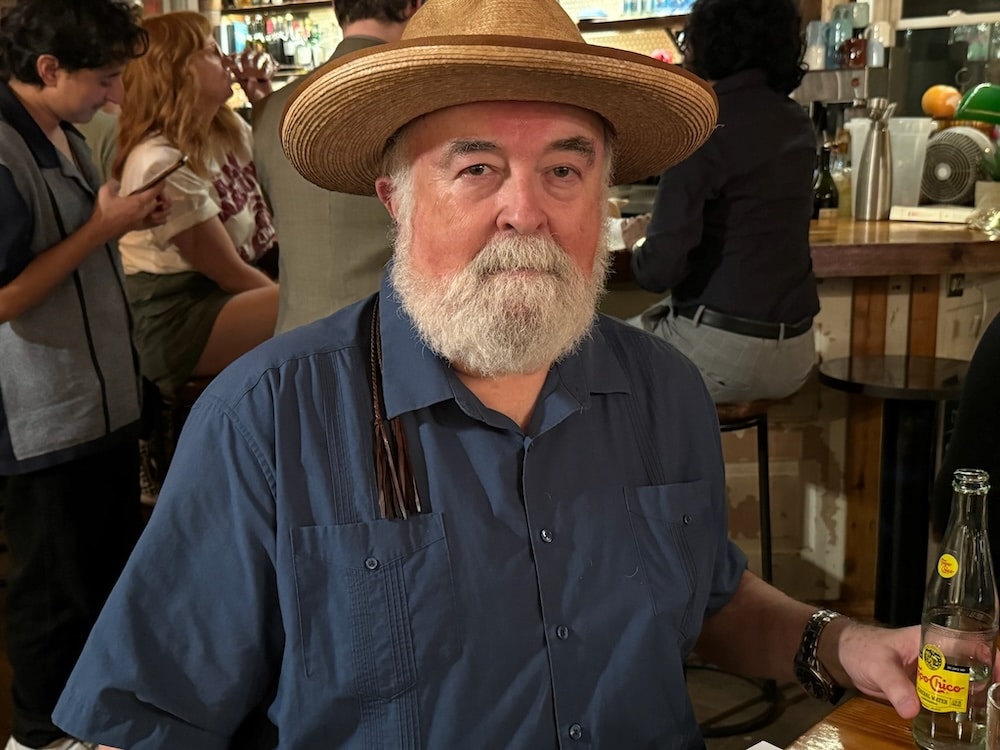
- In the latest episode of “We Don’t Color On the Dog,” Nesbitt sat down to discuss his fifth Ed Earl Birch novel, “The Fatal Saving Grace,” released on his birthday, Dec. 5. The conversation revealed not just the evolution of a compelling character, but the craft behind creating fiction that feels authentic and raw.
A Different Kind of Detective
Nesbitt’s hard-boiled Texas crime thrillers deliberately subvert traditional mystery conventions. “It’s not a whodunit per se,” he explains. “I’m basically doing pursuits, chases. What I love to do is just throw my main character, Ed Earl Birch, in the brierpatch and see whether he comes out alive or not.”
Unlike the infallible detectives of classic noir, Ed Earl Birch comes with bad knees, a wounded liver, three ex-wives, and crushing guilt over a dead partner from his days as a Dallas homicide cop. After being forced off the police force, he’s spent 20 years in what Nesbitt calls “the peephole wilderness of a private detective.”
- “I don’t particularly like having detectives that are super smart and flawless,” Nesbitt says. “Ed Earl is not Sam Spade or Philip Marlowe, and he definitely is not Frank Bullock. So he’s more of an everyman type.”
The Gift of Getting What You Want
In “The Fatal Saving Grace,” Nesbitt ages his protagonist while giving him something he’s long desired: a badge. Ed Earl becomes a DA’s investigator in the fictional West Texas town of Favor.
“Like all things that you get, that you’ve wished for for a long time, you really need to be careful what you wish for,” Nesbitt warns. “And he’s going to learn that the hard way.”
The challenge, Nesbitt explains, was aging Ed Earl authentically without making him “a cripple” or “a poster child for Geritol.” He credits fellow crime writer Dick Belsky’s interview with Michael Connelly about aging Harry Bosch as inspiration for handling this delicate balance.
From Journalism to Fiction
Nesbitt’s journalism background profoundly shaped his fiction writing. Breaking into the field in the late 1970s during the era of long-format journalism taught him to tell stories rather than just report facts.
- “I was already using a lot of fiction writing devices and figuring out how to spin a story,” he recalls. His years covering stories about West Texas—from Maquiladora plants to immigration issues—gave him both the setting and the ear for dialogue that makes his books crackle with authenticity.
The Bones of the Earth
West Texas isn’t just a backdrop in Nesbitt’s novels—it’s a character itself. He describes the region where “the Rockies coming in from the Northwest, you’ve got the vestiges of the Ozarks coming in from the east, and then you’ve got the Sierra del Carmens coming up out of Mexico and they collide.”
- “It looks like the bones of the earth have been ripped open for you to see,” he says. “So I just thought this is the perfect place to set stories of revenge and redemption.”
Writing Without a Net
Despite his journalism training, Nesbitt writes fiction as a self-described “pantser”—flying by the seat of his pants without detailed outlines. “I do not want to risk snuffing out that spontaneous, genius phrasing and passages that I don’t know where it comes from,” he explains.
- “The Fatal Saving Grace” is available now in Kindle and paperback wherever books are sold and on Amazon.
