

Immigration Detention
GAO: Taxpayers Are Covering $249 a Day Per Bed
A new Government Accountability Office report says ICE never signed an agreement for the Everglades facility it relied on, never negotiated what it would cost, and is reimbursing the state through a FEMA grant at a rate 171 percent above ICE’s median.
The U.S. Government Accountability Office reports that ICE relied on Florida’s Alligator Alcatraz as an integral part of its operations without ever entering into a contract or agreement authorizing it as a federal immigration detention facility. The federal government is now reimbursing Florida through a FEMA grant at a bed rate far above what ICE pays elsewhere.
- The findings come from Immigration Detention: Urgent Planning Needed to Avoid Further Waste of Taxpayer Dollars (GAO-26-108663), released Sept. 24. The report examines six new ICE detention expansion initiatives launched since January 2025. GAO says four of the six have been scaled back. Florida’s facilities are one of them.
“ICE did not follow its normal process of entering into a contract or intergovernmental service agreement with the state of Florida and, as a result, did not negotiate costs for the Florida Soft-Sided Facility.”
What GAO Found
- No contract, no agreement. The Florida Soft-Sided Facility opened in July 2025 at the Dade-Collier Training and Transition Airport in Ochopee. ICE officials told GAO the agency did not instruct Florida to open it and did not enter into any agreement authorizing it as a federal facility. The Florida Division of Emergency Management and its contractors ran it.
- ICE leaned on it anyway. Officials in ICE’s Miami Field Office told GAO in February 2026 that ICE was processing and housing all male noncitizens detained in Florida at the facility before transferring or removing them. It held an average of 1,386 detainees in fiscal year 2026.
- A shaky legal basis. ICE officials cited the existing 287(g) agreement with Miami-Dade County. GAO notes that those agreements do not reference the facility or show that ICE approved Florida to use it as an immigration detention site.
- Costs were never negotiated. ICE typically negotiates costs before signing detention contracts. According to ICE officials, senior leadership directed this initiative, so that step was skipped.
- Standards problems. The DHS Office of Inspector General inspected the facility in January 2026 and found it did not meet several detention standards, including sufficient living space and recreation time. Staff could not clearly identify which standards they were using, so the inspectors applied both the Florida Model Jail Standards and ICE’s National Detention Standards 2019, using whichever was more restrictive.
- It closed in June 2026. Florida officials announced the closure on June 25, saying in part that the facility was designed to be temporary.
The Money: A FEMA Grant at $249 a Bed
ICE did not pay for the facility directly. DHS is reimbursing Florida through a FEMA grant program that FEMA and ICE began developing in April 2025, with Florida as the sole eligible recipient. On September 30, 2025, FEMA awarded Florida $608.4 million for the facility.
The grant authorizes a bed rate of $249 per detainee per day. That is roughly 171 percent higher than ICE’s median bed rate of $92 in fiscal year 2026.
The money came from an unexpected place. FEMA told GAO it used funds originally appropriated for the Shelter and Services Program, which Congress created to relieve overcrowding in Customs and Border Protection holding facilities and to support organizations that temporarily shelter released migrants. FEMA received $800 million for that purpose in fiscal year 2023 and $650 million in fiscal year 2024. The program received no appropriation for fiscal year 2026.
Baker Correctional Institution: Same Arrangement, No Paperwork
GAO says DHS has a similar arrangement with Baker Correctional Institution in Sanderson, Florida. ICE houses detainees there but, as of July 2026, has no agreement or contract authorizing its operation as a federal immigration detention facility. Its average daily population in fiscal year 2026 was 959.
FEMA approved Florida’s request to add Baker to the grant program, and it will be reimbursed at the same $249 bed rate.
A rough sense of scale (my arithmetic, not GAO’s): The $157 gap between $249 and ICE’s $92 median, applied to 1,386 detainees, works out to about $79 million for a full year at that population. At Baker’s 959 detainees, the gap is about $55 million a year. GAO does not make this calculation, and the Alligator Alcatraz population was an average over part of a year, but the numbers show why the bed rate matters.
The Bigger Picture
The Florida findings sit inside a broader criticism. GAO says ICE has spent billions on expansion without a comprehensive strategic plan. Its bed space goals have shifted from 80,000 to 92,600 to 100,000, and that last figure is not reflected in agency documents. ICE’s average daily detained population has grown from 39,314 in January 2025 to 67,180 in July 2026, and its authorized facilities have roughly doubled from 134 to 272.
GAO made one recommendation: that ICE’s director develop a comprehensive strategic plan with goals, activities, and resource needs. DHS agreed, but ICE does not expect to finish the plan until August 31, 2027. GAO says that given the size of the multi-year funding, “more timely completion may be warranted.”
In its response, DHS said ICE will keep meeting demand for bed space by “streamlining the detention and removal process and focusing on non-traditional facilities built specifically to support ICE’s needs.” Florida’s Everglades facility was the state’s own version of that approach, and it is now closed.
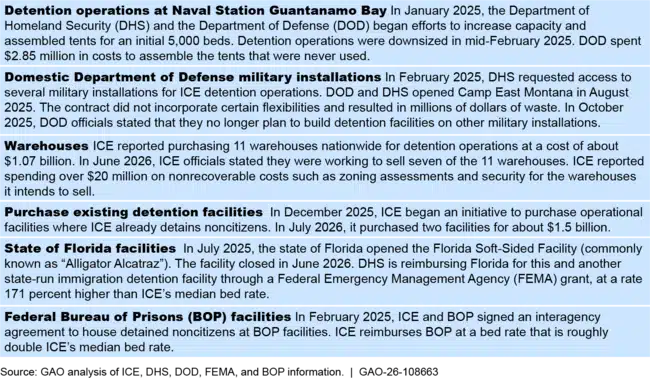
Read the report: GAO-26-108663, Immigration Detention: Urgent Planning Needed to Avoid Further Waste of Taxpayer Dollars, Sept. 24.