

Commissioner Ashlee Hofberger’s “Tourist Dollars At Work” and “Prohibited Uses of TDT Funds” flyers are supposedly based on “Florida Statute 125.0104. The commissioner said the flyers were done in consultation with the Clerk’s office.
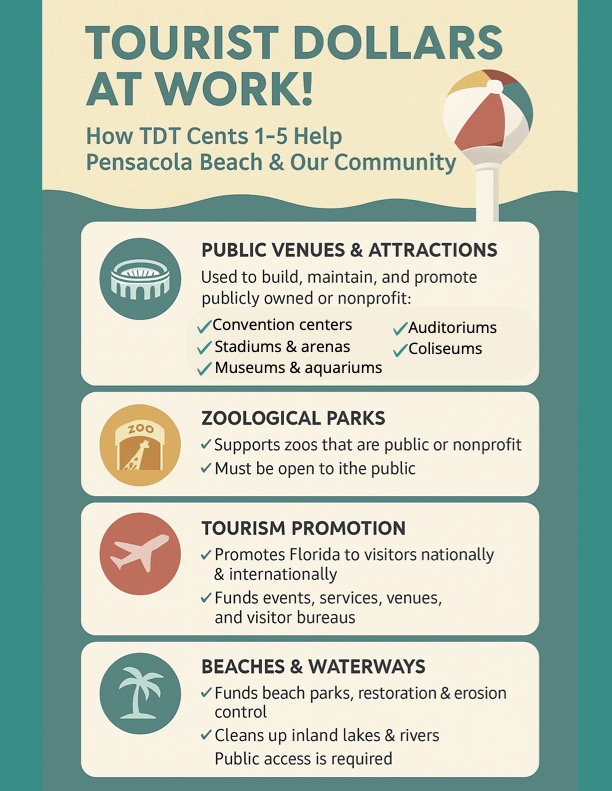
Unfortunately, the “Tourist Dollars At Work” flyer incorrectly states TDT fund can be spent on convention centers, stadiums, arenas, coliseums or auditoriums owned by a nonprofit. They can only be publicly owned.
- Under Sec. 125.0104 (5) 1(a): those facilities must be publicly owned and operated, although Sec. 125.0104 (5) 1(b) states the auditoriums may be “operated by organizations that are exempt from federal taxation pursuant to 26 U.S.C. s. 501(c)(3).”
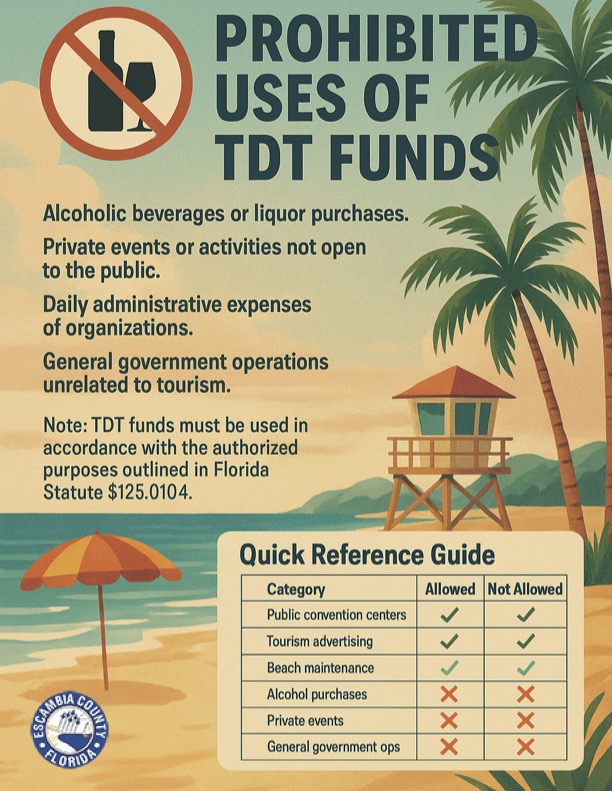
“Prohibited Uses of TDT Funds” flyer states that alcoholic beverages or liquor purchases are prohibited under Florida law. However, Florida Statute 125.0104 makes no mention of alcohol. However, there is a county ordinance (see below). Neither the statute nor a county ordinance bans TDT funds for private events or activities not open to the public.
- The Walton County TDC does not have a problem promoting events that involve alcohol. It supports several such events that raise funds for nonprofits, including a Bloody Mary Festival that raises funds for Habitat for Humanity of Walton County and other charities.
The flyer also strangely checks both the “Allowed” and “Not Allowed” columns on its “Quick Reference Guide.”
Feel free to do a word search for “alcohol” and “private events” in the actual statute to prove me wrong. If there is another statute involving TDT dollars, please send it to me.
Or you can scan below the F.S. 125.0104 section labeled “AUTHORIZED USES OF REVENUE:”
(5) AUTHORIZED USES OF REVENUE.—
(a) All tax revenues received pursuant to this section by a county imposing the tourist development tax shall be used by that county for the following purposes only:
1. To acquire, construct, extend, enlarge, remodel, repair, improve, maintain, operate, or promote one or more:
a. Publicly owned and operated convention centers, sports stadiums, sports arenas, coliseums, or auditoriums within the boundaries of the county or subcounty special taxing district in which the tax is levied;
b. Auditoriums that are publicly owned but are operated by organizations that are exempt from federal taxation pursuant to 26 U.S.C. s. 501(c)(3) and open to the public, within the boundaries of the county or subcounty special taxing district in which the tax is levied; or
c. Aquariums or museums that are publicly owned and operated or owned and operated by not-for-profit organizations and open to the public, within the boundaries of the county or subcounty special taxing district in which the tax is levied;
2. To promote zoological parks that are publicly owned and operated or owned and operated by not-for-profit organizations and open to the public;
3. To promote and advertise tourism in this state and nationally and internationally; however, if tax revenues are expended for an activity, service, venue, or event, the activity, service, venue, or event must have as one of its main purposes the attraction of tourists as evidenced by the promotion of the activity, service, venue, or event to tourists;
4. To fund convention bureaus, tourist bureaus, tourist information centers, and news bureaus as county agencies or by contract with the chambers of commerce or similar associations in the county, which may include any indirect administrative costs for services performed by the county on behalf of the promotion agency;
5. To finance beach park facilities, or beach, channel, estuary, or lagoon improvement, maintenance, renourishment, restoration, and erosion control, including construction of beach groins and shoreline protection, enhancement, cleanup, or restoration of inland lakes and rivers to which there is public access as those uses relate to the physical preservation of the beach, shoreline, channel, estuary, lagoon, or inland lake or river. However, any funds identified by a county as the local matching source for beach renourishment, restoration, or erosion control projects included in the long-range budget plan of the state’s Beach Management Plan, pursuant to s. 161.091, or funds contractually obligated by a county in the financial plan for a federally authorized shore protection project may not be used or loaned for any other purpose. In counties of fewer than 100,000 population, up to 10 percent of the revenues from the tourist development tax may be used for beach park facilities; or
6. To acquire, construct, extend, enlarge, remodel, repair, improve, maintain, operate, or finance public facilities within the boundaries of the county or subcounty special taxing district in which the tax is levied, if the public facilities are needed to increase tourist-related business activities in the county or subcounty special district and are recommended by the county tourist development council created pursuant to paragraph (4)(e). Tax revenues may be used for any related land acquisition, land improvement, design and engineering costs, and all other professional and related costs required to bring the public facilities into service. As used in this subparagraph, the term “public facilities” means major capital improvements that have a life expectancy of 5 or more years, including, but not limited to, transportation, sanitary sewer, solid waste, drainage, potable water, and pedestrian facilities. Tax revenues may be used for these purposes only if the following conditions are satisfied:
a. In the county fiscal year immediately preceding the fiscal year in which the tax revenues were initially used for such purposes, at least $10 million in tourist development tax revenue was received;
b. The county governing board approves the use for the proposed public facilities by a vote of at least two-thirds of its membership;
c. No more than 70 percent of the cost of the proposed public facilities will be paid for with tourist development tax revenues, and sources of funding for the remaining cost are identified and confirmed by the county governing board;
d. At least 40 percent of all tourist development tax revenues collected in the county are spent to promote and advertise tourism as provided by this subsection; and
e. An independent professional analysis, performed at the expense of the county tourist development council, demonstrates the positive impact of the infrastructure project on tourist-related businesses in the county.
Subparagraphs 1. and 2. may be implemented through service contracts and leases with lessees that have sufficient expertise or financial capability to operate such facilities.
(b) Tax revenues received pursuant to this section by a county of less than 950,000 population imposing a tourist development tax may only be used by that county for the following purposes in addition to those purposes allowed pursuant to paragraph (a): to acquire, construct, extend, enlarge, remodel, repair, improve, maintain, operate, or promote one or more zoological parks, fishing piers or nature centers which are publicly owned and operated or owned and operated by not-for-profit organizations and open to the public. All population figures relating to this subsection shall be based on the most recent population estimates prepared pursuant to the provisions of s. 186.901. These population estimates shall be those in effect on July 1 of each year.
(c) A county located adjacent to the Gulf of Mexico or the Atlantic Ocean, except a county that receives revenue from taxes levied pursuant to s. 125.0108, which meets the following criteria may use up to 10 percent of the tax revenue received pursuant to this section to reimburse expenses incurred in providing public safety services, including emergency medical services as defined in s. 401.107(3), and law enforcement services, which are needed to address impacts related to increased tourism and visitors to an area. However, if taxes collected pursuant to this section are used to reimburse emergency medical services or public safety services for tourism or special events, the governing board of a county or municipality may not use such taxes to supplant the normal operating expenses of an emergency medical services department, a fire department, a sheriff’s office, or a police department. To receive reimbursement, the county must:
1.a. Generate a minimum of $10 million in annual proceeds from any tax, or any combination of taxes, authorized to be levied pursuant to this section;
b. Have at least three municipalities; and
c. Have an estimated population of less than 275,000, according to the most recent population estimate prepared pursuant to s. 186.901, excluding the inmate population; or
2. Be a fiscally constrained county as described in s. 218.67(1).
The board of county commissioners must, by majority vote, approve reimbursement made pursuant to this paragraph upon receipt of a recommendation from the tourist development council.
(d) The revenues to be derived from the tourist development tax may be pledged to secure and liquidate revenue bonds issued by the county for the purposes set forth in subparagraphs (a)1., 2., and 5. or for the purpose of refunding bonds previously issued for such purposes, or both; however, no more than 50 percent of the revenues from the tourist development tax may be pledged to secure and liquidate revenue bonds or revenue refunding bonds issued for the purposes set forth in subparagraph (a)5. Such revenue bonds and revenue refunding bonds may be authorized and issued in such principal amounts, with such interest rates and maturity dates, and subject to such other terms, conditions, and covenants as the governing board of the county shall provide. The Legislature intends that this paragraph be full and complete authority for accomplishing such purposes, but such authority is supplemental and additional to, and not in derogation of, any powers now existing or later conferred under law.
(e) Any use of the local option tourist development tax revenues collected pursuant to this section for a purpose not expressly authorized by paragraph (3)(l) or paragraph (3)(n) or paragraphs (a)-(d) of this subsection is expressly prohibited.
County Ordinance Sec. 90-31 Bans Alcohol
County Ordinance Sec. 90-31 (c) states: “Public funds may not be expended on alcoholic beverages.” It was passed Oct. 4, 2001.
- However, the ordinance does not prohibit public funds for private events or activities not open to the public.
(b) Public funds may be appropriated for expenditures, including but not limited to:
(1) Payments for Chambers of Commerce (or county-sponsored) events promoting tourism and/or economic development of the county.
(2) Keys to the county and other commemorative items, including, but not limited to: globes, statues, potted plants and pictures and frames, for visiting dignitaries, and/or the costs of welcoming receptions, luncheons, and dinners for such dignitaries.
(3) Payment for costs and expenses for meals and hospitality of persons interested in the economic development of the county.
(4) Payment for costs and expenses related to sister county program events sponsored by Escambia County, other counties, the State of Florida, trade groups or associations, and chambers of commerce.
(5) Payment for costs and expenses of trade and tourism-related tours and trips to foreign countries sponsored by Escambia County, other counties, the State of Florida, trade groups or associations, and chambers of commerce.
(6) Payment for flowers and official telegraphic condolences on behalf of the county upon the illness or death of persons designated by the county administrator.
(c) Public funds may not be expended on alcoholic beverages.
(d) Expenditures for meals, entertainment and/or hospitality for county employees is expressly prohibited by this section unless such expenditures are incident to F.S. § 125.045(2), wherein county employees are participants in an activity contemplated in subsection (b) of this section.
(e) All expenditures are subject to budget appropriation by the board of county commissioners.
(f) The appropriation of all expenditures is governed by applicable state and local law.