
Investigation
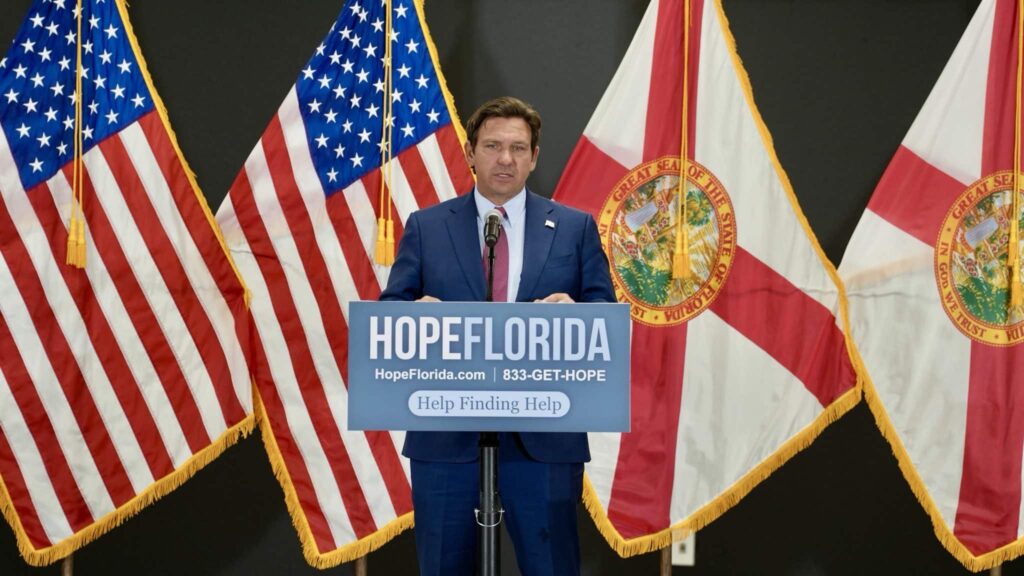
Someone leaked a sealed grand jury report to CBS News Miami that found that the DeSantis administration misappropriated $10 million in taxpayer money by diverting funds from a Medicaid settlement to the Hope Florida Foundation, CBS News Miami reported Aug. 26.
- Florida grand jury reports are confidential and not released to the public except as allowed by law or by court order. The grand jury report was filed under seal with the Leon County Clerk’s Office on Jan. 28. There have been media reports that individuals named in the report have objected to its release.
The CBS News Miami has the report online, and I reviewed it.
The Leon County grand jury concluded what I reported last year that $10 million from a Medicaid overbilling settlement with Centene Corporation was misappropriated after it was funneled through the Hope Florida Foundation to two political committees that ultimately steered money into the fight against last year’s marijuana legalization amendment and into the Republican Party of Florida.
The grand jury inquiry began after Pensacola Republican state Rep. Alex Andrade raised allegations of fraud and abuse during the 2025 legislative session. The grand jury voted in August 2025 to investigate under its broad authority to examine whether public officials acted incompetently, illegally, or contrary to good morals in the conduct of public affairs.
- The jury’s bottom line: The money was misused, but no single person can be held criminally responsible because no witness—among a parade of state agency heads, lawyers, and political operatives—would admit to deciding that the $10 million should go to Hope Florida in the first place.
How the money moved
Centene originally offered Florida $67,048,611 in February 2023 to settle claims that it had overbilled the state’s Medicaid program through its pharmacy benefits management structure. By the time the deal was finalized in September 2024, the terms had changed: the state would collect $57,048,611, and $10,000,000 would go as a “donation” to the Hope Florida Foundation, the direct-support charity championed by First Lady Casey DeSantis.
The settlement was signed by four officials: then-Chief Deputy Attorney General John Guard, Agency for Healthcare Administration (AHCA) Secretary Jason Weida, Insurance Commissioner Michael Yaworsky, and Department of Health Chief of Staff Cassandra Pasley.
Within days of landing in Hope Florida’s account, the $10 million was split into two $5 million grants and sent to a pair of 501(c)(4) political nonprofits — which then moved nearly all of it into a political action committee chaired by then-Governor’s Chief of Staff James Uthmeier.
According to forensic accountant Julian Dozier, whose bank-record analysis the jury called “thorough, credible, and detail oriented,” the money trail ran like this:
- Oct. 4, 2024 — Centene’s $10 million reaches Hope Florida
- Mid-October 2024 — Hope Florida grants $5 million each to Secure Florida’s Future (chaired by Chamber of Commerce CEO Mark Wilson) and Save Our Society from Drugs (led by Amy Ronshausen)
- Within about a week — Secure Florida’s Future sends $3.75 million and Save Our Society from Drugs sends $4.75 million to Keep Florida Clean, Uthmeier’s PAC
- October 2024 — Keep Florida Clean sends $7 million to the Republican Party of Florida, which sends $2 million back, for a net transfer of $5 million
- February 2025 — Keep Florida Clean disbands; its remaining funds move to the Florida Freedom Fund, another PAC chaired by Uthmeier
Both nonprofits’ grant applications explicitly stated they would not engage in political activity or “electioneering communications.” Both organizations then used the bulk of the money to help defeat Amendment 3, the ballot measure to legalize recreational marijuana, which failed at the polls.
Who Said What
Mark Wilson, Secure Florida’s Future’s director and the Florida Chamber’s president, testified he applied for the grant at the suggestion of a fellow board member, Frank Walker, and denied the money “passed through” his organization. But the jury noted his group’s typical bank balance ran between roughly $110,000 and $158,000 in the months surrounding the grant. The $5 million deposit was an outlier the panel says was quickly diverted for political purposes in contradiction of the group’s own application.
Amy Ronshausen of Save Our Society from Drugs testified that Uthmeier personally called and texted her in October 2024 directing her to apply, then connected her with Hope Florida’s outside attorney, Jeff Aaron, who advised her to request $5 million. She got the money three days after applying and sent $4.75 million to Keep Florida Clean within a week, saying she believed it was the best way to fight the marijuana amendment. However, the jury found such a use at odds with her own grant application’s promise to avoid political activity.
Joshua Hay, then-chairman of the Hope Florida Foundation, approved both $5 million grants without the vetting the charity’s other requests normally went through. He told the jury he assumed the money was tied to hurricane relief and used the phrase “the road to hell is paved with good intentions” in describing his own judgment. The jury found his testimony “transparent and credible.”
Katie Strickland, then a deputy chief of staff to Gov. Ron DeSantis, fared worst in the jury’s assessment. Despite being identified by other witnesses as present for key conversations, she said she never read the settlement agreement and couldn’t recall who directed the money to Hope Florida. The jury found her “not credible” and said she was “the least informative” of all the witnesses.
AHCA Secretary Jason Weida testified the $10 million was a “bonus” Centene offered to incentivize a quick settlement, not core Medicaid reimbursement. The jury rejected his explanation, calling it inconsistent with Weida’s own decision to reimburse the federal government using the full settlement amount rather than the reduced figure his “bonus” theory would imply.
John Guard, the former chief deputy attorney general, acknowledged he had “political concerns” about the Hope Florida carve-out but said those concerns were resolved once the agreement was restructured to make AHCA—not the Attorney General’s Office—the lead party. The jury found he signed without doing the due diligence the money required.
James Uthmeier, now Florida’s Attorney General, did not testify before the panel. The jury noted that “no witness admitted or identified who directed the money to go to Hope Florida” in the first place, even as testimony established that his PAC, Keep Florida Clean, was the ultimate destination for most of the funds and later moved money to the Republican Party of Florida and to the Florida Freedom Fund, another Uthmeier-chaired committee.
The findings
The jury laid out several reasons it concluded the $10 million was misappropriated rather than legitimately donated:
- The rushed timeline: the settlement came together quickly and funded in just seven days, 45 days before the election on Amendment 3
- No press release touting the recovery of taxpayer money, unlike other states that settled with Centene
- No notice to the Legislature, despite state law generally requiring it for large settlements
- No restrictions placed on how Hope Florida or the two PACs downstream could use the money
- Only two organizations were invited to apply for the grants, rather than opening the process up
- Keep Florida Clean’s donations ultimately reached the Republican Party of Florida
The panel also found that AHCA’s Weida reduced the disputed portion from $10.8 million to an even $10 million specifically to stay under the $10 million threshold in Florida Statute 216.216, which requires settlement money the state receives to go into General Revenue rather than be spent independently by an agency.
What the jury wants changed
The grand jury issued two recommendations to the Legislature:
- Require that any money received by the state from any source be deposited into General Revenue, with real penalties for violations
- Enact clear rules governing how direct-support organizations like Hope Florida can use taxpayer-linked funds, including tracking, monitoring, and consequences for misuse
Since the money was diverted, what has happened to the main players:
Gov. DeSantis appointed:
Ashley Moody to the U.S. Senate
James Uthmeier – Florida Attorney General
John Guard – Judge on the Second District Court of Appeal
Responses
Uthmeier’s deputy chief of staff wrote to CBS News Miami: “Grand jury proceedings are confidential. Unauthorized disclosure of those proceedings is a crime.”
“This baseless smear has been debunked over and over again,” DeSantis spokesman Alex Lanfranconi posted on X. “In fact, if any confidential grand jury report was leaked to the press, that’s the only crime committed here.”