

Escambia Children’s Trust is touting on social media the number of sessions provided by the programs it has funded for the past two and a half years. A session is defined as up to one full day of services provided to a child at a single location.
- Under the title “Momentum in Out-of-School Time Programming—2.5 Years of Changing Lives and Building Futures,” the Trust states: “From March 1, 2023, to August 31, 2025, Out-of-School Time Programming delivered 8,056 sessions across 49 program sites, engaging over 4,000 children.”
- Under the title “Fueling Positive Change via Mental Health Supports—2 Years of Growth, Hope and Lasting Change,” the Trust states: “From October 1, 2023 to August 31, 2025, Mental Health Services Programming provided 5,550 services countywide impacting over 1,200 children.”
The Instagram post’s caption: “Thanks to our amazing community partners, over 4,000 children joined 8,000+ after-school sessions and 1,200+ received informal mental health support through 5,500+ services across Escambia County. That’s what growing trust together looks like.”
Results, Not Volume
While the volume of sessions appears impressive, the actual accomplishments of the Escambia Children’s Trust need to be measured by how much its programming has improved the metrics listed in its 2022 Needs Assessment Report. See FINAL-ECT-Needs-Assessment.
- In her letter to the community, then-Executive Director Tammy Greer wrote, “We take our charge to safeguard public funds seriously. Our goal is to invest in programs and services that are most likely to yield an exponential return to the community.”
The needs assessment identified 24 core indicators and four themes: Children Are Healthy; Children Are Ready to Succeed in School and Life; Children Are Safe and Protected From Abuse and Neglect; and Children Have Support to Help Them Avoid Risky Behaviors.
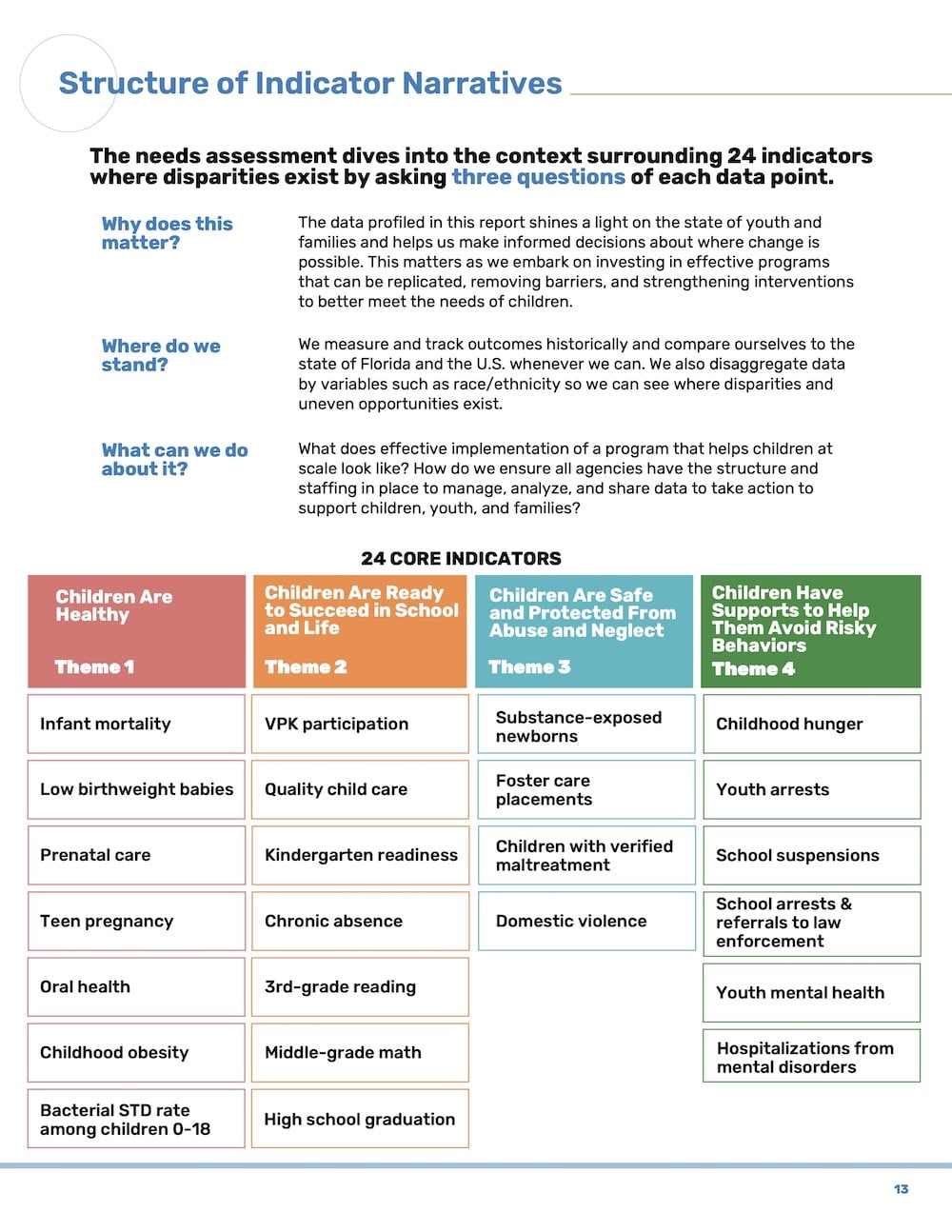
- The Needs Assessment stated Escambia County ranked #45 out of 67 Florida counties for child well-being and #50 in health outcomes.
Measuring Accomplishments: How much has the Trust helped improve the core indicators and these two critical rankings? Which programs are helping our children actually improve?
- The Trust’s 2024 Indicator Report Card showed Escambia County ranked #58 for child well-being and #51 for health outcomes. Read ECT-Indicator-Report-Card-2024.
Accurate Measures, Report Cards Required
Quality, not quantity, is the accurate measure of success, and only when metrics prove a program is effective. This is how we build trust in the Escambia Children’s Trust. We need an accurate report card that shows how the 24 core indicators and the two rankings have changed. We must also identify which programs are driving those improvements. Not all Trust sessions have been effective.
Update: I initially tried to calculate how many sessions Navy Point Elementary held for its 484 students over an entire school year. The Trust data manager shared that it would only be 178 sessions. A session is a day of service, regardless of the number of children served.