
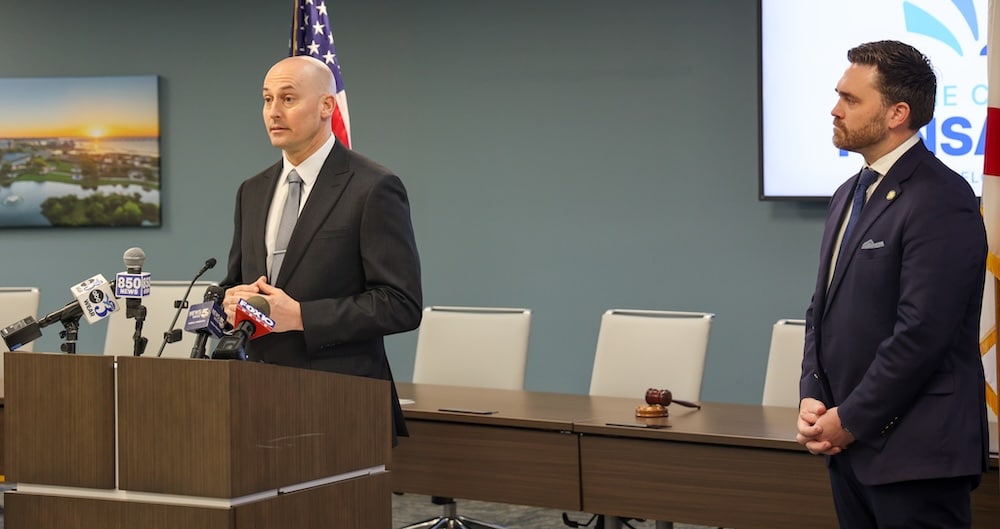
Mayor D.C. Reeves has selected Eric Winstrom to lead the Pensacola Police Department, pending city council approval. Winstrom, currently the chief of police in Grand Rapids, Michigan, will begin his service on March 2, bringing 21 years of experience from the Chicago Police Department and nearly four years of leadership in Michigan’s second-largest city.
- “I’m acutely aware of the long-term impact this choice will have, not just on the officers who wear the badge, but on every neighborhood with every resident in Pensacola,” Reeves told reporters. The mayor stressed that his search focused on “proven administrative leadership and a track record of departmental excellence.”
Why Winstrom
With the departure of Chief Eric Randall and the unforeseen retirement of a deputy chief, Reeves said the department “lacked that organizational leadership depth” needed at this moment.
The Difference: What set Winstrom apart was his specific experience as an external hire who successfully transformed a struggling department. “What makes Eric the right fit for this moment is this specific experience coming into a new community as chief and building a successful culture,” Reeves explained. “He has a proven body of work navigating tragedy and complex legal challenges, but just as importantly, he knows how to build a team by listening to the officers on the ground.”
In Grand Rapids, Winstrom inherited a department that was “really, really struggling.” “To be blunt, we did it,” Winstrom said in a (We Don’t) Color on the Dog interview following the press conference. “That police department is 180 degrees different from where we started it. We have filled every budgeted vacancy. We have grown the size of the police department. We have reduced crime enormously.”
Running to Pensacola
When asked why he would leave a successful tenure in a larger city, Winstrom was emphatic: “I’m not running away from Grand Rapids. I am running to Pensacola.”
Grand Rapids has a metropolitan area of over a million people and a police force four times the size of Pensacola’s. But Winstrom said on the podcast that he’s “not really a politician” and prefers the nuts and bolts of policing over the bureaucracy of massive departments.
- “I’ve had other opportunities to go to the larger cities,” he said, noting that recruiters reached out when his candidacy in Pensacola became public. “And every one of ‘em I looked, and they’re not poised for the same success that the city of Pensacola is.”
Opportunities: He sees both professional and personal opportunities in Pensacola. Professionally, he appreciates a city that “takes policing seriously, which is not seeking to over politicize it.” Personally, he wants a place where his family can put down roots.
- “Successful for me will be if they get ready to join the workforce, they get ready to start a family, and they want to stay where we are,” he said of his two children, Connor and Molly.
What Attracted Him to Pensacola
Winstrom was struck by how Pensacola is growing responsibly. “There’s something special going on in Pensacola,” he told reporters. “Pensacola is a city that’s progressing. It’s advancing. It’s becoming that city that is beckoning people that, like I said about my kids, this is a place that we want to make our forever home.”
- He also connected the city’s success to effective policing. “Show me a successful police department, and you’ll see a successful city,” he said. “You never see the other way around.”
The Challenge of Being an External Candidate
Winstrom faced skepticism when he arrived in Grand Rapids as an outsider, and he expects the same in Pensacola. The position had strong internal candidates, including Erik Goss, whom the mayor praised for his “years of dedicated service to this city and the integrity he’s shown throughout his career.”
- “I get it,” Winstrom told reporters who asked about officers who might prefer an internal hire. He recalled working for superintendents from Miami, Los Angeles, and Dallas in Chicago. “All outsiders who had a different perspective, and all of them were met with skepticism by me because they were strangers.”
His message to skeptical officers and residents: “I get it, and I’m going to earn that trust.”
- Just 28 days into his Grand Rapids job, Winstrom faced an officer-involved shooting that made national headlines. “I had to be the first one to show up, and the last one to leave, and had to lead from the front,” he said on the podcast. It took about six weeks to two months to win over the department and the city.
Building Trust and Leadership
Mayor Reeves explained that developing leadership depth will be a priority. “I feel like if Chief Winstrom does his job and I do my job, we should, for the foreseeable future, be a high-performing department of which we would continue to rotate in and promote from within,” the mayor said.
Winstrom told me he’s positioned to leave Grand Rapids with “probably 10 people that could step into the police chief’s role successfully” by constantly involving his leadership team in decision-making and sending them to prestigious training programs.
- The most challenging interview, Winstrom admitted, was facing about 50 Pensacola police employees, many of whom clearly supported the internal candidate. “I walked into the police department and faced a room full, they had a pack, probably 50 plus people in there of individuals who worked for the department, who clearly, a lot of ‘em, were very passionate about supporting Eric Goss, the internal candidate.”
After 45 minutes of discussion, he said, “After a little bit of uncomfortableness, I got a lot of good positive feedback.”
The Mayor’s Perspective
Mayor Reeves defended his decision to hire an external candidate. “What we look for is the best person most fit for the job today,” he said. “I did not prescribe to the definitions of internal or external.”
The mayor framed the police chief selection as the city’s most important decision. “All of those great things that I’ll get up to any podium and brag about with the city of Pensacola, every single one of those doesn’t matter if we don’t have safety,” Reeves said.
Winstrom will begin his service on March 2, pending city council approval. “I will not let you down,” Winstrom promised. “I will be the hardest-working employee of the city.”
For more on Chief Winstrom, check out the section below the podcast.

Building Bridges Between Badge and Community
In a wide-ranging podcast interview, Chief Winstrom revealed the philosophy and experiences that shaped his approach to law enforcement—one that prioritizes community relationships as much as crime statistics.
The Power of Faith Leaders
During his interview process in Pensacola, Winstrom met with diverse groups throughout the city, but he singled out the clergy meeting as particularly impactful.
- “There’s actually a lot of crossover between faith leaders in the community and police,” Winstrom told me. “A lot of times on an individual’s darkest days, those are the people that get reached out to.”
He described being at hospital bedsides with crime victims and their families. “It’s the only non-family members are me and the clergy there. Developing those relationships is extremely important.”
But faith leaders serve another crucial function—they can bridge gaps between police and communities hesitant to trust law enforcement. “Groups of people or crime victims or witnesses that aren’t quite comfortable talking to the police are often comfortable talking to faith leaders in the community,” Winstrom said. “We literally can solve homicides with that sort of cooperation.”
Ethical Growth and Responsible Development
Winstrom was drawn to Pensacola partly because of how the city is managing its growth. He noted the construction visible throughout downtown but emphasized that growth alone isn’t enough.
- “We talk a lot about gentrification and growing a city ethically, and this is a city, you look out the window here and see something construction going on. It’s a city that’s growing, but it’s doing it in an ethical way,” he said.
He sees this responsible approach to development as connected to effective policing. The two reinforce each other in ways that make communities thrive.
Why Size Matters Less Than Impact
Winstrom pushed back on any suggestion that leaving Grand Rapids—with a metropolitan area of over a million people and a police force four times Pensacola’s size—represented a step down.
“I know enough of working in a giant bureaucracy, being that there’s only so much positive impact that a police chief can have in certain cities,” Winstrom explained. When recruiters reached out after his Pensacola candidacy became public, he evaluated those larger departments and found them wanting. “Every one of ‘em I looked and they’re not poised for the same success that the city of Pensacola is.”
He contrasted Pensacola with cities that “over-politicize” policing. “I appreciate a city that takes policing seriously, which is not seeking to over politicize it and demanding we abolish the police,” he said.
Tailoring Solutions to Community Needs
Perhaps most telling was Winstrom’s emphasis that effective policing can’t be imported wholesale from one city to another.
- “Every community is different,” he said. “What works in the city of Chicago, it doesn’t work in LA, it doesn’t work in Grand Rapids and might not work in Pensacola. So it’s going to be tailoring the police department to what the city wants.”
This philosophy of listening first and adapting solutions to local needs will be tested immediately. Winstrom knows he’ll face skepticism from officers who supported internal candidate Erik Goss and from residents who question whether an outsider can understand Pensacola.
But he’s been here before. In Grand Rapids, he faced similar doubt and overcame it through constant presence, transparent communication, and demonstrable results.
Developing the Next Generation
One metric of Winstrom’s success in Grand Rapids that received less attention during the announcement: he’s leaving behind “probably 10 people that could step into the police chief’s role successfully.”
He accomplished this by constantly involving his leadership team in decision-making, sending them to prestigious training programs like the FBI National Academy, and giving them opportunities to handle critical incidents and media relations.
- “Not everyone likes to be in front and center and in front of the camera, but if you’re going to be a police chief, you have to be able to advocate for the department,” Winstrom explained.
Mayor Reeves sees developing similar depth in Pensacola as essential. “I feel like if Chief Winstrom does his job and I do my job, we should for the foreseeable future be a high performing department of which we would continue to rotate in and promote from within,” the mayor said. “There’s no better symbol of high performance than having people ready to go and to be able to go into those roles.”
Winstrom begins his service March 2, pending city council approval. His first task will be the same one he faced in Grand Rapids: earning trust through presence, transparency, and results.
- “I will not let you down,” he promised. “I will be the hardest-working employee of the city. I’ll definitely be the hardest-working member of the police department.”