
Campaign 2026 | Governor’s Race
With eight days left, the Democratic nominee for governor told a Seville Quarter rally that a divided, broken nation is about to turn the tide, then talked about his father, his party switch and why he says Florida’s economy is failing the people who live here.
Litigating Who We Are
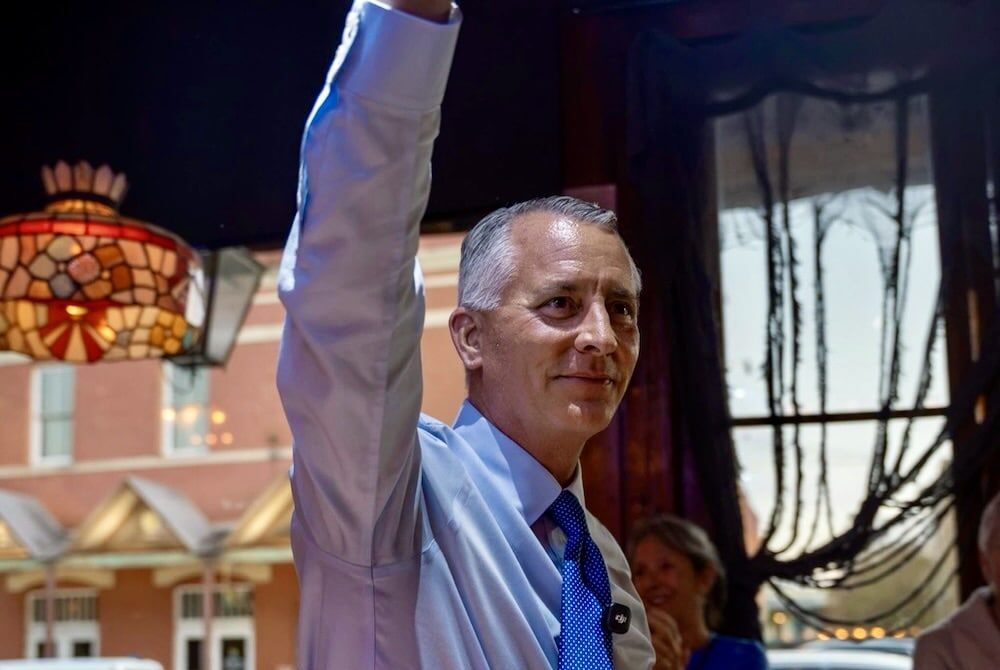
David Jolly, the Democratic nominee for governor, told a Pensacola crowd at Seville Quarter on Monday, Oct. 26, that Americans are more divided than ever, but that eight days from now voters will prove otherwise. “We’re a nation that’s broken, but we’re a nation that eight days from now is going to defy history,” he said.
- Jolly, joined by running mate Gwen Graham, spoke for about 30 minutes without a script. He called the race a “toss up” and said it is about more than policy. “We’re litigating something more than just policy right now,” he said. “We’re litigating who we are as a people.”
Pushing Back Against We Must Hate Each Other
The heart of the speech was a warning about what he says politicians are telling voters. Jolly said the country’s politics are broken because the country itself is, and he accused leaders of telling voters that more division is the answer.
“This is a moment where our politics are broken because we’re a nation that’s broken. We’re more divided than we’ve ever been before.”
The pitch he rejected. Jolly described politicians telling voters that “if we just hate each other a little bit more” and “if we just stay a little more divided,” life will improve. He gave examples of how far that has gone: asking people for their voter registration “before we decide whether or not to befriend them,” or choosing a different seat on Sunday morning rather than sit next to someone of another party.
“Our politicians are telling us if we just doubt each other a little bit more, that somehow life is going to get better and they’re wrong and we know it’s wrong.”
The answer he offered. Jolly said voters can reject that and “answer the calling of our founders.” For people of faith, he added, it is also “the calling of our creator.” He told the crowd what he expects on Nov. 3.
“We are going to exercise a democracy and decide that we’re not a nation that’s going to go in this direction anymore. We’re about to turn the tide and choose a new future for our people.”
Jolly’s Faith
The story about his father. Jolly lived in Pensacola for several years, and his father, a Baptist minister, led the Pensacola Bay Baptist Association for roughly 20 to 25 years. He said he has been thinking about one story in particular while back in town.
In the 1960s, he said, his father was a young pastor in a small Georgia town when a young Black woman came forward to be baptized. A deacon warned him that he would no longer be the pastor if he went through with it. “And he did it, and they ran him out of town,” Jolly said.
“I wonder whatever happened with that young black woman that my father baptized. She’d be about 80 years old right now.”
He returned to the story at the end of his remarks, telling the crowd, “History is watching.”
Faith, with a boundary. Jolly said he talks openly about his faith, but drew a line on what he thinks the job requires. “The role of the governor is not to evangelize, but it’s to secure freedom for the most number of people,” he said.
A New Coalition
The party switch. Jolly, a former Republican congressman, addressed his history head-on. “Like some of you in the room tonight, I used to be a Republican. Some are offended by that. I apologize,” he said. He then thanked the Republicans and independents in the room and acknowledged the registration numbers Democrats face.
“Only 29% of Floridians are registered as Democrats. Folks, we can’t do this on our own, but that doesn’t mean we abandon our values.”
He said he joined the party to change its reach, not its beliefs. “I didn’t come into the Democratic party to change it. I came into the party to grow it.”
Three values
Jolly’s three values for what he called the new coalition:
- The economy should work for everybody. “We don’t have to fight the haves to fight for the have-nots, but the economy’s not working for everybody, and we know that.”
- Let the private sector lead, but government fills the gaps. Housing, health care and education, he said, are things the private sector “not set up to do.”
- Protect everyone’s rights. “The government should protect everyone’s rights,” he said, “and the government should stay out of everybody’s business as well.”
Brownsville and the Alabama line
Jolly made his economic case local. He cited school truancy in Brownsville, saying the cause is not indifference. “We got truancy rates in the local school that are ticking up, not because the parents don’t want to educate their kids, but because they’re worried about putting a roof over the heads [of] their children,” he said. He added that families fear needing “two bus stops to get to a hospital.”
He also said Pensacola teachers are crossing the state line for work: “We got teachers in Pensacola who are teaching in Alabama because they get paid $20,000 more for crossing the state line every day.”
The proposals he laid out
- Homeowners insurance: “I don’t support a hurricane tax. I never have and I never will.” Jolly and Graham propose a pre-funded state catastrophic fund for hurricane coverage, which he said would cut homeowners’ premiums by 60 to 70 percent.
- Property taxes: Whether or not Amendment 3 passes, he said, the issue must be revisited next year. He favors a homestead exemption for first-time buyers and keeping the state baseline exemption, with expanded exemptions decided locally so “Escambia County can determine what’s right for Escambia County.”
- Health care: Scale up direct delivery of primary care in all 67 counties so patients are “treated for 99 bucks instead of $99,000.” He said states that expanded Medicaid saw better outcomes and lower costs, an argument he pitched to both “a progressive that wants to expand healthcare or a conservative that wants to save money.”
- Schools: Keep school choice, but add what he called a consumer-protection approach. Private schools taking vouchers “shouldn’t get to charge you more than the 8,500 bucks they’re taking in that voucher,” and schools unwilling to teach a child to read “don’t deserve a voucher.”
History, and who should run the institutions
Jolly acknowledged that consultants tell candidates to avoid the culture wars, then did the opposite. He said Florida’s governor has suggested there were good parts of slavery, and that his opponent has said the same of Jim Crow.
“There were no good parts of slavery and no good parts of Jim Crow.”
He called for every Florida child to learn about the Rosewood massacre, the Groveland Four, the murder of Harry T. Moore and his wife, and the Pulse nightclub massacre. “It doesn’t weaken us. It doesn’t shame us to know our history. It strengthens us,” he said. Of the state’s culture-war fights: “Culture wars have victims and culture wars are wrong.”
A nod to UWF. Jolly also went off script to say that Martha Saunders “should still be the president of the University of West Florida,” then widened the point. “We got a governor that decided to try to shape all of our institutions in the fashion of his own ideology, and that’s not the role of a governor.”
- He said the governor’s job is to let subject-matter experts lead public health, higher education and the environment and promised that he and Graham would replace the surgeon general on their first day.
The closing pitch
Jolly dismissed his opponent’s attacks. “My opponent is arguing ideology, communism, socialism, radicalism. Folks, sorry, Gwen, and I, we’re not radical. We’re not even cool.”
He ended on the idea that the election is a test of trust, and shared a story about a former Republican U.S. senator in his early 90s, an ordained Episcopal priest, who told him he would vote for every Democrat on the ballot unless given a reason not to.
“When you have a chance to change the world, you take it.”