
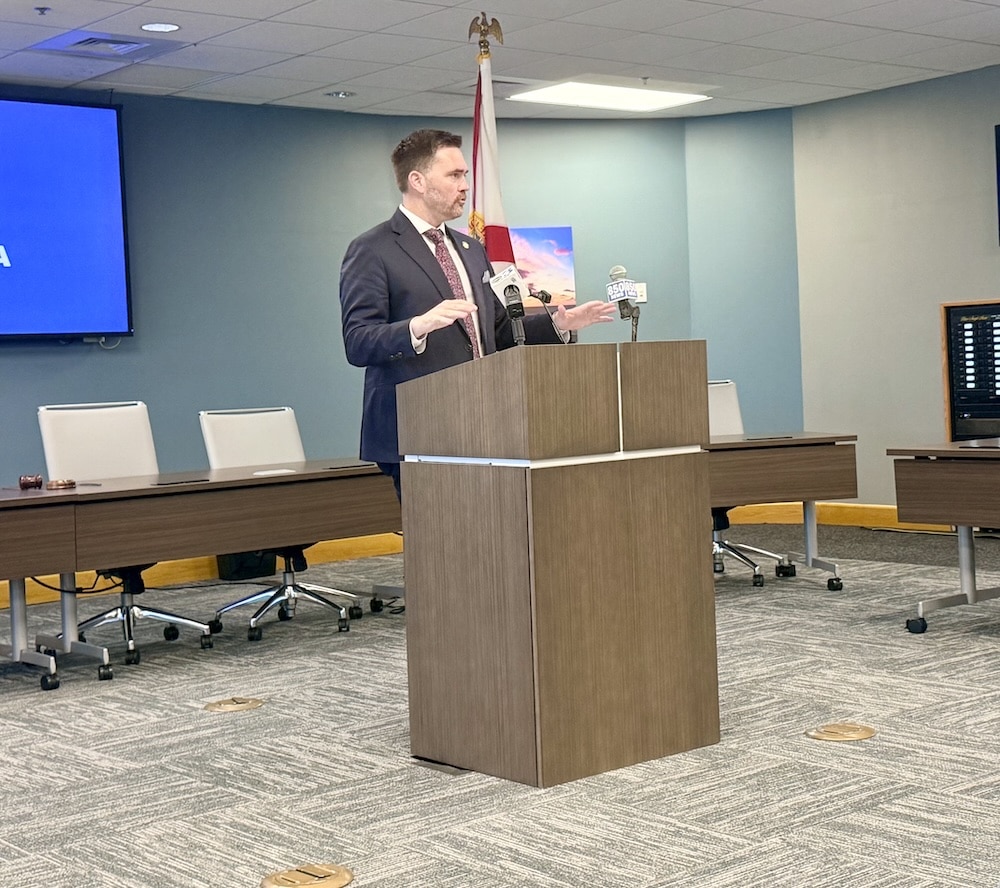

Pensacola Mayor D.C. Reeves said this morning he does not support the $58 million Tax Increment Financing rebate application submitted by Inspired Communities of Florida (The Dawson Company) and Corporate Contractors Inc. for the Rhythm Lofts and REVERB by Hard Rock hotel project on Lot 5 at Community Maritime Park—at least not as currently written.
- “As proposed right now, I don’t support it,” Reeves said at his Tuesday press conference. “I just need more information to understand a $58 million potential request and what the public gets in return.”
But the mayor made a distinction between opposing the rebate application and opposing the project itself.
- “It doesn’t mean I don’t support the project. It doesn’t mean I don’t appreciate the potential investment here, the development group. It’s nothing personal to those ideas.”
The Mayor’s Core Objection
Reeves framed his skepticism around a straightforward question: What does the public actually get for $58 million in tax abatement?
- He offered a back-of-the-napkin example to illustrate his concern. A 13-story high-rise of this scale would, by his estimate, require roughly $4.5 to $5 million in fire infrastructure investment from the city—plus approximately $2 million in recurring annual costs. That’s money the taxpayer pays that doesn’t appear in the developer’s return-on-investment calculations.
“When we look at what we’re going to give a discount on an abatement of that size, that doesn’t take into consideration what the taxpayer’s going to have to pay for,” he said.
Process Concerns
The mayor also raised questions about how the project arrived at this point. The original lease approved by city council in August 2024 was not negotiated around the assumption of a TIF rebate
- “I probably would wait to go to underwriters before we understood what the general appetite of the city was for that request,” he said. “If there was going to be tea leaves that it was going to require a $50 or $60 million abatement, I would think that’s probably a ground floor conversation to have at the city level—not, we’ve now gotten underwriting contingent upon an ARA and now we hope that you’re in this corner.”
He also flagged what he sees as a potential duplication between the CRA’s Area Reinvestment Agreement for Affordable Housing program and the state’s Live Local Act. Both provide tax relief tied to affordable housing. When the ARA was created, Live Local didn’t exist. Now that it does, Reeves questioned whether layering both on the same project amounts to a double subsidy.
He Acknowledges the Developer’s Argument—But Isn’t Sold Yet
Reeves didn’t dismiss the developers’ financial case. When asked about lender contingencies and Diane Hendricks’ personal guarantee, he acknowledged the complexity.
- “Obviously, that’s what they’ve conveyed to us,” he said, but stopped short of endorsing the conclusion that the rebate is therefore justified.
He also noted the actual rebate figures haven’t been fully verified. The Dawson team has put the net annual rebate at approximately $2.9 million. Reeves suggested the true number may be lower once the Live Local exemption is properly factored into the TIF calculation.
“Does that Live Local get taken out before they calculate TIF? So there’s even some things to work through.”
- Note: After the presser, I walked into Escambia County Property Appraiser Bubba Peters and his team, who were headed to meet with Deputy City Administrator Amy Miller on the TIF rebate calculations.
The CRA Board Has the Final Say
Reeves made it clear that his opinion doesn’t control the outcome.
- “There is no legal requirement nor ARA requirement that this has the approval of the mayor of the city of Pensacola. Ultimately, this is a financial decision that rests with the CRA board, and frankly, they don’t need my support.”
He said if the CRA board has the votes to approve the application as submitted, he would not stand in the way.
- “If they got four votes on the CRA for exactly what’s proposed, I respect that.”
The Door Is Open
Despite his stated opposition, Reeves repeatedly signaled a willingness to be persuaded—by better data, revised terms or direct conversation with the development team.
- “My doors are always open, my spreadsheet, my Excel works. We’re happy to entertain anything—be it the same version of this request with a better understanding of what the public return on investment is, or a lesser request.”
He said outside advisors are conducting an independent financial analysis of the application as required by the ARA process—and that analysis could change his view.
- “That analysis can come back and maybe the severity of what we see off the cuff right now isn’t as bad. I’m open-minded to that.”
Lot 5 has sat vacant for over a decade. The next few weeks will determine whether it stays that way.