Local Government / Public Safety
City Puts EMR Recycling on Notice After Fifth Fire in Two Years
Mayor Reeves says scrap pile height violations are “clear and pretty evident,” and taxpayers are footing the firefighting bill.
The City of Pensacola has formally demanded answers from the owners of a South Palafox-area recycling facility after a May 26 blaze became the fifth fire in two years at the site—a pattern Mayor D.C. Reeves called a dangerous and costly outlier for city residents.
City Attorney Adam Cobb sent a letter dated June 1 to EMR USA Metal Recycling and its local operation, Southern Recycling, LLC, both represented by Jones Walker attorney Daniel Harrell, outlining the city’s concerns and inviting the companies to participate in a joint investigation with local, state, and federal partners. Read Letter to Southern Recycling
“It is not foreign that facilities like this have issues. It is foreign for cities to have five fires where our taxpayers are paying to have to go put out these fires happening in a span of two years.”
—Mayor D.C. Reeves
What the Letter Says
Cobb’s letter to Harrell notes that the Pensacola Fire Department has responded to each of the five fires at the facility at 1000 S. Myrick Street, describing each incident as “a significant, but largely avoidable, risk to the health and safety of people and property at and around the Facility.”
- The letter states that the city’s Fire Marshal previously communicated “numerous fire suppression and public safety requirements” to the companies, including better management of the size and spacing of scrap piles. Despite those directives, the city’s initial investigation of the May 26 fire found “deficiencies in compliance with the Fire Marshal’s prior instructions.”
Cobb invited EMR and Southern Recycling to participate in ongoing conversations with the city and its state and federal partners to identify deficiencies and opportunities for improvement, asking Harrell to confirm his clients’ willingness to participate.
Reeves: Pile Height Concern
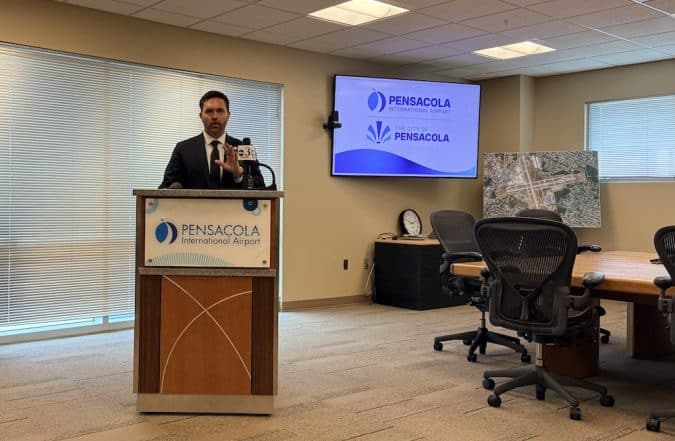
Speaking to reporters Tuesday morning, Reeves identified the height of scrap piles as the most prominent compliance failure—and one he said his team could see plainly on site.
- “It’s pretty common sense logic that the higher a pile of potential flammable items is, the harder it is to put out,” Reeves said. “We had continually advised on that. It was clear and pretty evident when our team went out there that that was not being adhered to and not being listened to.”
Reeves also corrected a factual error from the city’s earlier public statements: the total fire count is five incidents, not four as initially reported.
EMR Has Already Responded
Despite the formal tone of the letter, Reeves offered a measured note of optimism on Tuesday. EMR, he said, has already reached back out to schedule a meeting.
- “To their credit, EMR has already reached back out to set up a meeting,” Reeves told reporters. “So more to come on that. I don’t have any times or dates.”
He compared the situation to other past disputes the city has navigated with private operators, including TSA and Lumos, where raising concerns publicly helped produce process improvements.
“What I’m hopeful for is that it’s a good productive conversation, and if there’s some tangible results from it that makes our city safer and doesn’t put our firefighters in harm’s way.”
—Mayor D.C. Reeves
What the City Can—and Can’t—Do
Reeves addressed questions on Tuesday about what legal leverage the city holds. He acknowledged the limits of government authority over private property, even when public safety concerns are mounting.
- “The mayor or the city council does not have the ability to go to private property in a legally allowable use in terms of zoning, in terms of being a business that has the license to operate,” he said. “We can’t come in and just tell someone they can’t operate on private property, and that’s a big misperception.”
But he made clear the city is actively reviewing its code enforcement and legal options to determine what authority it can exercise to hold operators accountable.
- “We are concurrently working on looking at what our legal code enforcement … there’s a multitude of things that we can look at and say, what foothold does the city have to ensure that operations like this are being good community partners and are following the rules?” Reeves said. “That’s going to take a deeper analysis.”