
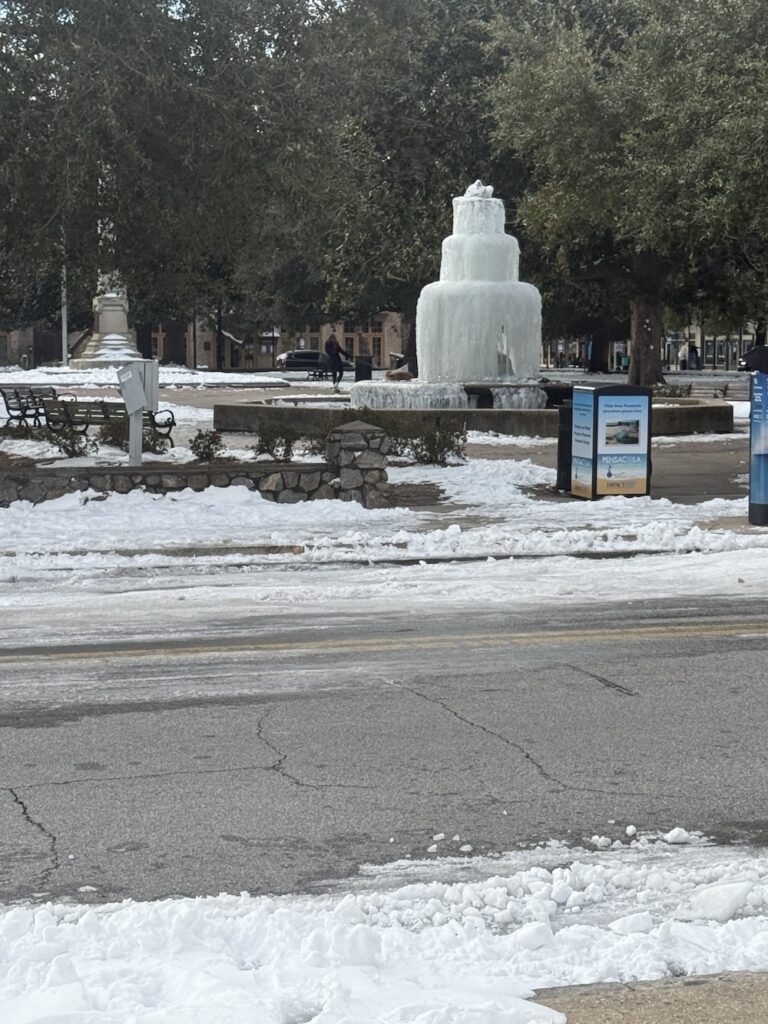
Last week, cities like Atlanta, Houston, New Orleans, Gulf Shores, Milton and Pensacola experienced rare snow, shattering decades-old records. National Oceanic and Atmospheric Administration (NOAA) sent a press release highlighting the vital role its satellites played in monitoring and forecasting the rare weather event.
NOAA’s mission to understand and predict our changing environment is supported by its fleet of advanced satellites. During this historic storm, NOAA’s GOES and JPSS satellites provided critical data for tracking the potent winter system that dropped unprecedented snow in some areas and brought record cold to parts of the South.

GOES East: Near Real-Time Storm Monitoring The GOES East satellite captured near real-time imagery of an Arctic air mass plunging into the Deep South, colliding with warm Gulf moisture to create ideal conditions for snow. Its advanced sensors allowed meteorologists to visualize cloud cover, track the storm’s development, and assess precipitation potential.
JPSS Satellites: In-Depth Atmospheric Analysis Complementing GOES East, the JPSS satellites provided detailed data about the atmosphere, including temperature profiles, humidity, and cloud properties. These granular insights were essential for helping accurately predict the extreme cold and snowfall in regions unaccustomed to such weather events.
Preliminary Snowfall Reports
* **Atlanta:** Received 3.2 inches of snow in January 2025, surpassing its annual average of 2.2 inches.
* **Houston:** Houston Hobby Airport recorded 3 inches of snow, a rare occurrence for the city.
* **New Orleans:** Louis Armstrong New Orleans International Airport recorded 8 inches of snow.
* **Gulf Shores, Alabama:** Received 8.8 inches of snow.
* **Milton, Florida:** Recorded 9–10 inches of snow, potentially surpassing a Florida state record.
* **Myrtle Beach, South Carolina:** Received around 4–5 inches of snow, with 6 inches reported in Conway, South Carolina.
* **Pensacola, Florida:** Pensacola International Airport saw 8.9 inches of snow, a significant amount considering the city rarely has measurable snowfall.
WHY THIS MATTERS: Project 2025’s “Mandate for Leadership 2025: The Conservative Promise” recommends that the president dismantle NOAA and redistribute its functions to other agencies, privatize them, or shift them to state and territorial control.
Why? Because Project 2025 supporters believe NOAA “has become one of the main drivers of the climate change alarm industry and, as such, is harmful to future U.S. prosperity.”
- Project 2025 is a policy initiative proposed by the Heritage Foundation. The new UWF Board of Trustees chair Scott Yenor and Trustee Adam Kissel are Heritage Foundation fellows.