
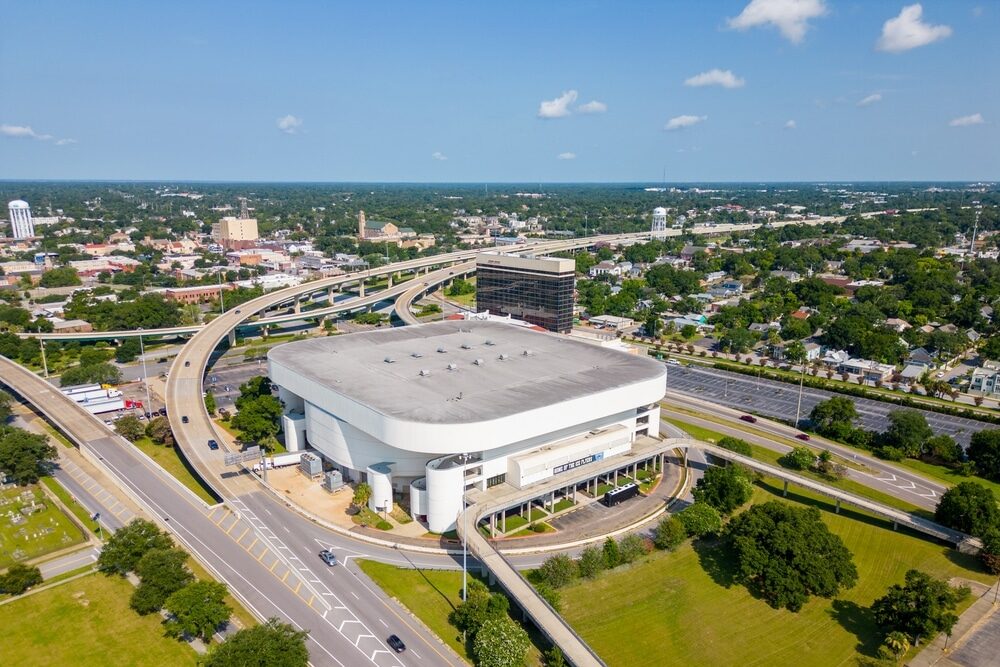
City and county leaders agree to expedite facility improvements while awaiting the completion of a comprehensive district study.
Pensacola city and county officials are moving to accelerate renovation plans for the aging Pensacola Bay Center following presentations from consultants Michael Capps and Scott Morton on the facility’s future and potential surrounding neighborhood redevelopment.
During a joint task force meeting, Commission Chair Mike Kohler and Mayor D.C. Reeves expressed urgency about moving forward with Bay Center improvements, citing concerns that potential state legislation could impact the availability of Tourist Development Tax (TDT) dollars used to fund such projects.
“I don’t know how much y’all stay up with what’s going on the state legislature, but the TDT dollars were to basically the use for property tax offset,” Kohler said, noting that legislative changes could “hijack some of our TDT offers,” if the project isn’t advanced by July 1, 2026.
Consensus on Building Renovation
Despite some initial discussion about forming a citizen committee to guide the redevelopment process, officials ultimately agreed to postpone that decision until after receiving the comprehensive study from the consulting team. Commissioner Lumon May voiced concerns that creating a committee would be “premature” and could make the process “more confusing.”
There was a clear consensus among officials that the Bay Center requires significant renovation regardless of what happens with surrounding development.
- “The bones of this building are good. So we know this is going to have to be renovated,” said Councilwoman Jennifer Brahier.
Mayor Reeves emphasized the importance of not waiting on broader district planning to begin work on the facility itself. “I just would hate to sit on the landmine that we all agree on waiting on other information in a second building and all that kind of stuff.”
County Budget Director Stephan Hall outlined the financial parameters for the project. With $25 million already committed through a bank loan, approximately $75 million remains available for the Bay Center renovation under current TDT bonding capacity.
Crucially, Hall confirmed that existing bonds would be protected from potential changes in state legislation. “If we have something bonded, those are usually preemptive to any new legislation,” he explained, providing reassurance about the project’s financial security once bonds are issued.
Ongoing Feasibility Study
Michael Capps, General Manager of the Bay Center with ASM Global, delivered an update on the ongoing feasibility study examining renovation options for the 40-year-old facility and the possibility of adding a new event center to the property.
“We’re looking at what can be projected for occupancy, what type of events we can recruit,” Capps explained to the assembled officials. “They’re in the process of reaching out to associations throughout the country with sports organizations, convention organizations to see what the interest is, what the seasons look like, this Pensacola market that they would be interested in getting into.”
The study, which began with site visits in early June, is examining multiple scenarios for the Bay Center’s future, including ice facilities, multi-use flex spaces, convention centers, and sports courts. ASM Global is working with consultant CSL to analyze market demand and financial projections for each option.
Escambia County Commission Chair Mike Kohler emphasized the critical need for any renovation to eliminate the facility’s operational subsidy, noting the county has invested over $10 million in the Bay Center from 2020 to 2025, with current annual subsidies reaching $1.3 million.
“Whatever we end up going with down the road, we have to have a return on investment. We can’t keep losing money,” Kohler stated.
Capps responded that the facility has been trending in the right direction financially. “Right now, we’re at $1.3 million a year. We’ve been coming ahead of budget for the past five years. So we’re trending in the right direction, and I think with these new improvements that we specifically focus, and if that’s all we do, then that’s all we do, but it will improve the building operation.”
The study’s scope encompasses three main objectives: renovating the existing building to modernize its facilities, developing an operational model to eliminate subsidies, and exploring the potential for additional event space, contingent upon funding availability. Current renovation plans already underway include a $10 million investment in new ice flooring, repaving the parking lot, updated fencing, LED lighting systems, and improved sound equipment.
“The ice floor has been pulled up, so if you’ve seen a lot of equipment out in the parking lot, that’s the new ice floor that’s going in,” Capps noted. “All of that will be implemented by October 1 with the new hockey season.”
Broader Redevelopment
Scott Morton, principal of Smith Gee Studio, outlined a comprehensive approach to redeveloping not only the Bay Center itself, but also the entire district, including the Grand Hotel property and Technology Park.
Mayor Reeves emphasized that the proposed study would work “in tandem with, not in conflict with” the technical study already underway by ASM, the Bay Center’s operator. The goal is to provide an objective, third-party perspective that represents the interests of both the city and the county.
“I’d like to have someone who’s not in the business of operating this facility,” Reeves explained. “I’m sure they’re going to do a great job on all those technical aspects, but someone who represents the city, the county, and all of us with really no other dog in the fight other than let’s try to bring you the most objective data that we can.”
The mayor stressed the importance of leveraging private investment rather than relying solely on public funding. “Why is it that we should only be taking on any improvements in the Bay Center, anything on our own with whatever bond dollars you guys decide that you want to use?” he asked. “Why would we not look at opportunities to leverage?”
Smith Gee Studio brings significant experience to the proposal, having worked on Pensacola’s Community Redevelopment Agency (CRA) plan in the late 2000s. Morton highlighted several successful projects, including Nashville’s Gulch District—a former train yard that has become the city’s largest tax contributor per acre and a premier tourism district outside of Broadway.
“I actually compare this a lot with the Bay Center because it’s a similar scale, a little larger scale, but a similar location,” Morton said of the Gulch project. “It was downtown adjacent, and it was a way to expand your downtown, the ability to create economic engines. And so I think this could be an amazing district for Pensacola, and it could really largely be driven by private sector investment.”
City Councilwoman Jennifer Brahier raised concerns about “participation fatigue” in the community, noting residents have been involved in numerous planning exercises over the years. “The public is really worn out on charrettes and studying,” Brahier said. “They have been so involved in so many plans that don’t move. You talked about a 2008 CRA. We just finished a CRA. We’ve got so many, and this exact same area has been involved in all these different public input sessions.”
- Morton acknowledged this challenge, saying, “We figured as much that participation fatigue is probably fairly heavy at the moment. And that’s why we want to look at more conventional ways to attract participation, not a no participation plan.”
City Councilwoman Allison Patton stressed the importance of creating something immediately actionable.
“What has to come out of this for me, we do, I think, have a relatively short timeline to work with. It is a plan that not only takes into account obviously all the stakeholder feedback from here, which it should but comes with the lens of developers and what is actually doable, feasible, and I mean financially feasible, where we don’t necessarily from a public perspective have to bear the burden of all of the cost.”
She continued: “I want to see something that we can say is marketable to private developers on the day we get it and not something that we have to go out and try to attract development after the fact and maybe change because it wasn’t designed in the way that would attract the capital.”
Morton responded that his team would include market and development consultants to address those concerns.
“We are going to have the market consultant on us who is going to specialize in both mixed-use development and market studies. What is the market outlook over the next 10 years? But we also want to pull in a development consultant that can look at the costs, can look at the ROI on it,” he said.
“Having a master developer on our team to look at it through the lens of what’s actually developable in the market, what could be financed and what people will find a good return on that they would find attractive is going to be an integral part of our study.”
Commissioner Lumon May emphasized the importance of inclusive development, noting the area’s history. “Most studies have resulted in a displacement of the people from this geographical area, unfortunately,” he said.
“And so there’s a long history of people being included in studies but not included in the development. So I think that when you have the deliverables, they must be attainable or achievable and realistic, and maybe a bad word, but inclusive, because we have this area that is critical.”
Mayor Reeves concluded by emphasizing he didn’t want timeline pressures to compromise community engagement. “I just don’t want it to get squeezed so much that then we lose the validity of the project from an engagement standpoint,” he said. “And certainly one of my favorite observations as mayor is we’ve done too much community engagement. So that’s a good problem to have.”
No contracts have been signed, with Reeves stating the presentation was designed to “afford the opportunity of our city council, of our county commission to be able to answer any questions and ensure that this study is what they want it to be before we were able to engage with them at all.”
Next Steps
Officials agreed to reconvene once the comprehensive study from the consulting team is complete, which is expected within the next couple of months. Councilwoman Allison Patton expressed hope that the study would provide “enough intelligence and feedback from a macro planning standpoint to help inform which of those options might make the most sense.”
The task force emphasized that while they want to move quickly on the Bay Center renovation, they remain committed to ensuring any improvements complement the broader district redevelopment vision rather than rushing into a subpar product.
The meeting concluded with officials committed to moving forward on Bay Center improvements while awaiting the comprehensive district study to guide the next phase of planning for the surrounding area.