
Local Government
No Bathroom, No Apology: The Long Fight Over Veterans Memorial Park’s Restrooms
A decade of donated labor, city sign-offs and a design collapsed the moment D.C. Reeves became mayor. Now the city is shipping in a prefab unit from Seattle—and the man who ran the original project for ten years isn’t buying the mayor’s version of events.
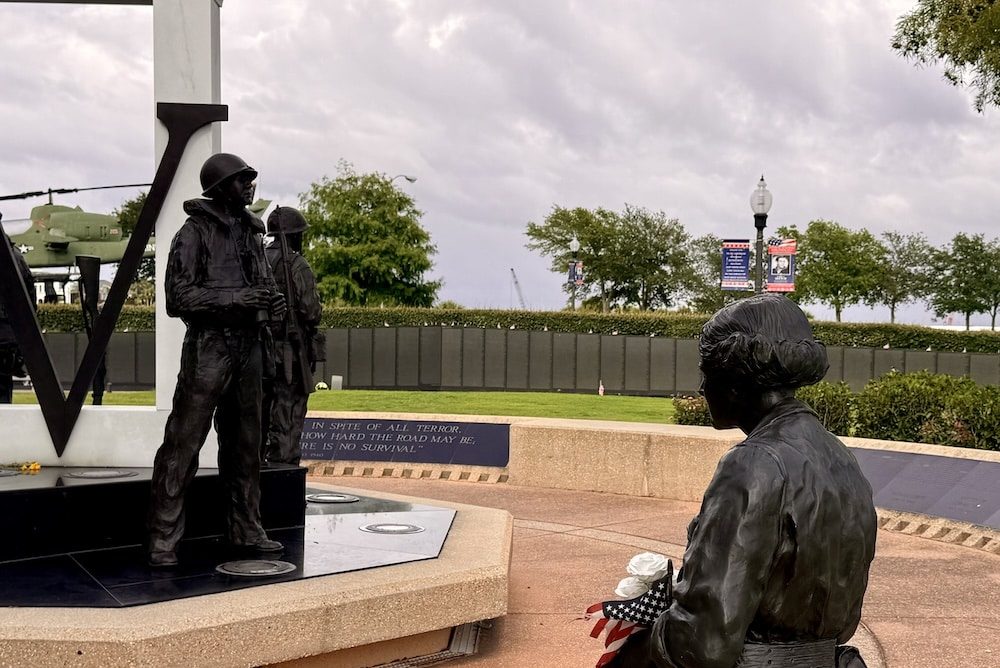
Veterans Memorial Park has needed real restrooms for years. Veterans, their families and school groups who visit the park for field trips have made do with rented port-a-potties or ventured to nearby businesses for potty breaks, a fact that drew embarrassment after the Pensacola News Journal published “Veterans flush with ’embarrassment’ over no bathrooms at Memorial Park“ on May 25.
Mayor D.C. Reeves says the city is finally moving. At a July 8 press conference, he told me the city was going “ahead full steam” on a pre-fabricated restroom for the park.
“We can get you exact timelines. I don’t think it’s down to the day, but we’re moving with urgency.”
But Reeves didn’t stop there. The mayor tends to throw political jabs at those who cross him and did so at the press conference. He took aim at the Veterans Memorial Park Foundation, suggesting the board itself was to blame for the delay by objecting to his plans and failing to raise funds to cover budget shortfalls.
“We’ve said over years of time, if there is something above and beyond what we can provide in the budget, certainly we’re all ears for VMP to provide funding or donations—not that they have to, but we are moving. We haven’t seen any of that, and that’s certainly their decision.”
Reeves went further, framing the foundation’s recent push for a quick fix as a concession that the city had been right all along.
“Now given their newfound desire of just getting something in there as quickly as possible versus kind of trying to reinvent the wheel like we have many, many times to be as harmonious as possible, then great. That gives us clear direction from them to move forward with the building.”
Those comments did not sit well with Pete McKanna, who spent a decade on the foundation board and served as the park’s operations officer, effectively running its care and maintenance.
A Decade of Work, Undone
The board turned to McKanna because of his background in development. “I’m not an architect or an engineer, but my 35 years doing it, you know, I worked very closely with them so I know how they think, what they want,” he said.
His first move was a stopgap: a climate-controlled, handicap-accessible portable restroom built on a proper concrete pad with sewer and water hookups, funded by an IMPACT 100 grant and donations, plus $50,000 from the Pensacola City Council for installation.
- Hot and cold running water, climate control—”state-of-the-art,” McKanna called it
- Popular with park visitors almost immediately
- Forced out after former city councilman Brian Spencer and nearby Aragon residents, organized as “Citizens for Preservation of Admiral Mason Park Inc.,” argued it encroached on the neighboring park
That fight set the stage for the push for a permanent facility. Then-Mayor Grover Robinson walked the park with McKanna and foundation president Paul Entrekin, and McKanna picked the spot himself.
“Grover, this is the best location in the entire park. It’ll blend in. Nobody will really notice it, but it’s on the main path.”
McKanna said even Spencer signed off at that meeting. From there, McKanna’s concept drawings were handed to an architect, engineer and local contractor. The resulting design included men’s and women’s restrooms, full handicap accessibility, an educational center and equipment storage—kept affordable by heavy in-kind donations from the community.
“Everyone donated something. That’s why we kept the price down. It was worth much more than $700,000.”
By McKanna’s account, the project cleared every hurdle: department sign-offs, city council approval, and Mayor Robinson’s personal approval. The foundation even fronted roughly $25,000 to $28,000 of its own money for architectural and engineering drawings after Robinson promised to reimburse it from discretionary funds to “fast-track” the project.
Then the mayoral transition hit.
McKanna’s account of the handoff: Robinson brought the finished, approved project to incoming Mayor D.C. Reeves—and was rebuffed. McKanna says Reeves told Robinson: “This ain’t my deal. I’m not signing off on anything. It’s your deal, and I’m mayor. You’re not in the conversation.”
“And from that moment on to this very moment, absolutely no cooperation whatsoever.”
The Mayor’s Version
Reeves has his own timeline. At his May 27 press conference, in response to the PNJ’s “embarrassment” story, he described the restroom effort as a 12-year saga that only gained real momentum over the past three years—under his administration. He said no money had gone toward a permanent restroom in the first nine years of that effort.
- Reeves also pointed to a failed RFP process, saying the foundation had assured the city it had lined up enough contractor interest to come in under budget—only for no bidders to show up at the pre-bid meeting. The project came in over budget, and the city had to start over.
Meanwhile, the clock has been running on a $750,000 state grant approved by the Florida Legislature in 2023 for a restroom and education center, pushed by the foundation and requested by the city. The grant carried a two-year deadline that has already been extended once and was set to expire again this June—though the city says it secured another extension. So far, about $150,000 of that grant has gone to engineering work. No bathroom has been built.
“Unbelievable that Reeves is Getting Away with this”
McKanna has tired of Reeves’ political posturing and questions the decision to use an out-of-town company for the restrooms.
“Why are we going to Seattle, Washington to have something done for the community here?”
He described Reeves’ plan bluntly: “Two stalls… no air conditioning, no climate control, no nothing.”
McKanna said the human cost of the delay is real. He recalled a school superintendent who apologized to him personally because teachers had stopped bringing classes to the park once there was nowhere for kids to use the restroom.
“It’s just unbelievable that Reeves is getting away with this. Everything’s been approved, ready to go in the ground. And he walks in, just because he’s a new mayor, doesn’t respect what was already in place.”
The bottom line: A fully designed, community-funded, city-approved $700,000 restroom and education center sat ready to build when Reeves took office. Three years later, veterans and school kids are still using port-a-potties, and the city is now planning a stripped-down prefab unit from out of state. Whether that counts as moving “with urgency” depends on who you ask.