
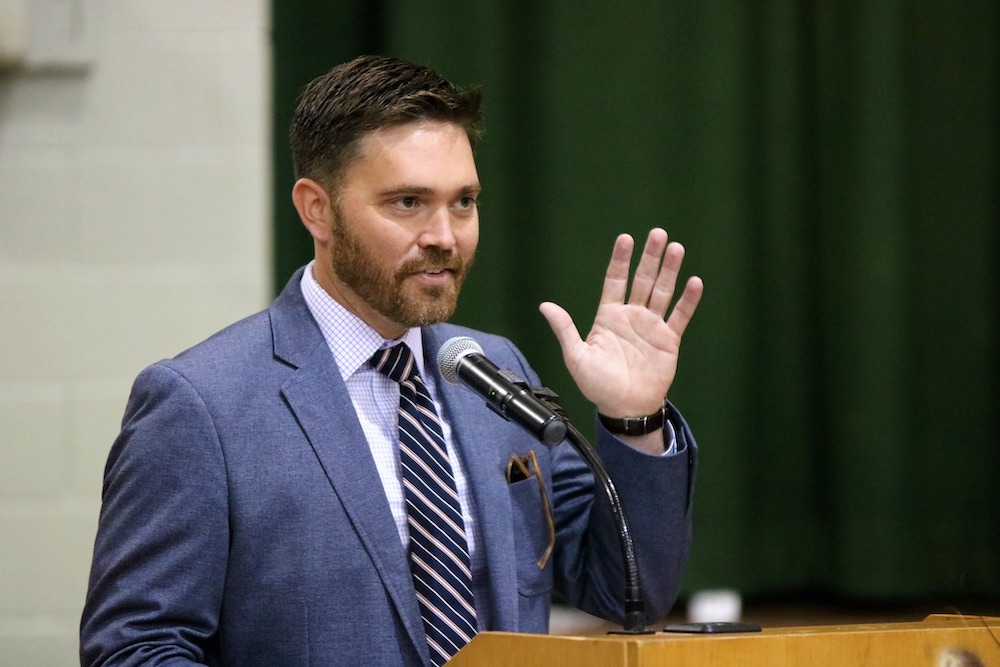
 D.C. Reeves is Pensacola’s third strong mayor. The fight to change Pensacola’s form of government from a city-manager to a strong mayor was almost as contentious as the Community Maritime Park battle. Inweekly and this blog were earlier supporters of the change.
On Nov. 10, 2005, while the Pensacola City Council was debating whether to have a referendum on the Community Maritime Park, I suggested in my Outtakes column that we include whether the city should switch to a strong mayor form of government:
Currently, Mayor John Fogg’s job is primarily ceremonial. He represents the city at official functions, chairs the council meetings and makes committee assignments. Tom Bonfield, the hired city manager, actually runs the city.
Pensacola is a town that is governed by a 10-member committee. Anyone who has served on such a large committee or board knows how difficult it is to get such an unwieldy group to accomplish anything—unless it has a strong leader that is empowered to set the agenda for the group and execute its plans.
This city needs to have a strong, full-time mayor that is truly Pensacola’s CEO. The strong mayor could push this coastal town out of the doldrums that allow the rich to get richer, the poor to get poorer and an endless stream of studies that never achieve anything. The strong mayor would be the one person the voters could hold responsible for city government. If they don’t like what’s happening, then they can elect someone else.
After we won the referendum fight in September 2006, I suggested five possibilities for the next big issue:
- Property tax caps
- Strong Mayor
- Annexation – At the time, Baptist Hospital wasn’t within the city limits.
- Consolidation
- Healthcare: uninsured
The only one that gained momentum was the strong mayor, which meant changing the city’s charter to make the largely ceremonial mayor the city’s chief executive officer.
- I argued, “Meanwhile, the 10-member council-city manager form of government is a decent provider of basic services, but not innovative. We hold on to money-losing enterprises like the Port and City garbage services. We have an arbitrary small boundary to our downtown area. We have no one elected official to recruit new businesses. Everything happens here so slowly in a world that is speeding by us.”
On August 20, 2007, a group of over 25 business and community leaders, led by financial advisor John Peacock, made a presentation at the Pensacola City Council’s Committee of the Whole meeting. The Pensacola City Council agreed to review the city charter. Peacock made a passionate plea for change in a viewpoint we published.
By the end of the year, the City Council appointed a charter review commission, which was chaired by attorney Crystal Spencer.
We covered the meetings, and the discussions were heated, particularly the June 19, 2008 meeting:
- March 2008 Charter Commission notes
- Notes: Charter review 4.16.08
- Notes: Charter review 6.19.08
- More notes: Charter Review
By May 2009, the new charter was nearly finished. The document included:
The charter called for a strong mayor, who would “exercise the executive powers of the City and supervise all departments.” He would serve a four-year term.
The City Council would become the legislative branch. The at-large seats would be eliminated and the council membership reduced to seven single-member districts. They, too, would serve four-year terms. The council elections would be staggered every two years, similar to how the county commission elections are done.
The Mayor would appoint the City Administrator – who serves at his pleasure. He would also appoint the City Attorney – which must be approved by the City Council.
Dig Deeper: The final draft would keep the two at-large council members, but voters would later eliminate them through a referendum.
No Boss Mayor was formed to fight the new charter, and I dissected their arguments, as I did during the Community Maritime Park fight.
I posted my analysis of the charter:
Pensacola has a unitarian form of government, meaning the power, in theory, is vested in one elected body. There is an administrative staff, but its role is to implement the directives, programs and policies of the council. In other words, the council passes it, the staff gets it done. If the staff fails to do so, it is removed. If the council fails to follow the wishes of the voters, its members aren’t re-elected.
It’s very straightforward. The council runs the city. Voters can change the council if they aren’t happy and can thereby change how the city is run.
Pensacola city government doesn’t quite operate this way. There are several barriers to this straightforward governance. Some are actually good, others are not.The City Council only controls two positions, city attorney and city manager. By law, council members are not to interfere with the city administration. Read more.
- In November 2009, the new charter passed 7,762 to 6,308. Ashton Hayward defeated Mayor Mike Wiggins the following year to become the city’s first strong mayor.





Actually, nothing in the Charter approved in 2009, and first effective on January 1, 2010, provides for a Strong Mayor or for a Weak City Council but we now have both. In August 2009, CRC Chair Crystal Spencer wrote to Mayor Wiggins and the Council advising that the new Charter did “not” provide for a strong mayor. I have many times sent her very long letter to multiple councils but they don’t read it. Spencer clearly advised that the new Charter provided for a separation of power with checks and balances. That lasted 3-4 months at best. The Mayor should have been made the leader of the Council – as in Charleston, Orlando, Jay, etc. and many or even most municipalities with Mayor-Council forms of government – but CRC member Jim Reeves insisted that the Mayor be removed from the Council – the state law “governing body” of the city (and so also removed from the CRA board). Mr. Reeves said that he did not want the Mayor to be subject to Florida’s Government-in-the-Sunshine Law. This is consistent with what John Peacock told me in 2008. He said the new Mayor would act on behalf of “important area businessmen” to give them their decisions they want bypassing a meaningful role for the Council. Peacock told me that the Council would function as a rubber-stamp body as it has since mid-2011. The CRC was expressly directed to prepare and submit a final report to the Council describing its recommendations. It refused to do so. Mayor Wiggins told me he felt he lacked the authority “to make Crystal finish the job.” Malcom Thomas was present for the discussion. The CRC was also required to hold a public hearing “after” finalizing its recommendation but, again, refused to do so. In 2008, Peacock had told me that he was guiding Spencer to propose a form of government suitable for a follow-on consolidated county government. Councilman Sam Hall confirmed that Peacock (then a non-city resident) was telling Spencer what to do. (The three of them used to hold secret meetings.) CRC meetings include plentiful mention of consolidated government but they were not described in the falsified meeting minutes that City Clerk Burnett told me were drafted by Spencer not her, tasked by the Council to be the CRC’s recording secretary. Spencer once said that she only studied charters with “county-sized populations” and said she was drafting that Charter for a city with a population of 300,000. Sherri Myers and I have long disagreed on the impact of form of government. Both can work. Council-Manager forms (like Ashville, Greenville, Gulf Breeze, Fort Walton Beach, etc.) work just as well as Mayor-Council forms (Charleston, Orlando, Jay, etc.) Century has a Mayor-Council form of government. It works badly. The “only” difference between the two forms of government is the role of the Mayor. In a Mayor-Council form, an elected Mayor is the chief executive. (It’s organized like the federal government.) In the Council-Manager form, the chief executive, normally called a City Manager, is appointed and subject to removal at any time. An interesting idea I have come up with would be to have a Council-Manager form but call the chief executive the Mayor, i.e. CEO. A major flaw in our current Charter is that the city’s executive powers are divided between two people – a Mayor and a City Administrator. At a minimum, the two positions need to be combined as can be done by charter amendment.
I have reviewed every charter in towns and cities in Florida that are comparable in size to the city of Pensacola. No other city allows the mayor to decide the organizational structure of the city. Furthermore, every city that has a mayor council form of government, the mayor serves on the city council. These are the two major flaws in the city charter. What we have is a charter that does not provide for checks and balances on the mayor’s power. If you look at the council agenda’s the mayor sponsors most of the agenda items. When I served on the city council I tried to sponsor legislative agenda items at every council meeting. It always bothered me that the mayor can have out of the sunshine meetings with council members. In effect he can lobby them and make promises behind closed doors. This form of government is not democratic or progressive. What we have as a result is a lazy city council.