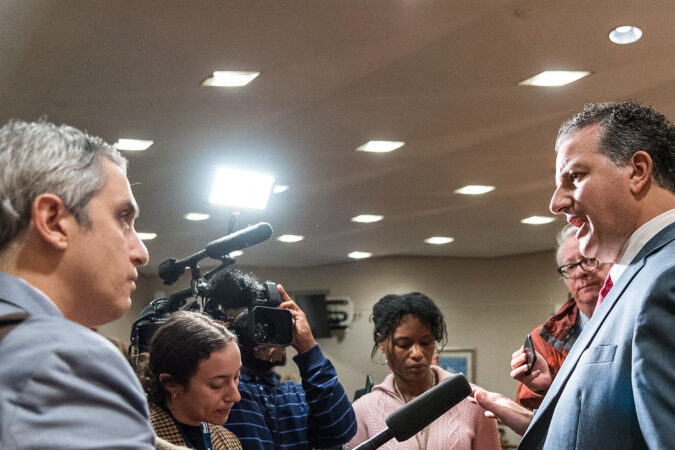
In a recent interview on “We Don’t Color on the Dog,” Congressman Jimmy Patronis revealed his behind-the-scenes efforts to protect Pensacola’s most cherished ambassadors—the Blue Angels—while simultaneously building a robust constituent services operation that prioritizes people.
Discovering an Unexpected Congressional Network
Since arriving in Washington, the former Florida Chief Financial Officer has made a remarkable discovery: many of his colleagues have deep personal connections to Northwest Florida through military training. “I start discovering all these members of Congress that either trained at Pensacola, they trained at Whiting Field, they trained at Hurlburt Field,” Patronis explained. “So many of these airmen, their kids were born in northwest Florida.”
This network extends beyond military connections. Congressional representatives from Georgia, Alabama, Kentucky, Tennessee, and Indiana regularly vacation at Northwest Florida’s beaches with their families, creating what Patronis calls “an alumni” affection for the region.
Blue Angels Under Threat
Patronis’s protective instincts kicked in when he learned how easily congressional language could relocate treasured institutions. He pointed to a recent example where Senator Ted Cruz attempted to move the space shuttle from the Dulles Airport museum to Texas with “a simple stroke of the pen.” The realization that “you can move something as storied as the Blue Angels from one part of the country to the other” prompted immediate action.
- While Patronis’s proposed protective amendment didn’t make it through the Rules Committee—which “ran to about two o’clock in the morning”—he secured crucial support and funding. The same members who pledged to keep the Blue Angels in Pensacola helped secure dollars for hangar restoration following Hurricane Sally damage. As Patronis noted, the Rules Committee chair personally assured him: “There’s no way we’re going to let the Blue Angels leave Pensacola.”
Though the amendment didn’t pass this round, Patronis isn’t backing down. “I don’t think I’m going to necessarily walk away from it.”
Building a People-First Operation
While fighting legislative battles in Washington, Patronis is simultaneously revolutionizing constituent services back home. His approach reflects his restaurant industry roots: immediate, personal problem-solving rather than distant communication.
“I like face-to-face meetings. I like our staff being able to fix problems, and I tend to fight hand-to-hand combat on the ground as opposed to 50,000 feet.”
His new offices will open in August—a “mothership” location at Pensacola State College and a Crestview office on the campus of the Northwest Florida State College. But it’s his hands-on philosophy that sets him apart.
During a recent slow period, Patronis answered constituent phone calls, wanting his interns to see that “it’s not beneath me to answer the phone when the phone rings.” One caller, a retired Navy aviator and commercial pilot, unknowingly spoke directly with the congressman about legislative concerns.
- The veteran later praised the office, saying, “Every time I’ve called your office since you’ve been in office, a real person has answered the phone.”
Looking Forward
As Patronis settles into the August recess period, he’ll be making rounds throughout the district rather than working from Washington’s 50,000-foot altitude. His message is clear: whether protecting iconic institutions like the Blue Angels or ensuring every constituent call gets answered by a real person, this congressman is committed to hands-on, personal service.
+






As a conservative Democrat, I will note that we have serious issues facing the country, ultimately I think it was an advantage to him that he stood against corporate orthodoxy in his party on certain issues in the primary, while generally standing where conservative Floridians are Democratic or Republican on issues like gun rights.
I know in my party I am not happy that we have one candidate for Governor, that when you look at how Donalds and Jolly go at it, first Jolly is essentially a St. Petersburg Republican of the traditional mold who all the sudden becomes a Democrat and shows no real change in substance, I think in an open race many different candidates are needed, but it seems like Jolly is running only to be an anti-voucher Republican, and there are those who oppose that program, however when one knows where the Democratic primary vote is, I can think of what counties those who utilize vouchers are far more likely to be Democratic than Republican, and my concern in looking at 2026, is, November, I am not so sure that making it a referendum on vouchers is not going to basically harm the ticket in those counties where it is mainly Democratic base voters who use vouchers, I can think of several.
I am a conservative Democrat, and I believe in progress, ultimately I believe traditional public schools can survive and reach new heights, but my concern with Jolly is mathematically, it doesn’t add up, far more Democratic parents vote to keep the vouchers for their children, while on the Republican side, some other issue has them vote for the Republican nominee even if they are not happy with the voucher program, I just don’t understand Jolly’s logic.