
Mayor D.C. Reeves covered a wide range of pressing issues facing the City of Pensacola, from homeless shelters to major infrastructure projects and community development initiatives.
Pallet Shelters
Mayor Reeves announced that the Homeless Reduction Task Force has unanimously approved two applications for pallet shelter installations. The Reentry Alliance Pensacola (REAP) will place at least 14 units on West Blount Street, while Offensive Corp. has requested 13 units on their site at North Palafox.
- “The goal with the pallets was: let’s get housing yesterday, let’s get housing today,” Reeves emphasized. The city has allocated $1 million in funding for these climate-controlled, temporary housing units that can be assembled within hours and are built to withstand Florida’s building codes and wind requirements.
The pallet shelters represent a flexible solution while the community continues discussions about establishing a low-barrier shelter—a more complex undertaking requiring broader community partnerships.
- “If you’re waiting on the government to solve your problems solely, you’re going to be waiting a long time,” Reeves stated. “We need private development to get off the sidelines and work with us.”
Baptist Hospital Project at “One Yard Line”
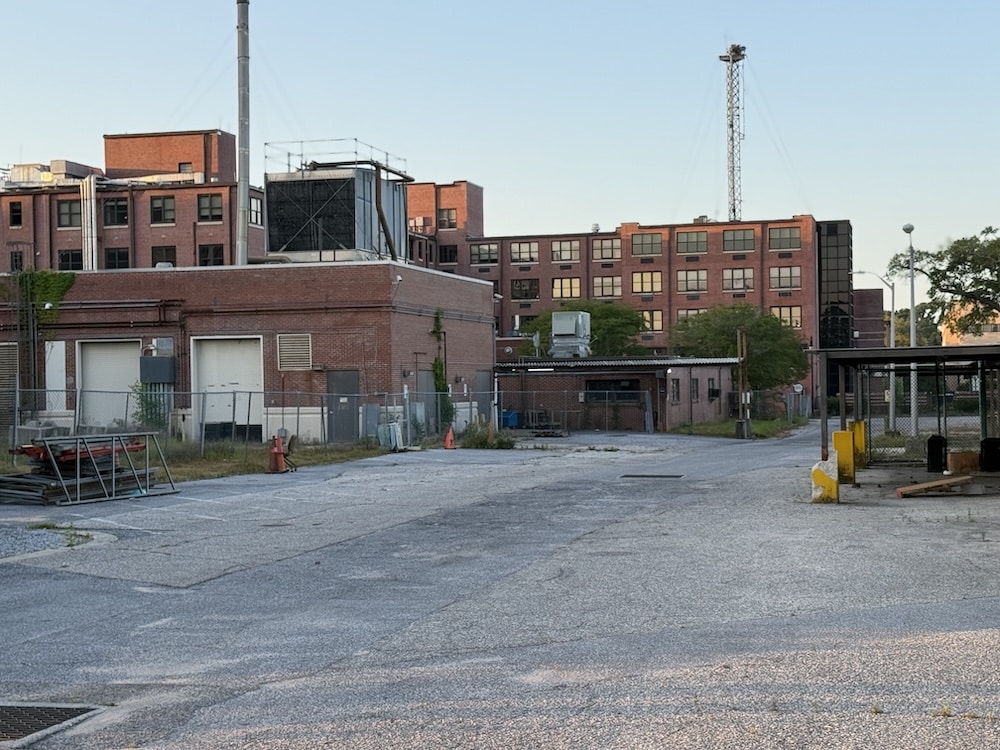
On Thursday morning, the mayor will address the Escambia County Commission about the redevelopment and demolition of the Baptist Hospital’s “legacy campus.” A stake is $2 million that the commissioners had pledged to former state Sen. Doug Broxson for demolishing the buildings that Baptist abandoned in September 2023. Commission Chair Mike Kohler has questioned why the City didn’t take the lowest bidder for the demolition phase.
- “We are at the one-yard line of a generational impact in our city, in our county,” Reeves stated, emphasizing the long-term benefits for the community. “We’re there for them to ask the technical questions that have been partially asked and to clear up assumptions — or what I asked for was just allow us our day in the sun to come and tell you exactly how we got here.”
He, his staff and representatives from Baptist and GeotTech will be there “to answer any questions that they have.” He added, “We can talk about as granular as we want on the technical aspects, whatever size rock concrete’s going to be, we will have people way smarter than me there to be able to discuss whatever level of detail.”
Addressing the community significance, Reeves added: “What I want to talk about is the generational impact this will have on the city and the county. Every city resident is a county resident, and we’re only about a seven iron away from the county where Baptist Hospital is.”
Childcare Crisis Requires Multi-Pronged Approach
Following a recent childcare summit, Mayor Reeves outlined the key findings about Pensacola’s childcare challenges. The primary issues identified were workforce retention and compensation.
- “Here are these people taking care of our zero-year-olds and our one-year-olds, and they might be making $14 an hour. And then we wonder why it’s hard to find or why it’s hard for a small business owner to be successful when you have people turn it over,” the mayor explained.
Local daycare operators shared their struggles during the summit: “We had a couple of people running daycares here saying, ‘Hey, we got somebody comes in and six months later they’re out and then we got to train them again. And that impacts quality.”
The city is exploring several solutions, including following Miami-Dade’s model of providing up to $6,000 annually in supplemental income to childcare workers who remain with the same employer. ”
- What’s really cool is they you only get the $3,000 every six months if you stay at the same place. So it’s not only supplementing their income, it’s helping these businesses keep the people there,” Reeves noted.
A follow-up meeting is scheduled for July 9 to develop concrete action plans. The mayor said, “We don’t need to reinvent the wheel. If there’s people out there doing something that is going to be impactful for us, then let’s figure [it] out.”
Budget Concerns and State Policy Impacts
With the state budget process ongoing in Tallahassee, Mayor Reeves expressed concerns about potential property tax changes, noting that the city collects approximately $28 million in property taxes—critical funding that supports police and fire services.
- “This is not a nice to have… this is not discussing and eliminating property taxes in a haircut. I would say it’s a decapitation of our budget,” the mayor warned “Just go look at the police and fire line items and see if one more than what we generate in the general fund. Property tax is about 35%, and we spend more on police and fire [than] we collect in property tax.”
Regarding budget planning amid uncertainty, Reeves noted: “We are approaching our budget apprehensively, right in more of a defensive posture than the first two times I’ve done this… we know something is coming.” He cited broader economic challenges, saying: “Go look at sales tax generation in the entire state. Things are plateauing or declining, depending on how you look at it.”
The city is approaching its current budget development with increased caution while monitoring state-level decisions.
Looking Ahead
Several upcoming events were highlighted, including a resiliency seminar on Thursday, June 12, from 8:30 a.m. to 4:30 p.m. at Sanders Beach, developed in conjunction with the city and county’s natural resource management department.