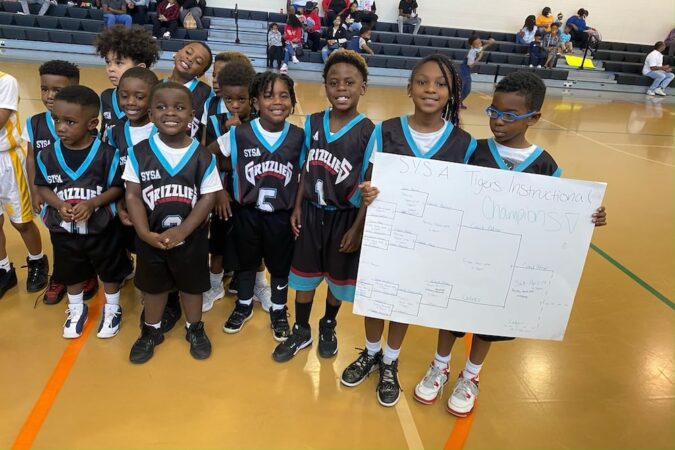
In the heart of Pensacola’s Westside, a remarkable story of community transformation has unfolded. The Southern Youth Sports Association (SYSA), a cornerstone of youth development in Escambia County for decades, wants to expand its reach with the construction of the new $3 million Rafferty Center at Legion Field.
- Tomorrow, the Pensacola City Council will vote on the Ground Lease Agreement between the City and SYSA for the construction of the Rafferty Center.
From Humble Beginnings to Community Cornerstone
The roots of SYSA trace back to the 1980s when a 14-year-old Lumon May walked into a chaotic gym with his younger brother. Seeing the disorder—people smoking, cursing, and a general lack of structure—young May took it upon himself to create order. With remarkable initiative, he organized basketball teams, created makeshift uniforms with markers, and established tournaments that soon packed the gym with spectators.
- “We put poster boards all around the gym. I put up the brackets, and we held big tournaments for the kids. Fans packed the place,” May recalls about those early days.
What began as one teenager’s effort to bring structure to a neighborhood gym has evolved into an organization that now serves over a thousand children annually, offering not just sports programs but comprehensive youth development services, including after-school care, tutoring, and academic support.
More Than Just Sports
While athletics serve as the entry point for many children, SYSA’s mission extends far beyond the playing field. As co-founder Lumon May explains, “Our mission is to develop integrity and character through the four b’s—Bible, books, ball and balance. We want to develop youth spiritually, teach them to work hard in school, to act disciplined in their sport and to work to strike a balance in their lives.”
The impact is evident in success stories like Terrell Hankins, who grew up in challenging circumstances with a mother struggling with addiction and a father and brother in prison. Through SYSA’s mentorship, particularly from coaches like Ray Palmer, Hankins found stability and guidance. Today, he works as a chemical operator at Reichhold Chemicals and volunteers as a coach with SYSA, paying forward the support he received.
- “I just basically told them how the program saved my life,” Hankins shared about his message to current SYSA players.
“Growing up in a single-parent home and with my mom having a drug addiction, the center was my outlet, a place to get away from my situation.”
The Rafferty Center: A New Chapter
Despite its growth and success, SYSA has faced space limitations at the current Theophalis May Community Center. With nearly a thousand children participating in various programs, many teams can only access the gym once a week during school months—not enough time to build the meaningful relationships that are central to SYSA’s mission.
- Enter the Rafferty Center, named for Troy and Ashley Rafferty, who kickstarted the capital campaign with a $1 million pledge. The new facility will feature two basketball courts (named in honor of Junius Boling, grandfather of NFL star and SYSA alumnus Doug Baldwin Jr.) and several classrooms, effectively doubling the organization’s capacity.
The Florida Legislature, Bear Family, Quint and Rishy Studer, Jim and Shirley Cronley, and partners at Levin Papantonio law firm have also contributed to the project.
“We have so many basketball teams, so many programs, and cheerleading and dance that most of our children can only get in the gym for practice once a week during the school months,” explains May. “To have an impact with kids, our coaches need to spend more time with them to develop strong relationships.”
A National Model of Community Investment
The SYSA model has proven so effective that its influence now extends beyond Florida. Doug Baldwin Jr., who credits SYSA for much of his personal and professional success, has replicated the model in Renton, Washington, where he settled after his NFL career with the Seattle Seahawks.
- “A lot of the lessons that I’ve learned and the fortitude and the strength that’s propelled me to be able to get through college, being so far away from home and then getting into the NFL as a young man and trying to navigate that world and then being able to be healthy afterward and start a family and all of that started back home in Pensacola, Fla., with SYSA,” Baldwin reflects.
Dig Deeper: The Family First Community Center in Renton opened in 2023. The City of Renton contributed $4 million for the project, and the Renton School District contributed the land. HealthPoint partnered to operate an on-site medical, dental, and behavioral health clinic.
Why Sports Facilities Matter
For those wondering why another gym matters in the grand scheme of community development, SYSA’s approach provides the answer.
- “Because you can look at so many other mentoring programs and the educational tutorial program, you don’t have any children. We use sports as the vehicle of liberation for children from all the detriments—educational, social and health—in their lives,” explains May.
Michele Inere, a former UWF basketball star who now works as a general magistrate in the First Judicial Circuit while coaching at SYSA, sees enormous potential in the expanded facilities: “Now, having both of those gyms right there is just going to open up the door for us to do so many more things that are not just going to benefit our kids but the whole community.”
The Village Approach
Throughout SYSA’s evolution, the concept of community—”the village”—remains central. From its founding with modest donations from community leaders John Chandler, Derrick Brooks, and Rev. Theophalis May, to the substantial community investment in the Rafferty Center, SYSA exemplifies what happens when a community invests in its young people.
As Troy Rafferty puts it, “Ashley and I feel we have an obligation to do everything we can to make sure that all the kids in the community have the opportunity to succeed. SYSA has been a perfect match for us. They are developing the future leaders of our community.”
For the volunteers, coaches, and mentors who make SYSA work day-to-day, the organization’s expansion represents not just new facilities but expanded opportunities to shape lives.
As Coach Ray Palmer, who helped establish SYSA, notes: “Sports gets them there, but to me, it’s much, much deeper than sports. I mean, you can go anywhere and play sports. But to mentor and mold someone and make them a positive citizen, to me, that’s what it’s all about.”
- The Rafferty Center stands as a testament to what communities can achieve when they invest in their young people—not just as athletes, but as whole individuals with potential that extends far beyond any playing field.
Decision Time
Though the Pensacola City Council approved a 25-year lease for the land in December 2021, Mayor Reeves has spent several months renegotiating the lease.
Under the new lease, the City will be responsible for the maintenance of the proposed recreational facility. Considering the estimation of the size of the building, the City has agreed to provide a yearly amount of $17,500 for maintenance fees, which can be rolled over to a maximum of $52,000.
- The City will own the property and also pay for janitorial services once the building is complete.
- The utilities are estimated at $25,000 and operating supplies of $3,000, which will be included in the FY 2027 budget request.
At his weekly presser yesterday, Mayor D.C. Reeves hinted that some council members may have heartburn over the City contributing to the $3 million that SYSA is giving to the City, but he expressed enthusiasm for the project.
- “Anytime anybody approaches us to say, ‘Hey, we want to donate a $3 million facility to help youth in our community,’ I think that’s a great conversation,” Mayor Reeves stated. “I wish every conversation in my office started like that.”
The mayor emphasized the project’s significant community value, noting that it transforms “empty dirt that’s been sitting empty for generations” into a facility that increases capacity for youth services.
While acknowledging concerns about maintenance responsibilities, Reeves defended the city’s commitment to the project.
“Can I defend putting up $17,500 of maintenance money every year for a $3 million building? Absolutely,” he said.
“And that doesn’t even count the impact that it’s going to have. How many hundreds and thousands of kids over that amount of time are going to be positively impacted because that building exists?”
What makes this project different from other city commitments, according to Reeves, is that “this is a facility that wouldn’t otherwise exist (without SYSA).” The city’s primary investment is providing the land, while gaining an asset that will serve community needs.
Addressing concerns about the lease terms, the mayor expressed confidence in the administration’s track record of accountability while remaining open to council input: “I feel like we put some good accountability in there. We were a good community partner for someone (SYSA) that wants to invest in kids in our community.”