
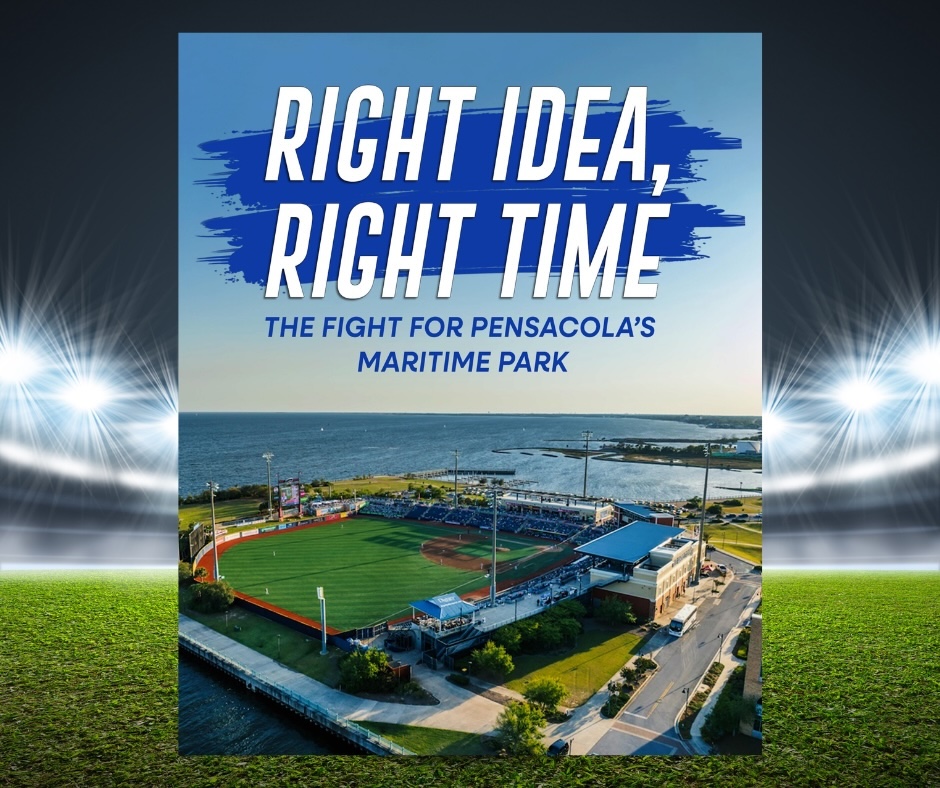
When people stroll down Palafox Street in downtown Pensacola, they see a vibrant city celebrating its rich history. When they attend a baseball game at Blue Wahoos Stadium or listen to the Pensacola Symphony play at the Randall K. and Martha A. Hunter Amphitheater, they enjoy one of Florida’s most beautiful settings. Few know of the struggle to pass the referendum for the Community Maritime Park, which was the catalyst for Pensacola’s renaissance.
The story of the referendum has been retold several times, and some of the tales are accurate. But memories fade, and the emotions that linger often create a different impression of what really happened.
For the past year, I have interviewed people who were involved in the passage of the referendum, combed the archives of the Pensacola News Journal and Inweekly, and dug up old posts on Rick’s Blog. For every person I interviewed, there probably were at least two or three others that I could have, but at some point, I had to start writing.
The Community Maritime Park referendum really was a fight for the future of Pensacola. There were passionate people on both sides. Some were more honest than others to try to win their points as the debate over the park raged over nearly two years. However, the battle was about more than a ballpark.
A Very Different City
Twenty years ago, Pensacola was a city in crisis. Hurricane Ivan had devastated the community in 2004, but the storm only highlighted deeper problems that had been plaguing the area for decades. With Escambia County ranking as the 17th poorest in the nation and young people fleeing at alarming rates, the city’s future looked bleak.
- The waterfront—which should have been Pensacola’s greatest asset—symbolized everything wrong with the community. A 27-acre prime property sat vacant while residents endured toxic fumes from the notorious “Old Stinky” sewage treatment plant. Downtown was so affected by the noxious smell that local media created a “Poot Index” to warn residents when air quality became dangerous.
Into this environment stepped an unlikely coalition: healthcare consultant Quint Studer, retired Vice Admiral Jack Fetterman, and University of West Florida President Dr. John Cavanaugh. Their ambitious proposal called for a $70 million public-private partnership featuring a baseball stadium, maritime museum, conference center, and 20 acres of public green space.
Embracing Change
Twenty years after the Community Maritime Park concept had its public debut, I sat down with two old friends in Quint Studer’s Maritime Place office overlooking Blue Wahoos Stadium.
- Mort O’Sullivan, his voice carrying the weight of someone who had seen Pensacola through its ups and downs, shared how he realized something dramatic was needed. “I knew as we entered the new century that we were not in a good place. Government problems, economic problems, poverty,” he told us. “And I knew somebody had to come along and reverse the community’s prevailing negativity and stagnation.”
The process would be painful but necessary. “I didn’t know it would be us,” he reflected. “But as this thing unfolded and I saw the vitriol rise in this community, I said we needed to fight it. We were at an impasse, and somebody had to win and push us forward.”
Quint added, “We were dealing with a mindset that resisted change and couldn’t envision something better.”
Looking back, the fight over the Maritime Park became a proxy battle for Pensacola’s future. Would we remain stuck in our old ways, or would we embrace the possibility of change?
You can read more about the book on inweekly.net. The book is available on Amazon.
During my research, I came across this video produced by the Appleyard Agency and released days before the vote. Many of these community leaders we have lost, but it’s Who’s Who of Pensacola in 2006: Nancy Fetterman, Walter Biggs, Roger McDonald, Ron Townsend, Gene Elebash, John Appleyard, Earl Hutto, M.J. Menge, Susan Pote, Henry Roberts, Oliver Darden, Collier Merrill, Carolyn Fleming, Hugh King and Ellis W. Bullock, Jr.
