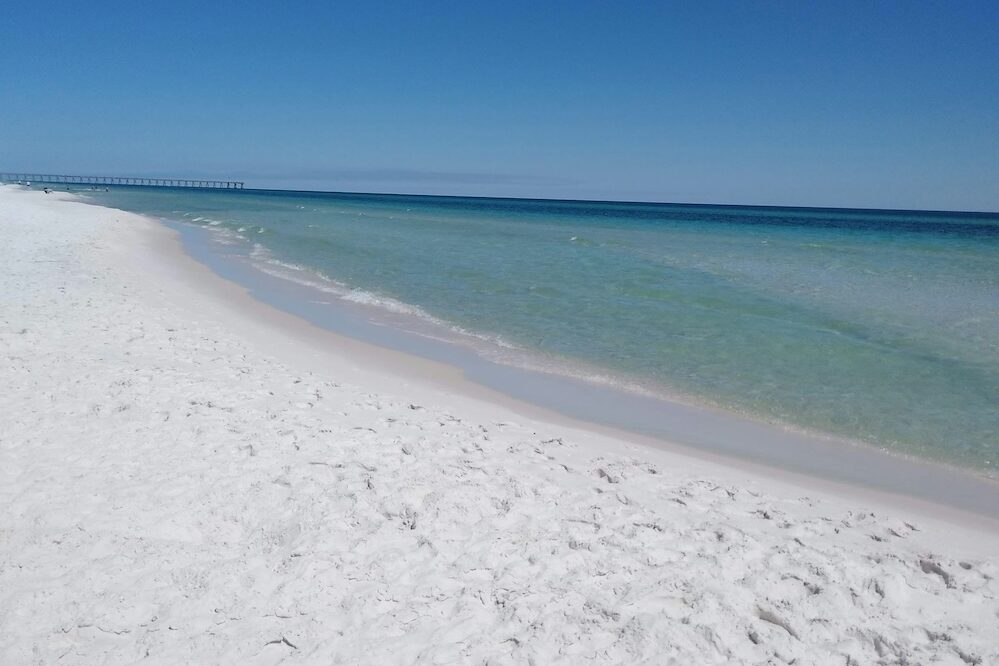
A grassroots coalition is asking the Escambia Board of County Commissioners to consider a compromise proposal that its organizers say could end years of conflict over public beach access on Perdido Key, without costly and divisive litigation.
- Save Our Beaches, a group formed from the merger of Save Pensacola Beach and Open Beach Access 4, submitted a formal position paper and cover letter this week requesting that the proposal be placed on the agenda for the BCC’s March 5 meeting. The group is asking County Attorney Alison Rogers and Administrator Wes Moreno to help facilitate that discussion.
A 75-Foot Easement as Middle Ground
The proposal seeks to establish a perpetual 75-foot public easement along the Gulf-front of Perdido Key, running from the Gulf Islands National Seashore boundary eastward to the Florida-Alabama state line. The easement would mirror an existing federal perpetual easement already in place in the Gulf Beach subdivision, which was established based on historic customary use by the public.
- “As a compromise to full beach access up to the dune line, all Gulf-front condominium owners shall adopt and the County shall establish a limited, uniform, and perpetual 75-foot public easement,” the proposal states.
Why? Save Our Beaches argues the easement approach offers something meaningful to all stakeholders:
- Private property owners would gain a clear, enforceable boundary and legal certainty, while the public would gain guaranteed access to the shoreline.
- The group contends the easement would also create a uniform standard that simplifies enforcement and reduces the patchwork of private signage, cordoning and barriers that have created what they describe as an increasingly hostile beach environment.
Rooted in Customary Use Law
The group’s legal argument rests on Florida’s doctrine of customary use, which recognizes the public’s historic and uninterrupted enjoyment of a beach over time as the basis for continued access rights. Save Our Beaches says it has collected testimony dating public use of Perdido Key’s Gulf-front beaches back to at least 1945.
2018 Law: A 2018 legislative measure attempted to limit local governments’ ability to acknowledge customary use. It was partially addressed by 2025 legislation (SB 1622 and HB 6043), which the group says reaffirmed the legal concept of recreational customary use and restored the public’s standing to seek it.
- “The public has been provided clear, statutory standing to sue local governments who fail to enact a customary use ordinance,” the letter warns, framing the compromise as a way to avoid that outcome.
Addressing Condo Owner Concerns
The proposal directly acknowledges concerns raised by Gulf-front condominium owners, including trespassing near pools and restrooms, dune trampling, litter, noise, and large unauthorized events such as weddings and parties on the beach.
- Avoiding Privatization: Save Our Beaches proposes that the County address those concerns through active management and enforcement rather than privatization of beach space. Specifically, the group calls for the County to regulate and license beach vendors, commit resources to regular trash pickup, increase code enforcement, and improve the sign ordinance on the Key. Under the proposal, private fencing, rope cordoning, sandwich boards in the sand, and beach chair barricade lines within the 75-foot easement would all be prohibited.
Retaining Public Access 1
The proposal also pushes back against any effort to close Public Access 1, which the group describes as the only free county public access point for 1.8 miles of Perdido Key shoreline and the sole walkable access for adjacent neighborhoods north of Johnson Beach Road. Save Our Beaches proposes keeping the access point open but capping it at its existing 40 parking spaces, with no future expansion, as a concession to property owners concerned about increased traffic and crowding.
Lowering the Cost to Visit Johnson Beach
A fifth component of the proposal asks the County to begin a federal process under the Federal Lands Recreation Enhancement Act to negotiate a local discount fee structure at Johnson Beach, the Gulf Islands National Seashore unit on Perdido Key. The group notes that Johnson Beach no longer sells day passes and argues that fees should be set at a level accessible to all Escambia residents regardless of income — noting the beach’s historic significance as the only local beach open to Black citizens during segregation.
A Warning Against Delay
Save Our Beaches was direct in its warning about the consequences of inaction. The letter, signed by spokespeople Melissa Pino and Dianne Krumel, argues that without a local compromise, Escambia County will inevitably be drawn into years of conflicting court rulings across Florida’s circuit and appellate courts — litigation that could ultimately require resolution by the Florida Supreme Court.
“Save Our Beaches would like our community to avoid this scenario and strive for a local solution that works to the benefit of all,” the letter states.
The BCC is scheduled to meet on March 5. Read Save Our Beaches Proposal for Expanded Access of Gulf-front Perdido Key Beach
Save Our Beaches Letter
Dear Escambia Board of County Commissioners, Ms. Rogers, and Mr. Moreno,
In a true spirit of compromise, and with the earnest goal of a workable, fair solution for increased public access on the Gulf-front beach of Perdido Key, Save Our Beaches respectfully asks that the attached proposal for expanded beach access on Perdido Key, along with this cover letter, be placed on the County Attorney’s report for discussion at the next regular BCC meeting (March 5th 2026).
While we are immensely grateful for the local and state-wide press that has brought our crucial local question of public vs. private beach rights to heightened awareness, we are also saddened by the escalation of divisiveness over this issue. The public’s right to access our most precious local resource is the unifying force of our grass-roots movement, but we hold other values dear as well: cohesive community, local decision-making, responsible leadership, and rational outcomes. The disparate legal scenarios of Walton and Escambia County are apples to oranges—attempts to equate them by some local officials aside. Nonetheless, we are keenly aware that the longer a battle over customary use intensifies, the closer Escambia will careen into the unfortunate climate of mutual hostility seen in other beachfront communities in the State of Florida.
Save Our Beaches is grateful to our District 2 congressional representative Alex Andrade for shouldering last year’s bill to repeal the disastrous 2018 measure limiting local authority to acknowledge and enact customary use (HB 631). Unfortunately, it has become apparent that a mere repeal of that measure did not suffice for restoring peaceful and mutual enjoyment of our Gulf-front beaches to our coastal communities, and instead relies on local advocacy to battle the question to the forefront of municipal and county governments.
We believe it should be an easy decision for local government to simply acknowledge customary use where it obviously exists, and pass an ordinance defining its geographical parameters. Short of a whole-cloth State solution, however, it is apparent how customary use will play out across the State of Florida: district by district, lawsuits will be filed on local governments by either private owners or the public, no doubt resulting in cross-rulings on both a circuit and appellate level. In the end, these suits may need to be resolved by the Florida Supreme Court. Although circuit and appellate decisions in some districts may prove highly persuasive in others, none of those decisions will technically legally bind any other district.
Save Our Beaches would like our community to avoid this scenario and strive for a local solution that works to the benefit of all, without the need for participating in the chaos of clashing Florida courtrooms, which will inevitably resound with angry plaintiffs from both sides in the next couple of years. Make no mistake: the public has been provided clear, statutorial standing to sue local governments who fail to enact a customary use ordinance. And we have already collected sufficient public testimony to clearly demonstrate that the custom of use on Perdido Key, time out of mind, has been from the dune line down, for the entirety of the Gulf-front extent of the once peninsula, now barrier island.
We beg to differ with Commissioner Stroberger’s mistaken notion that there is no possibility for compromise, or his viewpoint that the private owners are the only stakeholders who have anything of value to offer. Likewise, Chairwoman Hofberger’s notion that the dune restoration efforts on the Key, fueled by millions and millions of taxpayer dollars, are analogous to roads and other infrastructure being repaired to the benefit of discreet neighborhoods after a storm, is flawed. Escambia ordinance demands that infrastructure such as sidewalks and lighting are funded by the neighborhoods that require them, and any repair conducted after a storm is for the benefit of safe public passage in general. A public with stronger legal standing to sue for customary use than some private owners’ desire to exclude the public from in front of their properties does indeed have a great deal to offer towards a workable compromise, as do the Board of County Commissioners representing the taxpayers at large.
It is our belief that the attached proposal is a true compromise, with all stakeholders providing something of value to the others, and it is our hope that the County Attorney and the EBOCC will not only place this email and the attached proposal on the agenda for the next meeting, but will recognize the many merits of the proposal, and advocate for its acceptance by the Perdido Key Association and the entirety of the various ownership entities who enjoy Gulf-front situations, which have been largely and meticulously bolstered by the taxpayers of Escambia County during multiple phases of dune restoration that is ongoing to this day.
Save Our Beaches is a strengthened and reinvigorated collective born of the fusion of two distinct groups, Save Pensacola Beach and Open Beach Access 4. Nobody watching the efforts, or the results, of the SPB yellow shirts over the last eight years needs to be reminded of the force of Save Pensacola Beach’s 2018 ballot referendum, a measure that passed overwhelmingly, with 80.2% of the vote, and clearly demonstrated the will of the people: public beaches are not just an important, but an integral and vital, part of being a citizen of Escambia County.
Nor will the forget the pastel rainbow shirts that battled Beach Access 4 open after years of intense struggle and public debate, during which our advocacy never wavered. Due to Michael McCormack’s steadfast attention and research to the public access challenge on the Key, a perpetual easement of a “Golden Mile” of public access has been reinstated. And because of Gary Holt’s tireless efforts, a County ordinance was passed that clearly recognizes the detrimental nature of sign pollution to habitat, wildlife, vegetation, and the restorative human right to enjoy the beach without being accosted from all sides by visible targets of their peaceable enjoyment.
Public beaches are more than just beautiful stretches of white sand along the Gulf. They are the economic engines that drive our coastal community. People visit, move here, and raise families here for one reason: access to the shoreline. That access fills our hotels and vacation rentals, supports our restaurants, and sustains the small businesses that employ our friends and neighbors.
It is not out-of-town ownership deeds, but the people of Escambia County—families, teachers, servers, first responders, business owners, and retirees—who are the backbone of Perdido Key. They support businesses during the off-season, volunteer after storms, and invest in this community long-term. Allowing residents access to public beaches isn’t just fair, it’s absolutely essential to maintaining a stable, thriving coastal economy. When the citizens of Escambia County are welcomed on their own shoreline, we strengthen community pride, encourage good stewardship, and ensure economic resilience. When that access is limited and denied, we risk dividing the very community that makes this place special. We have great hope that the Escambia Board of County Commissioners will do everything in their power to embrace their oath to represent all of the citizens of Escambia, fulfill their fiduciary responsibility to release the Perdido Key economy from its current stranglehold, and encourage the PKA and the Gulf-front condo owners to see the value of this olive branch, and accept our offer towards restoring a happy and vibrant beach atmosphere for citizens, owners, and visitors alike.
Sincerely,
Melissa Pino and Dianne Krumel
Spokespeople, Save Our Beaches



Excellent summary article! Captures the consolation to adjacent properties and compromise while still recognizing the historic public access of Perdido Key Beaches.
FEMA money was used post IVAN for restoration and the justification in the application was there were public accesses there. So they got federal money. Greedy condo owners thwarted the addition restoration that was supposed to be follow up. It was part of the application for federal dollars. Valentino was commissioner then. Underhill came along with his fraud BS. Dredge the Pass deceit and placed sand offshore so that it would find its way to the shore. It’s been restored with public dollars. Walk anywhere you want.