
Following a recent appellate court decision lifting Florida’s open carry prohibition, law enforcement across the state faces a complex legal puzzle about where firearms can now be carried.
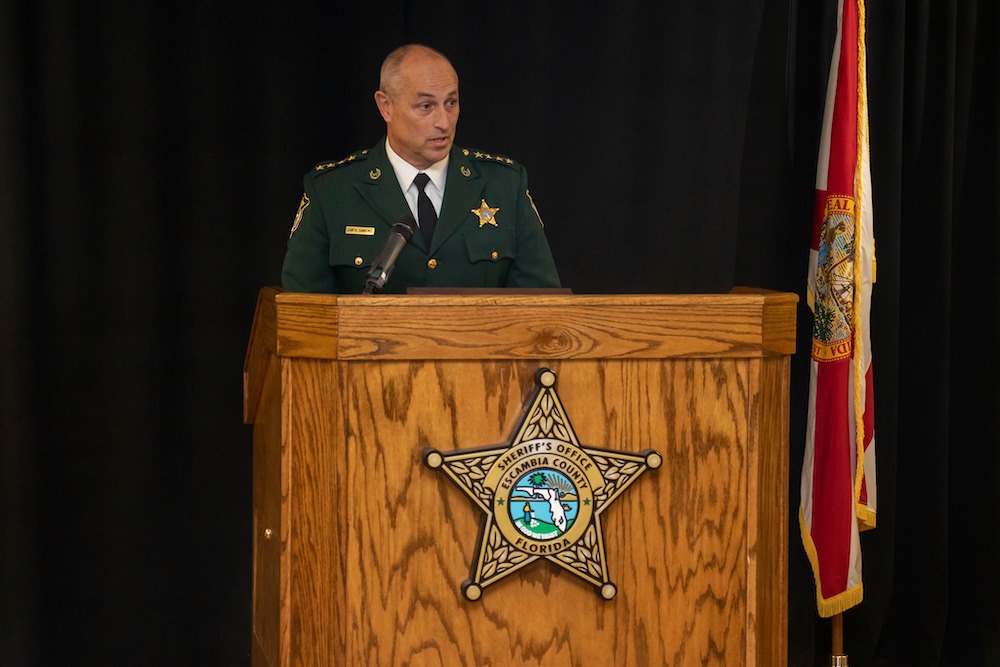
- Escambia County Sheriff Chip Simmons favors the constitutional rights approach over restrictive interpretations.
The Legal Dilemma
The confusion stems from the interaction between two different statutes. “There was an open carry prohibition, and then there was a statute regarding concealed carry. The concealed carry is what had those 15 exceptions,” Sheriff Simmons explained. These exceptions included courthouses, sheriff’s offices, and meetings with governing bodies.
However, with the open carry prohibition removed, questions arise about whether concealed carry restrictions apply to open carry. Simmons said, “There are some questions as to whether [the restrictions] even apply because [the concealed carry statute] deals with the concealed carry. And then it also talks about a licensed individual. Well, none of those apply to open carry.”
Constitutional Rights Take Priority
Rather than trying to force concealed carry restrictions onto open carry situations, Sheriff Simmons leans toward a constitutional interpretation. “Right now, I’m tending towards siding with a constitutional right. We have a constitutional right to bear arms in the United States. We mirror that with the state of Florida.”
- Under this approach, open carry would be permitted in most locations. “We’re tempted now as we continue our contemplation to side with a constitutional right saying that you can open carry in all these locations except for the schools, except for the courthouses, except for the airports.”
Statewide Inconsistency
The legal uncertainty has created inconsistent enforcement across Florida. “I’ve talked to a number of sheriffs,” Simmons said. “They are applying the 12(a) exemptions as maybe more or less, that’s the only thing available to us to show at least a version of legislative intent.”
Background: Florida Statute 790.06(12)(a) lists areas where concealed carry is not allowed, such as:
- Any place of nuisance (as defined by law).
- Any police, sheriff, or Highway Patrol station.
- Any detention facility, prison, or jail.
- Any courthouse or courtroom (except that a judge may carry and decide who else may carry).
- Any polling place.
- Any meeting of a governing body (county, school district, municipality, etc.).
- Any meeting of the state legislature or a legislative committee.
- Any school, college, or professional athletic event not related to firearms.
- Any elementary or secondary school facility or administration building.
- Any career center.
- Any portion of establishments primarily devoted to dispensing alcoholic beverages for consumption on premises (bars, nightclubs, etc.).
- Inside the passenger terminal and sterile area of any airport.
- Any place prohibited by federal law.
Simmons continued, “There are sheriffs that are taking an approach that those 12(a) exemptions don’t apply [to open carry]. If you take that approach—and I’m inclined to take that approach myself—then we think there should be some common-sense exemptions, such as polling places and the meetings of the governing body.”
The Long Gun Problem
The long gun issue creates an even more complex legal puzzle. The problem stems from the precise language in the concealed carry exemptions. Sheriff Simmons explained: “Words matter. So if you use handguns, it’s not a rifle. It’s not a long gun, not a shotgun, not an AR.”
- This creates a bizarre legal loophole where the concealed carry restrictions specifically mention handguns but are silent on long guns.
“It says you can’t carry handguns, but can you carry long guns into a meeting of a governmental body? Well, that makes no sense to me. If you can’t carry open, carry a handgun in a holster, why am I going to let someone carry a long gun that may be strapped around your back?”
The sheriff points out the obvious contradiction: if lawmakers intended to restrict firearms in certain sensitive locations, it makes no sense that someone would be prohibited from carrying a holstered handgun but potentially allowed to carry a rifle or shotgun.
- Sheriff Simmons applies his constitutional framework consistently to both handguns and long guns: “I’m sworn to uphold the constitution and if at this point we are not going to restrict an individual from open carrying a handgun or a long gun into a government building or even to the lobby here at the sheriff’s office, again, a right is a right and the right to bear arms applies throughout with just some enumerated exceptions.”
Important Distinctions Remain
Regardless of open carry rights, Sheriff Simmons emphasized that proper handling requirements haven’t changed. “It doesn’t mean you can brandish. It doesn’t mean you can wave it around. Doesn’t mean you can be intimidating with it.”
- He warned that unholstering a weapon inappropriately remains dangerous and illegal: “If you reach out and you unholster your weapon, that’s a terribly dangerous thing to do and it is a crime and we will enforce that state statute.”
Simmons believes the Florida Legislature must address these ambiguities. “I happen to think that the legislature has got to do some cleaning up of the verbiage. If we have open carry now, where do we have the option to open carry? Where can we not have open carry?”



If you like our reporting, consider buying us a cup of coffee – here. Your donation will help broaden our reporting. Thank you.